
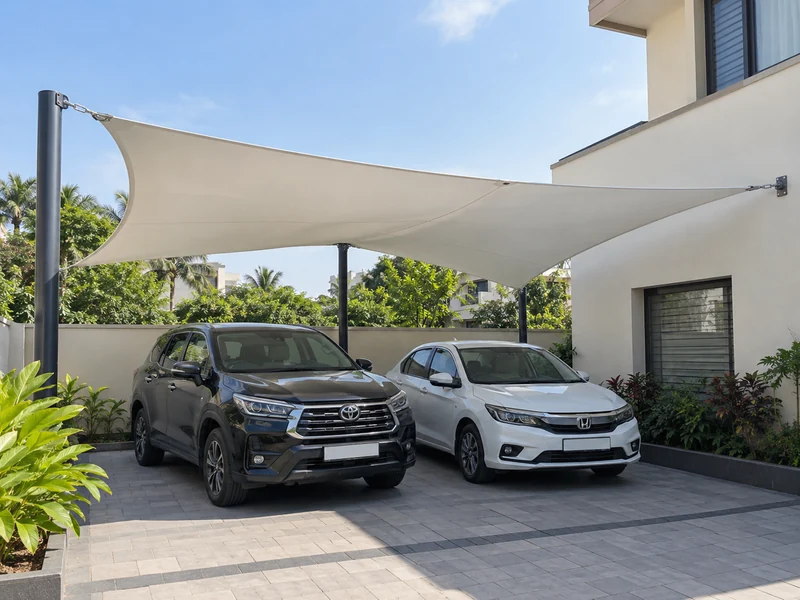
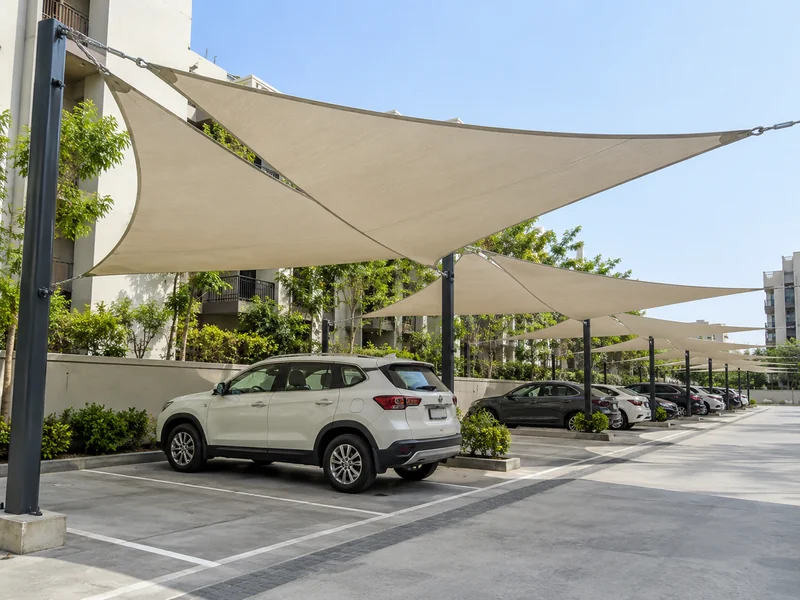
A car parking shade sail is a fabric sail tensioned between posts or walls to shade one or a few parked cars. It is also known as a car shade sail, parking shade net sail, car porch sail or carport shade sail. It is used at homes, villas, apartment visitor bays, small offices, clinics and shops with a few parking spots.
ShadeCo India Private Limited is a car parking shade sail manufacturer and supplier in India. We design, fabricate, supply and install single-car sails, two-car sails, overlapping sails for small parking rows, wall-and-post sails and two-wheeler parking sails. Most parking sails use breathable UV-stabilised HDPE, while PVC-coated polyester sails are used where rain cover is also needed.
Planning starts with how cars move in and out. We mark the bay edges, the space needed to open doors and the path cars take while turning. Posts are then placed behind or between the bays, never where a bumper or door will hit them.
Car Parking Shade Sail at a Glance
- Sail Shapes: Triangle, square, rectangle and overlapping sails sized to one, two or a short row of cars
- Fabric: Breathable HDPE for sun cover, or waterproof PVC-coated polyester where cars also need rain cover
- Posts and Fixings: Steel posts behind or between bays, wall pad eyes and stainless steel corner fittings
- Surface Finish: Powder coating or automotive paint in boundary-wall colours, or hot-dip galvanizing and epoxy paint
- Suitable For: Homes, villas, apartment visitor bays, small offices, clinics and shops
- Service Area: Parking sails for small sites installed across India
Why Choose a Car Parking Shade Sail
A car parking shade sail keeps the sun off a car's roof, seats and dashboard, so the cabin is cooler when you get in. Cars parked in the open in Indian summers get very hot, and plastic and paint fade over time. A sail blocks most of that sun at a fraction of the cost of a built carport.
Sails suit small parking areas where a full roof would be too much. They need only a few posts, which can sit along a boundary wall or between bays. A sail also keeps off bird droppings, leaves and dust from nearby trees.
Types of Car Parking Shade Sails
The right parking sail depends on how many cars need cover and where posts can stand without blocking them.
Single-Car Sail
One square or triangular sail covers one car. Two posts at the back and the house wall at the front are often enough.
Two-Car Sail
A larger rectangle covers two cars side by side, with posts behind the bays. The sail is tilted toward the back so water and leaves fall away from the doors.
Overlapping Parking Sails
Several sails overlap along a short row of bays, such as apartment visitor parking. Posts sit between pairs of bays, protected by wheel stops.
Wall-and-Post Parking Sail
High corners fix to a strong boundary or building wall and low corners go to posts. It saves posts on tight plots.
Two-Wheeler Parking Sail
A low, compact sail shades scooters and bikes at homes, shops and offices. Posts stand at the ends of the row so riders can wheel in easily.
Car Parking Sail Design: Fixing Points, Slope and Tension
Post positions come first. We keep them clear of door swings and turning paths and add wheel stops where a car could back into a post. Where a strong wall runs along the bays, it can carry one or two corners after a check.
The lowest edge of the sail must clear the tallest vehicle that parks there, including SUVs with roof carriers. We tilt the sail toward the back or side of the bays. With PVC sails, the low corner is placed so runoff does not land beside a car door.
Final measurements are taken between the installed posts and wall fixings, and the sail is cut to fit. Stainless turnbuckles set the tension, and we tighten them again after the first few weeks so the sail does not sag onto the car roof.
Technical Specifications
These details are a general guide for homeowners, housing societies and small business owners. The final layout, height and fabric are confirmed after we see the bays and the cars that use them.
Shade Sail Specifications
| Specification | Details |
|---|---|
| Sail Shapes | Triangle, square, rectangle or overlapping sails for one car to a short row |
| Fabric Options | UV-stabilised HDPE shade fabric (breathable) or PVC-coated polyester (waterproof) |
| Edges | Catenary edges reinforced with webbing or edge cable |
| Corner Hardware | Stainless steel D-rings, turnbuckles, shackles and pad eyes |
| Support Posts | Mild steel or galvanized steel posts behind or between bays |
| Surface Finish | Automotive paint, epoxy paint, powder coating or hot-dip galvanizing |
| Wall Fixings | Pad eyes on boundary or building walls only at structurally suitable points |
| Foundation | RCC footings designed for site soil and load, with wheel stops where needed |
| Slope and Drainage | Sail tilted away from car doors; low corner of PVC sails clear of the bays |
| Colours | White, ivory, sand and a range of bright and neutral colours |
| UV Protection | Up to 98% UV blocking, depending on the fabric |
| Wind Load Design | Posts and footings checked for the site wind load as per IS 875 (Part 3) |
Key Features
| Feature | Details |
|---|---|
| Cooler Car Cabin | Blocks direct sun on the roof, seats and dashboard |
| UV-Stabilised Fabric | Holds up to all-day sun over open parking |
| Breathable or Waterproof Option | HDPE for shade with airflow; PVC for rain cover |
| Catenary Edges | Curved edges keep the sail tight above the cars |
| Stainless Steel Hardware | Corner fittings resist rust from rain and car washing |
| Post Positions Clear of Doors | Posts stand behind or between bays, with wheel stops |
| Adjustable Tension | Turnbuckles stop the sail sagging toward car roofs |
| Wind-Checked Design | Posts and footings checked as per IS 875 (Part 3) |
Benefits of Car Parking Shade Sails
A parking sail is a simple, low-cost way to protect cars at small sites.
- Cooler Cars: Less heat build-up inside the cabin on summer days.
- Less Fading: Paint, dashboards and seats are protected from strong sun.
- Cleaner Cars: Bird droppings, leaves and dust land on the sail, not the car.
- Low Cost: Far less steel and work than a framed carport.
- Quick to Fit: Posts and sail can be installed in a short site visit.
- Works on Small Plots: Walls and a few posts are enough for one or two cars.
Applications of Car Parking Shade Sails
Homeowners and villa owners shade one or two cars in the driveway or front yard. Apartment societies cover visitor bays and a few resident spots. For larger parking areas with many bays, see our car parking tensile structures.
Small offices, clinics and shops shade customer and staff parking at the front of the building. Schools cover staff two-wheeler rows. For parking that also needs rain cover, see our waterproof shade sails.
Car Parking Shade Sail Price in India: What Affects the Cost
The cost of a car parking shade sail depends mainly on how many cars it covers and how many posts are needed. Using a strong boundary wall for some corners lowers the cost.
An HDPE parking sail is cheaper than a PVC one. Post height for tall vehicles, RCC footings, wheel stops, stainless hardware and colour also affect the price.
For a quotation, share photos of the parking area, the number of cars, the vehicle types, any wall that could take a fixing and the location.
How We Plan and Install a Car Parking Shade Sail
Parking sails must stay clear of moving cars, so every step checks clearance as well as strength.
- Step 1 – Site visit: We measure the bays, note door and turning space and check walls and ground for fixing points.
- Step 2 – Layout: We propose the sail shape, post positions, height and fabric, keeping posts clear of doors and bumpers.
- Step 3 – Structural check: Posts, wall fixings and footings are checked for the corner pull and site wind load as per IS 875 (Part 3).
- Step 4 – Posts and foundations: Posts are set on RCC footings behind or between bays, with wheel stops where cars could reach them.
- Step 5 – Final measurement and fabrication: Each sail is measured between the installed points and made to size with catenary edges.
- Step 6 – Tensioning and handover: We fit and tension the sail, park a car under it to check clearance, and re-tension after a few weeks.
Car Parking Shade Sail Design and Installation Solutions
ShadeCo India installs parking sails for homes, apartment societies, small offices and shops. Our team places every post around the cars, so the sail gives shade without getting in the way.
Why Work with ShadeCo India
ShadeCo India has been building fabric shade and tensile structures since 2010, a span of more than 15 years, and is ISO 9001:2015 certified. Our own engineers and installers set the posts and fit the sails, so clearance checks are done by the same team.
Our work has served Delhi Public School, Food Corporation of India, L&T, TATA, Adani, Al-Karim University, Indian Oil, Omaxe, VIVO, Lakhani, Indian Railways and Reliance. We also work with several other clients across India.
On every parking sail, we check vehicle clearance, post protection and tension before handover. Parking sail orders are typically delivered in 3–6 weeks, depending on sail count and customization.
Explore Our Shade Sail Projects
Parking shade is a large part of our projects page, with curved tensile parking canopies at factories, power stations and schools. Those are framed structures for many bays, built by ShadeCo India across India.
They are still useful to a home or small-office buyer. You can see how we keep posts out of the way of cars and how steel finishes look beside parked vehicles.
Explore our parking and other projects, then tell us how many cars you need to shade. We will suggest a sail layout that fits your bays.
Service Availability Across India
ShadeCo India provides car parking shade sail solutions across major cities and regions in India. Parking sail work is done in Delhi, Gurugram, Faridabad, Noida, Lucknow, Chandigarh, Ludhiana, Jaipur, Jodhpur, Shimla, Dehradun, Haridwar, Bhopal, Indore, Gandhinagar, Ahmedabad, Patna, Muzaffarpur, Mumbai, Pune, Bengaluru, Hyderabad, Chennai and Kochi. Smaller towns are also served based on project scope and site requirements.
Each parking sail is planned around local sun, wind and the cars that use the space. We fit sails at times when the bays can be cleared for a few hours.
Planning a Car Parking Shade Sail?
If you want to shade one car or a few bays at a home, apartment or small office, ShadeCo India can advise on sail shape, post positions and fabric.
We request you to share photos of the parking area, the number and type of vehicles and any wall that could take a fixing. Please mention the location as well, so our team can suggest a layout.
Kindly call +91-9873975818, email info@shadecoindia.com, or contact us through our contact page.
FAQ
Frequently Asked Questions - Car Parking Shade Sail
A car parking shade sail is a fabric sail fixed to posts or walls that shades one or a few parked cars. It keeps the cabin cooler and protects paint from sun, bird droppings and leaves. It suits homes, apartments and small offices.
The cost depends on the number of cars, sail size, posts, footings and fabric. HDPE is cheaper than waterproof PVC. ShadeCo India quotes from parking photos, vehicle types and location.
Breathable HDPE is the usual choice because it keeps cars cooler and costs less. PVC-coated polyester is better if the cars also need cover from rain. Either fabric can block up to 98% of UV over the car, depending on the grade.
Yes, when posts and footings are designed for the site. They are checked for wind as per IS 875 (Part 3). HDPE lets rain through, while a PVC sail sheds it to a low corner away from car doors.
Life depends on sun exposure, correct tension and care. Stainless fittings and coated posts resist rust from rain and car washing. Keeping the sail tight helps it last longer.
Its lowest edge should clear the tallest vehicle that parks there, including roof carriers. We set the height after checking the vehicles at the site.
Most parking sails are delivered in 3–6 weeks, depending on the number of sails and design. The sail is made after posts are installed and measured.
A sail suits one to a few cars and costs less, with just a few posts. A framed car parking tensile structure suits large parking rows that need wide, continuous cover.
