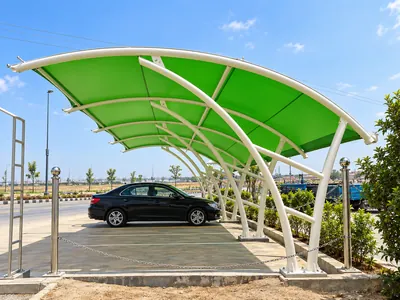
Car Parking Tensile Structures
View DetailsProduct description
Tensile car parking shades for homes, offices, malls and factories, with columns placed between or behind the bays so vehicles move freely and stay out of direct sun and rain.


Tensile structures, also called tensile fabric structures, tensile membrane structures or tensile roofing, are roofs and shades made from a high-strength fabric membrane stretched tight over an engineered steel frame. Held in tension, the fabric can span large areas from only a few supports, keeps out sun and rain, and takes on curved forms that conventional roofs cannot easily match. They cover car parks, walkways, stadiums, pools, entrances and plazas at commercial, industrial, public and residential sites.
ShadeCo India Private Limited is a tensile structures manufacturer and supplier in India. We design, fabricate, supply and install conical, hypar, barrel vault, cantilever and inverted umbrella tensile structures and retractable tensile roofs, in a choice of fabric types and GSM grades, for car parking areas, walkways, stadiums, swimming pools, auditoriums, playgrounds, atriums, resorts, institutions and public spaces.
ShadeCo India designs and installs tensile structures for a wide range of uses, from car parking shades and covered walkways to stadium roofs, atriums, and residential shade structures. Each solution is planned around the site layout, span, and level of sun and rain protection needed. Select a structure below to see its design options, applications, and project details.
Tensile car parking shades for homes, offices, malls and factories, with columns placed between or behind the bays so vehicles move freely and stay out of direct sun and rain.
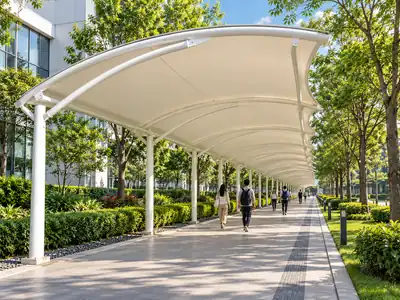
Covered tensile walkways linking gates, parking areas and building entrances in hospitals, schools and campuses, keeping people shaded and dry along the full route.
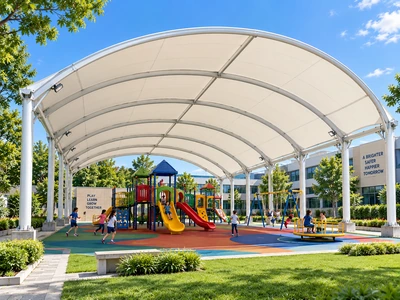
Tensile shade structures over play equipment in schools, parks and housing societies, cutting heat on slides and play surfaces, with columns kept outside the main play area.
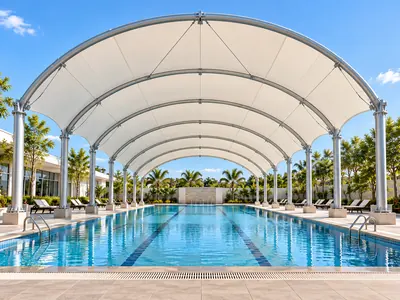
Tensile sun sheds over pools, decks and loungers in hotels, clubs and homes, reducing glare on the water and heat on the deck around it.
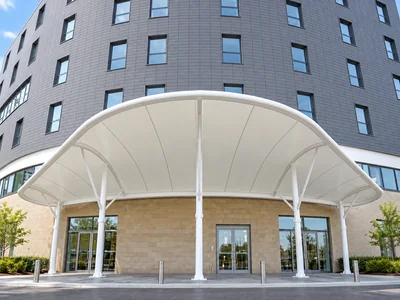
Tensile canopies over building entrances, porches and drop-off points that keep visitors dry and give the building a clear, shaded arrival point.
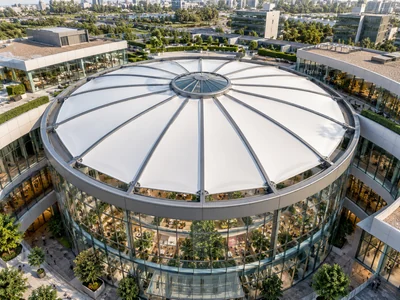
Tensile membrane roofs over atriums and internal courtyards that keep out rain and let soft, diffused daylight reach the floors below.
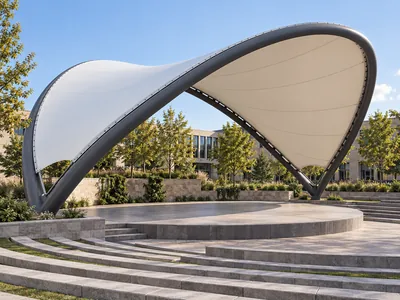
Tensile shade over amphitheatre stages and stepped seating, shaped to follow the curve of the venue and keep performers and the audience out of the sun.
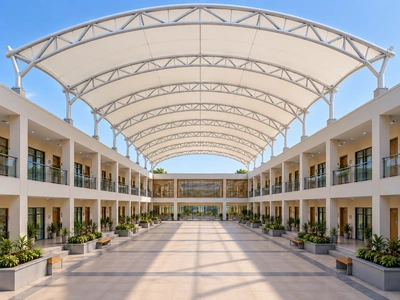
Fabric roofs over open courtyards in homes, hotels, schools and offices, with columns placed around entrances so the courtyard stays usable in sun and rain.
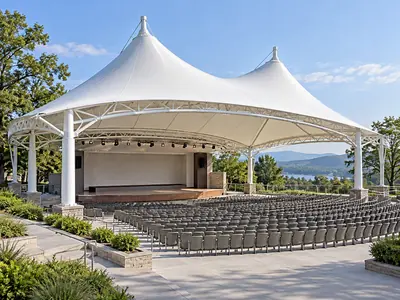
Large-span tensile roofs for open-air auditoriums and event venues, covering the seating and stage with few columns in the way of the view.
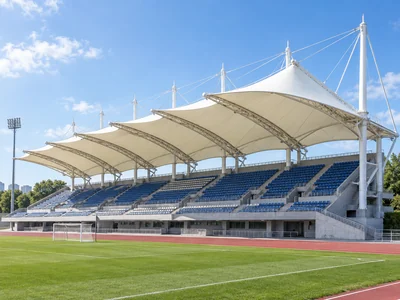
Tensile membrane roofs over stadium spectator stands, planned around seating rows, sightlines to the field and access routes.
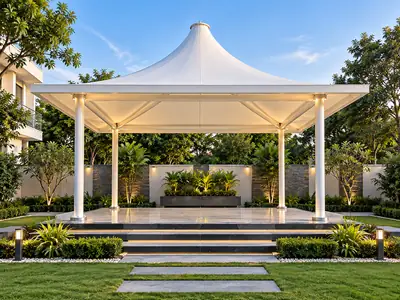
Open-sided tensile gazebos for gardens, resorts, terraces and lawns, with a fabric roof on a steel frame, often in conical or hypar shapes.
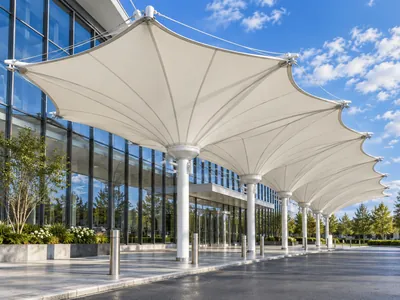
Inverted umbrella tensile canopies on a single central column, sloping inward so rainwater drains down the column. Used in plazas, courtyards and cafe seating.
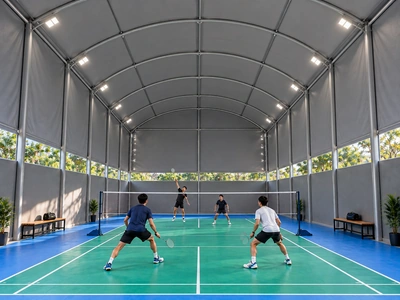
Tensile shade structures over outdoor badminton courts, covering the playing area and side clearance so games can continue in sun and light rain.
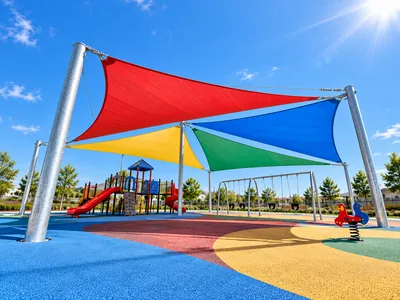
Fabric shade structures with shaped membranes on steel frames for pavilions, seating areas, courtyards and gathering spaces.
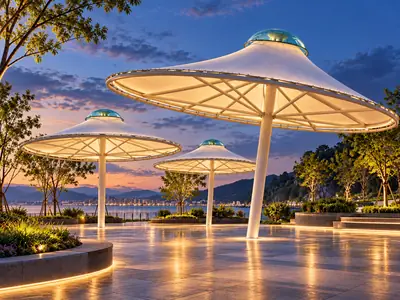
Architectural tensile structures designed as feature canopies for plazas, waterfronts and public spaces, using curved membrane forms and steel masts.
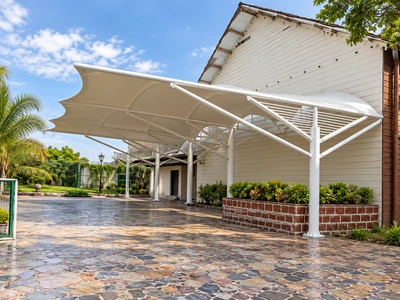
Cantilever tensile shades supported from one side only, keeping parking bays, drop-off zones and spectator seating free of front columns.
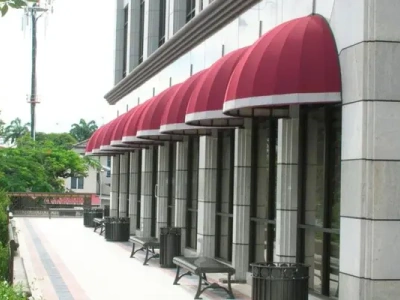
Fabric sun shades fixed above windows to block direct sun, reduce indoor heat and keep rain off the window opening.
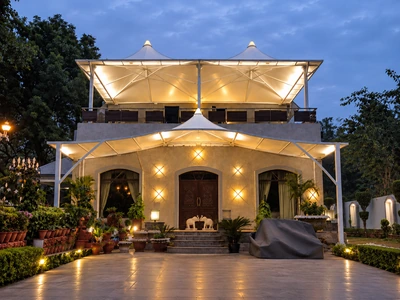
Tensile shade structures for homes and villas, over gardens, terraces, parking spots and outdoor seating, sized to the house and its layout.
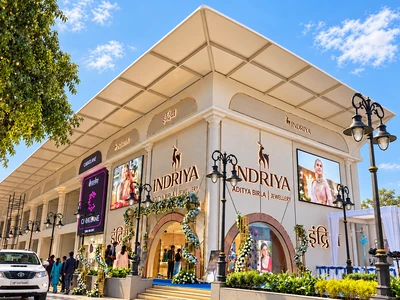
Tensile canopies for shops, showrooms, offices and business premises, over entrances, outdoor seating and pedestrian areas, with optional brand colours.
ShadeCo India designs and builds custom tensile structures around the site they are meant for, instead of picking a shape from a catalogue. The span, height and number of columns depend on what has to stay clear underneath, whether that is parking bays, a stage, rows of seating or a pedestrian route. The fabric is chosen for the level of sun and rain protection needed and how long the structure is expected to last, and it can be supplied in white or in a range of colours.
The steel frame can be painted to match the building, and LED lighting can be fitted on the columns or under the membrane so the space can be used after dark. The fabric can also carry a printed logo or brand colours, which is common on petrol pump canopies, showroom forecourts and commercial entrances. Where a structure connects to an existing building, the wall brackets and cable fixings are designed around what that building can carry, and drainage is planned so rainwater from the membrane does not run onto walls or walkways.
Tensile structures are designed in different geometric forms. The shape affects how the fabric is tensioned, how rainwater drains, how much area is covered, and how the structure looks on site. Choosing the right form depends on the span, support positions, and the architectural character of the project.
A conical structure lifts the fabric to a high central point, creating a tent-like peak. It is one of the most recognisable tensile forms and works well for plazas, entrances, resorts, and landmark shade areas where visual impact matters.
A hypar (hyperbolic paraboloid) form uses alternating high and low corners to give the fabric a twisted, saddle-like shape. It is a popular choice for modern shade structures, seating areas, and architectural canopies.
A barrel vault uses curved arches to create a long, tunnel-like roof. It suits walkways, car parking rows, sports areas, and other spaces that need continuous coverage over a long length.
Cantilever structures are supported from one side only, keeping the covered area free of columns. They are ideal for car parking, drop-off zones, and stadium seating where clear access is important. Explore our cantilever shade structures.
Inverted umbrellas slope the fabric down towards a central column, which also carries rainwater away. They are well suited to plazas, courtyards, cafes, and outdoor seating. View our inverted umbrella tensile structures.
A retractable tensile roof can be opened or closed as needed, giving shade and rain protection when required and open sky at other times. It is used for courtyards, restaurants, terraces, and multipurpose event spaces.
Tensile structures are widely preferred because they combine long-span coverage, design flexibility, fast installation, and reliable weather protection. Compared to heavy conventional roofing, tensile structures offer a lightweight and modern solution that can be adapted to almost any site layout or architectural style.
These advantages make tensile structures ideal for commercial, public, recreational, residential, hospitality, institutional, and infrastructure projects.
Parking is the most familiar use. Car parking tensile structures cover cars, two-wheelers, buses and trucks at homes, offices, malls, hospitals and factories, and walkway tensile structures link those parking areas to gates and buildings across campuses and commercial complexes. At the building itself, an entrance canopy marks the main door or drop-off point.
Larger spans are where tensile membranes are hard to replace. Stadium tensile structures roof spectator stands, while amphitheatre shade structures and auditorium tensile structures cover open-air stages and seating. Indoors and between buildings, atrium and courtyard tensile structures enclose open space without blocking the sky.
Schools and parks use playground shade structures over play equipment and assembly grounds, and hotels and clubs use swimming pool sun sheds over pools and water play areas. Petrol pumps, EV charging stations, toll plazas, bus stops and railway platforms need canopies that stand up to constant use. Resorts, wedding lawns, cafes and food courts often choose gazebo tensile structures or cabanas, factories and hospitals add shade over loading docks, canteens and waiting areas, and plazas and parks use landmark canopies and inverted umbrellas.
A tensile structure is made of three main parts working together: the fabric membrane, the steel support framework, and the connections that hold the fabric in tension. The specifications below give an overview of the components used in ShadeCo India tensile structures. Final specifications are confirmed for each project after site study and structural design.
| Component | Specification |
|---|---|
| Fabric Membrane | PVC-coated polyester, PVDF-coated PVC, PTFE-coated glass fibre, or HDPE shade fabric |
| Fabric Joining | High-frequency or hot-air welded seams, patterned to the approved design |
| Main Structure | Mild steel or galvanised steel columns, arches, rafters, and masts |
| Surface Protection | Anti-corrosion primer with protective paint coating, or hot-dip galvanising |
| Cables & Fittings | Stainless steel or galvanised wire ropes, turnbuckles, shackles, and edge fittings |
| Foundation | RCC foundations with anchor bolts, designed for site soil and load conditions |
| Wind Load Design | As per IS 875 (Part 3) for the project location |
| Drainage | Fabric slopes and gutters planned to direct rainwater away from the covered area |
| Fabric Colours | White, off-white, and a range of standard colours, subject to fabric availability |
The fabric decides how long the structure lasts, whether it keeps out rain, and how much maintenance it needs. The table below compares the most common tensile fabrics used in India.
| Fabric Type | Typical Lifespan | Waterproof | Best Suited For |
|---|---|---|---|
| PVC-Coated Polyester | 10–15 years | Yes | Car parking, walkways, entrances, gazebos |
| PVDF-Coated PVC | 15–20 years | Yes | Projects needing better self-cleaning and lower maintenance |
| PTFE-Coated Glass Fibre | 25+ years | Yes | Stadiums, airports, atriums, and premium permanent structures |
| HDPE Shade Fabric | 5–10 years | No (breathable) | Playgrounds, nurseries, and areas needing sun protection only |
Fabric weight, measured in GSM (grams per square metre), is one of the most important choices in a tensile structure. Heavier fabrics generally have higher tensile and tear strength, which allows larger spans and better performance in high wind zones. Lighter fabrics are more economical for smaller structures. ShadeCo India selects the fabric weight for each project based on the span, design, wind zone, and expected service life.
| Fabric Weight | Typical Use | Suitable Projects |
|---|---|---|
| 590 – 650 GSM | Small and medium spans | Gazebos, entrance canopies, window sun shades, residential shades |
| 750 – 900 GSM | Most permanent tensile structures | Car parking, walkways, courtyards, swimming pools, playgrounds |
| 1050 – 1500 GSM | Large spans and high wind zones | Stadiums, auditoriums, amphitheatres, atriums, coastal sites |
900 GSM PVDF-coated high-tenacity polyester is the most widely used fabric grade for permanent tensile structures. Its technical data is shown below as a reference. Datasheets for other fabric weights and types are available on request.
| Specification | Details |
|---|---|
| Application | Permanent Tensile Structures |
| Base Fabric | High-Tenacity Polyester |
| Surface Treatment | PVDF Coated |
| Fabric Weight | 900 g/m² |
| Total Thickness | 0.70 mm |
| Fabric Width | 267 cm |
| Tensile Strength (Warp / Weft) | 420 / 400 daN/5 cm |
| Tear Resistance (Warp / Weft) | 55 / 50 daN |
| Adhesion Strength | 12 daN/5 cm |
| Fire Rating | B1 / DIN 4102 |
| UV Resistance | Excellent UV Stability |
| Temperature Resistance | -30°C to +70°C |
| Solar Reflectance (Rs) | 75% |
| Solar Transmittance (Ts) | 7% |
| Solar Factor (g) | 11.5% |
| Warranty | Up to 10 Years* |
*Warranty is subject to the manufacturer's terms and conditions. Values are for 900 GSM PVDF-coated fabric; other fabric types and weights have different specifications.
For a broader technical understanding of the structural concept, you can refer to this overview of tensile structures.
Beyond materials, what matters most to users is how a tensile structure performs every day. These are the key performance parameters to consider when choosing a tensile structure for your site.
| Parameter | Performance |
|---|---|
| Sun & UV Protection | UV-stabilised fabrics block most direct sunlight and harmful UV rays |
| Heat Reduction | Light-coloured membranes reflect sunlight, keeping the area underneath noticeably cooler. Our 900 GSM PVDF fabric reflects 75% of solar energy (Rs) with a solar factor of 11.5% |
| Rain Protection | Fully waterproof with PVC, PVDF, and PTFE fabrics; HDPE is for shade only |
| Natural Daylight | Translucent fabrics allow soft, diffused daylight, reducing the need for daytime lighting (solar transmittance of 7% for 900 GSM PVDF fabric) |
| Wind Resistance | Designed for the wind speed of the project location as per IS 875 (Part 3) |
| Fire Behaviour | DIN 4102 B1 rated fabric available for public and commercial projects |
| Self-Cleaning | PVDF and PTFE coatings resist dirt build-up and are washed clean by rain |
| Maintenance | Low – periodic fabric cleaning, cable tension check, and steel touch-up painting |
| Service Life | 5 to 25+ years depending on the fabric selected |
| Temperature Resistance | -30°C to +70°C (900 GSM PVDF fabric) |
| Warranty | Up to 10 years on 900 GSM PVDF fabric, subject to manufacturer's terms |
The right balance of these parameters depends on how the space will be used. A car parking shade needs strong sun and rain protection, a playground mainly needs UV protection and airflow, and a stadium roof needs long life, wind resistance, and fire performance.
Tensile structures are often compared with polycarbonate, metal sheet, and RCC roofing. Each option has its place, and the right choice depends on the span, budget, appearance, and how the space will be used.
| Feature | Tensile Structure | Polycarbonate | Metal Sheet | RCC |
|---|---|---|---|---|
| Weight | Very light | Light | Medium | Very heavy |
| Installation Time | Fast | Fast | Medium | Slow |
| Large Column-Free Spans | Excellent | Limited | Good | Limited |
| Design Flexibility | Very high | Low | Low | Medium |
| Heat Under the Roof | Low | Can trap heat | High | Low |
| Can Be Relocated | Yes | Partly | Partly | No |
If you need a rigid, transparent roof, explore our polycarbonate roofing solutions.
The price of a standard tensile structure in India typically starts from ₹350 to ₹450 per sq ft + GST for 750–900 GSM fabric. This rate includes the fabric, steel frame, fabrication, and installation. Transportation and foundation work are charged separately. Large-span and custom-designed structures such as stadium roofs, atriums, and auditoriums are priced separately based on design and engineering requirements. Rates are indicative and may change with material costs. The final cost depends on the following factors:
PTFE and PVDF fabrics cost more than PVC or HDPE but last longer. Wide column-free spans need heavier steel and more engineering, and shapes such as hypar or conical structures take more fabric cutting and detailing than a simple barrel vault. The amount of steel, whether it is galvanised, and the paint finish all affect the price.
On site, tall or hard-to-reach locations need extra lifting equipment, and soil conditions decide how much foundation work is required. Transport distance and the design wind speed also change from city to city.
To get an accurate quote, share the area to be covered, the location, the intended use, and any photos or drawings of the site. Our team will suggest the most suitable design and provide a detailed estimate.
A tensile membrane gets its strength from its shape and its tension, so the design has to be worked out in detail before any fabric is cut.
ShadeCo India Private Limited designs, fabricates and installs tensile structures, from car parking shades and entrance canopies to stadium stands, auditorium roofs and atriums. Membrane patterning, steel fabrication and installation are handled by our own team, so the fabric and the frame are made to the same drawings.
Fabric options run from 590–650 GSM grades for small canopies to 1050–1500 GSM and PTFE fabrics for large spans and high wind zones.
ShadeCo India Private Limited, established in 2010, is an ISO 9001:2015 certified tensile structure manufacturer with over 15 years of experience in design, fabrication and installation. Our in-house team of engineers, fabricators and installers has delivered more than 800 projects across commercial, institutional, industrial and hospitality sectors.
We have worked with organizations including Delhi Public School, Food Corporation of India, L&T, TATA, Adani, Al-Karim University, Indian Oil, Omaxe, VIVO, Lakhani, Indian Railways, Reliance and several other organizations across India.
Every tensile structure is developed around the required coverage, site conditions and approved drawings before production begins. Our team coordinates membrane and steel fabrication, delivery and installation, and each structure is inspected against the design and specification before final handover.
For related shade and roofing options, you can also explore our shade sails, atrium tensile structures, polycarbonate roofing, and sports shade structures.
The project photos below include car parking and two-wheeler parking shades, building-side canopies, a conical rooftop canopy and terrace shades. On a well-made tensile structure the membrane sits smooth without wrinkles, the edges follow a clean curve, and rainwater runs to the drainage points instead of collecting on the fabric. You can view all our tensile structure projects on our projects page.


ShadeCo India provides tensile structure manufacturing, supply, fabrication, and installation support from Delhi NCR to major states across North, Central, and West India, including Delhi, Haryana, Uttar Pradesh, Punjab, Rajasthan, Himachal Pradesh, Uttarakhand, Madhya Pradesh, Gujarat, Bihar, and Maharashtra. With pan-India project execution, we also take up tensile structure projects in other states based on project scope and site requirements.
Our team regularly serves project requirements in key cities such as New Delhi, Gurugram, Faridabad, Lucknow, Noida, Chandigarh, Ludhiana, Jaipur, Jodhpur, Shimla, Baddi, Dehradun, Haridwar, Bhopal, Indore, Gandhinagar, Ahmedabad, Patna, Muzaffarpur, Mumbai, and Pune, along with Bengaluru, Hyderabad, Chennai, Kochi, and other cities across India.
Send us the area to be covered, the location and a few site photos or drawings. Tell us what needs to happen underneath, such as parking, seating, events or a walkway, and whether the structure will stand on its own or connect to an existing building. If you have a shape in mind, a reference photo helps. We will suggest a design and fabric and prepare an estimate.
Call ShadeCo India on +91-9873975818, email info@shadecoindia.com, or share your project details through our contact page.
faq
Tensile structures are lightweight architectural systems made from high-strength fabric or membrane materials stretched over a steel framework. They provide durable, flexible, and visually appealing shading and roofing solutions for different outdoor and semi-outdoor applications.
A standard tensile structure in India typically starts from ₹350 to ₹450 per sq ft + GST for 750–900 GSM fabric, including fabric, steel frame, fabrication, and installation. Transportation and foundation work are charged separately, and large-span or custom structures are priced based on their design. Share your site details with ShadeCo India to receive an accurate quotation for your project.
Tensile structures are used for car parking shades, walkways, stadiums, atriums, swimming pools, outdoor seating areas, building entrances, auditoriums, playgrounds, resorts, petrol pumps, EV charging stations, institutions, and commercial spaces.
The lifespan mainly depends on the fabric. PVC-coated polyester typically lasts 10–15 years, PVDF-coated fabric 15–20 years, and PTFE fabric 25 years or more. The steel framework lasts much longer with proper coating and periodic maintenance.
Yes, tensile structures made with PVC, PVDF, or PTFE fabric are waterproof and are designed with slopes that drain rainwater. HDPE shade fabric is breathable and is used only where sun protection is needed, not rain protection.
Installation time depends on the size and complexity of the structure. Smaller structures such as gazebos or entrance canopies can be completed quickly, while large stadium or atrium roofs take longer due to engineering, fabrication, and site work. ShadeCo India shares a clear timeline with every quotation.
Tensile roofing uses a stretched fabric membrane that can form curved, large-span shapes and keeps the area underneath cooler. Polycarbonate roofing uses rigid transparent sheets that let in more daylight but offer less design flexibility and can trap heat. The better option depends on the span, design, and how the space will be used.
Yes. ShadeCo India provides custom tensile structures based on project size, site layout, shape, color preference, fabric type, support framework, drainage requirement, and architectural design goals.

Let's Start Work Together