
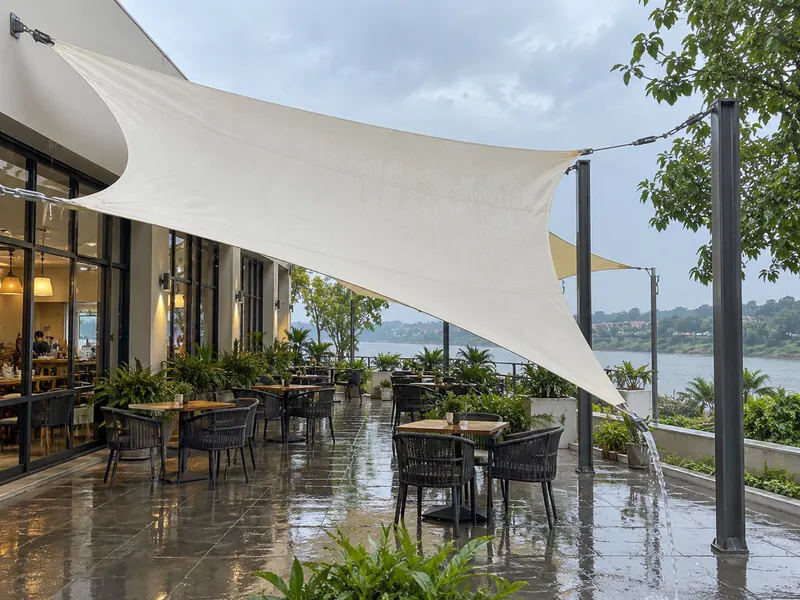
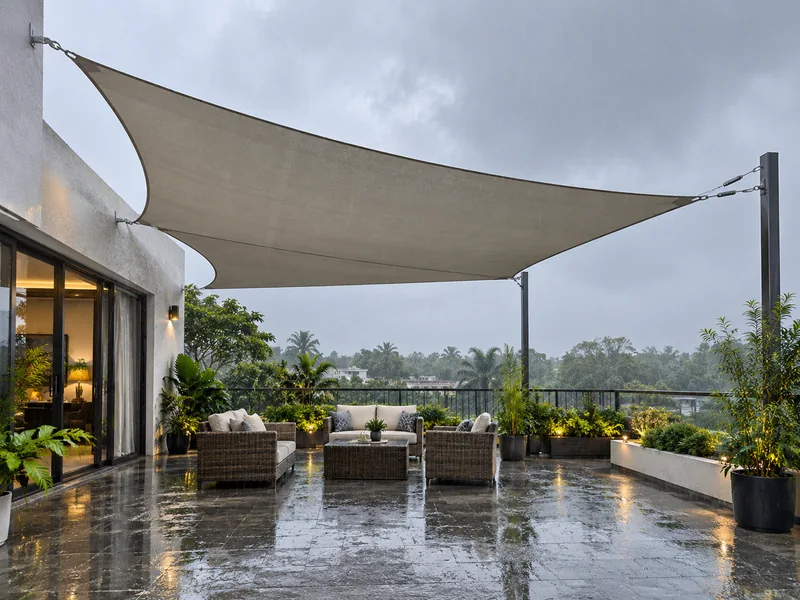
A waterproof shade sail is a shade sail made from PVC-coated polyester that keeps out rain as well as sun. It is also known as a rainproof shade sail, PVC shade sail, monsoon shade sail or water-resistant sail canopy. It is used over café seating, terraces, building entrances, patios and waiting areas that stay in use through the rainy season.
ShadeCo India Private Limited is a waterproof shade sail manufacturer and supplier in India. We design, fabricate, supply and install PVC triangle sails, twisted hypar sails, steep single-slope sails, overlapping rain sails and wall-fixed entrance sails. Each sail is cut from PVC-coated polyester with reinforced catenary edges and stainless steel corner hardware.
The first thing to plan is where the rain will go. A waterproof sail collects water across its whole surface and sends it to one low corner. We fix that corner first, over a drain, a planter or open ground, and then set the other corners higher to give a steep slope.
Waterproof Shade Sail at a Glance
- Sail Shapes: Triangle, hypar, steep single-slope and overlapping layouts, each with one planned low corner
- Fabric: Waterproof PVC-coated polyester that blocks rain and sun
- Posts and Fixings: Taller mild steel or galvanized steel posts at high corners, with stainless steel D-rings and turnbuckles
- Surface Finish: Hot-dip galvanizing or epoxy paint for wet exposure, or powder coating and automotive paint
- Suitable For: Café seating, terraces, entrances, patios and waiting areas used in the monsoon
- Service Area: Rainproof sails planned, made and installed across India
Why Choose a Waterproof Shade Sail
A waterproof shade sail keeps a seating area usable when it rains, not just when it is sunny. A breathable sail lets the first shower straight through, so chairs and tables get wet. A PVC sail sends that water away to one corner instead.
This makes a big difference in India's monsoon, when outdoor areas would otherwise sit empty for months. Cafés can keep serving outside, and homes can use the terrace or patio in light rain. The sail still gives shade on hot days.
Types of Waterproof Shade Sails
Every waterproof sail needs a clear path for water, so the layout starts from the low corner.
PVC Triangle Sail
Three corners make it easy to drop one corner low for runoff. It suits small patios and terrace corners. Our triangle shade sails page explains this shape in detail.
Twisted Hypar Rain Sail
Two opposite corners are high and two low, giving a strong twist. Water runs to the low corners quickly, and the twist keeps the fabric tight.
Steep Single-Slope Sail
One side sits much higher than the other, so the whole sail tilts in one direction. It works along building walls where water can drop into an existing drain.
Overlapping Rain Sails
Two or more sails overlap so water from the upper sail lands on the lower one, then runs off its low corner. The overlap keeps rain from falling through the gap.
Wall-Fixed Entrance Sail
High corners fix to the building above a door, and low corners go to posts away from it. Rain is sent away from the entrance, not onto people walking in.
Waterproof Shade Sail Design: Fixing Points, Slope and Tension
Slope is the most important part of a waterproof sail. A flat PVC sail holds water, which pulls the fabric down into a pool and loads the corners. We set a steep difference between high and low corners so water always moves.
The low corner receives most of the runoff in a steady stream. We place it over a drain, gravel or planting, away from doors, seating and paths. Where needed, a downpipe or chain can guide water to the ground.
Waterproof sails catch more wind than breathable ones, because air cannot pass through. Posts and fixings are checked for that load, and the sail is tensioned firmly so it does not flap. We re-check tension after the first few weeks of use.
Technical Specifications
These details are a general guide for café owners, homeowners and building managers who need rain cover. The final slope, low corner and fixings are confirmed after a site visit.
Shade Sail Specifications
| Specification | Details |
|---|---|
| Sail Shapes | Triangle, hypar, single-slope or overlapping layouts with one planned low corner |
| Fabric Options | PVC-coated polyester (waterproof); UV-stabilised HDPE offered where only shade is needed |
| Edges | Catenary edges reinforced with webbing or edge cable |
| Corner Hardware | Stainless steel D-rings, turnbuckles, shackles and pad eyes |
| Support Posts | Mild steel or galvanized steel posts, with taller posts at the high corners |
| Surface Finish | Automotive paint, epoxy paint, powder coating or hot-dip galvanizing |
| Wall Fixings | Pad eyes on walls or columns only at structurally suitable points |
| Foundation | RCC footings designed for site soil and the extra wind load on a solid sail |
| Slope and Drainage | Steep slope to one low corner, placed over a drain, gravel or planting |
| Colours | White, ivory, sand and a range of bright and neutral colours |
| UV Protection | Up to 98% UV blocking, depending on the fabric |
| Wind Load Design | Posts, fixings and footings checked for wind as per IS 875 (Part 3) |
Key Features
| Feature | Details |
|---|---|
| Waterproof PVC Fabric | Keeps rain off seating, tables and walkways under the sail |
| UV-Stabilised Coating | Gives shade in summer as well as rain cover in the monsoon |
| Planned Runoff Corner | Water is sent to one chosen point instead of dripping everywhere |
| Catenary Edges | Reinforced curved edges keep the fabric tight and smooth |
| Stainless Steel Hardware | Corner fittings resist rust in constant rain |
| Corrosion-Protected Posts | Painted or galvanized posts suit wet sites |
| Adjustable Tension | Turnbuckles let the sail be tightened after it settles |
| Wind-Checked Design | Posts and footings sized for the higher wind load of a solid sail |
Benefits of Waterproof Shade Sails
A waterproof sail lets outdoor spaces earn their keep all year round.
- Use in the Monsoon: Seating stays dry, so the area is usable in light rain.
- Shade in Summer: The same sail blocks sun on hot days.
- Controlled Runoff: Water goes to one low corner, away from people.
- Clean, Tight Look: A steep, well-tensioned sail looks sharp from every side.
- Lower Cost Than a Roof: Rain cover without building a framed roof.
- Protects Furniture: Cushions and tables stay dry under the sail.
Applications of Waterproof Shade Sails
Cafés and restaurants use waterproof sails over outdoor seating so service continues in the monsoon. Homeowners cover patios, terraces and balconies used through the rainy months. For cool, breathable shade where rain cover is not needed, see our HDPE shade sails.
Offices, clinics and showrooms place them over entrances and waiting areas. Schools use them over bus waiting points and small gathering spaces. Resorts use waterproof sails over outdoor lounges that must stay usable in sudden showers.
Waterproof Shade Sail Price in India: What Affects the Cost
The cost of a waterproof shade sail depends mainly on its size, the number of sails and the posts needed. PVC-coated polyester costs more than HDPE, but it adds rain cover.
Taller posts at high corners, stronger RCC footings for wind, stainless hardware, wall fixings, drainage at the low corner and site access all affect the figure. Overlapping layouts need extra sails and fittings.
For a quotation, share photos of the area, rough measurements, where water could drain and the location.
How We Plan and Install a Waterproof Shade Sail
A rainproof sail works only if water has a clear way out, so drainage guides every step.
- Step 1 – Site visit: We study the space, find a safe spot for the low corner and check walls and ground for the other fixing points.
- Step 2 – Layout: We set corner heights for a steep slope and agree the sail shape, colour and runoff point.
- Step 3 – Structural check: Because a solid sail catches more wind, posts, fixings and footings are checked as per IS 875 (Part 3).
- Step 4 – Posts and foundations: Taller posts go on RCC footings at the high corners, and pad eyes are fixed to approved walls.
- Step 5 – Final measurement and fabrication: We measure between the installed corners and make the PVC sail to that exact size.
- Step 6 – Tensioning and handover: The sail is tensioned, a water test confirms runoff, and tension is re-checked after the first few weeks.
Waterproof Shade Sail Design and Installation Solutions
ShadeCo India installs waterproof shade sails for cafés, homes, offices and resorts. Our team plans the slope, low corner and fixings so the sail stays tight and sends rain where it should go.
Why Work with ShadeCo India
Since 2010, ShadeCo India has built fabric shade and tensile structures for more than 15 years. We hold ISO 9001:2015 certification. Our in-house team plans the slope, sets the posts and fits the sail, so drainage is not left to chance.
We have worked with Delhi Public School, Food Corporation of India, L&T, TATA, Adani, Al-Karim University, Indian Oil, Omaxe, VIVO, Lakhani, Indian Railways and Reliance. Other organizations across India also count on our work.
On each waterproof sail, we test water flow to the low corner and check every fixing before handover. Delivery typically takes 3–6 weeks, depending on sail count and customization.
Explore Our Shade Sail Projects
Many projects on our projects page are rain-protected tensile covers, such as entrance canopies, parking shades and café roofs. They were built for schools, hospitals, resorts, factories and city bodies.
Those projects show how we deal with rain on fabric: slopes, edges and where water leaves the cover. The same thinking goes into the low corner and runoff point of a waterproof sail.
Look through ShadeCo India projects before you plan your sail. Then tell us where rainwater can safely drain on your site, and we will design the slope around it.
Service Availability Across India
ShadeCo India provides waterproof shade sail solutions across major cities and regions in India. Rainproof sail projects are taken up in Delhi, Gurugram, Faridabad, Noida, Lucknow, Chandigarh, Ludhiana, Jaipur, Jodhpur, Shimla, Dehradun, Haridwar, Bhopal, Indore, Gandhinagar, Ahmedabad, Patna, Muzaffarpur, Mumbai, Pune, Bengaluru, Hyderabad, Chennai and Kochi. Rainproof sails for other locations are planned based on project scope and site requirements.
Each waterproof sail is planned around local rainfall, wind and drainage. In heavy-rain regions, we use steeper slopes and plan the runoff point with extra care.
Planning a Waterproof Shade Sail?
If you need an outdoor area that stays dry in the monsoon, ShadeCo India can advise on the sail shape, slope and runoff point.
We request you to share photographs, rough measurements and where rainwater can drain on your site. Please also mention the location, so our team can plan a suitable waterproof sail.
Please reach us at +91-9873975818, by email at info@shadecoindia.com, or through our contact page.
FAQ
Frequently Asked Questions - Waterproof Shade Sail
A waterproof shade sail is a sail made from PVC-coated polyester that blocks both rain and sun. It is fixed at a steep slope so water runs to one low corner. It keeps seating dry in the monsoon.
The cost depends on size, number of sails, post heights, footings, hardware and drainage at the low corner. PVC fabric costs more than HDPE. ShadeCo India quotes from photos, measurements and location.
PVC-coated polyester is used because it does not let water through. It also blocks up to 98% of UV, depending on the fabric. For shade only, a breathable HDPE sail costs less.
Yes, when it has a steep slope and strong fixings. The slope stops water pooling, and posts and footings are checked for wind as per IS 875 (Part 3). A solid sail catches more wind, so tension matters.
Life depends on sun, rain, tension and care. A steep slope prevents water pooling, which protects the fabric and corners. Regular cleaning and tension checks help it last longer.
Without enough slope, rain collects in the middle and pulls the sail down. A steep slope keeps water moving to the low corner. It also keeps the fabric tight and the corners free of extra load.
A waterproof sail is usually ready in 3–6 weeks, depending on its size and design. Posts are installed first, then the sail is made to the measured size and water-tested.
Water runs to the lowest corner in a steady stream. We place that corner over a drain, gravel or planting, away from doors and seating. A chain or downpipe can guide water to the ground.
