
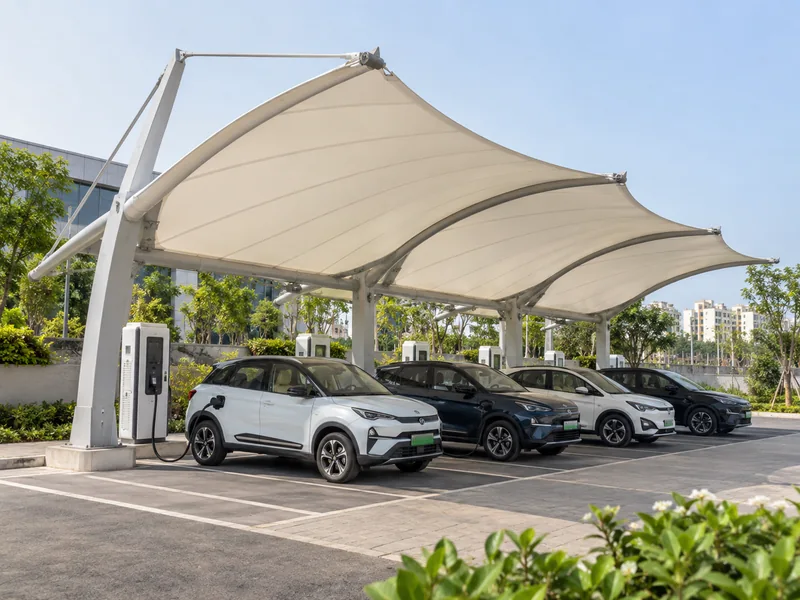
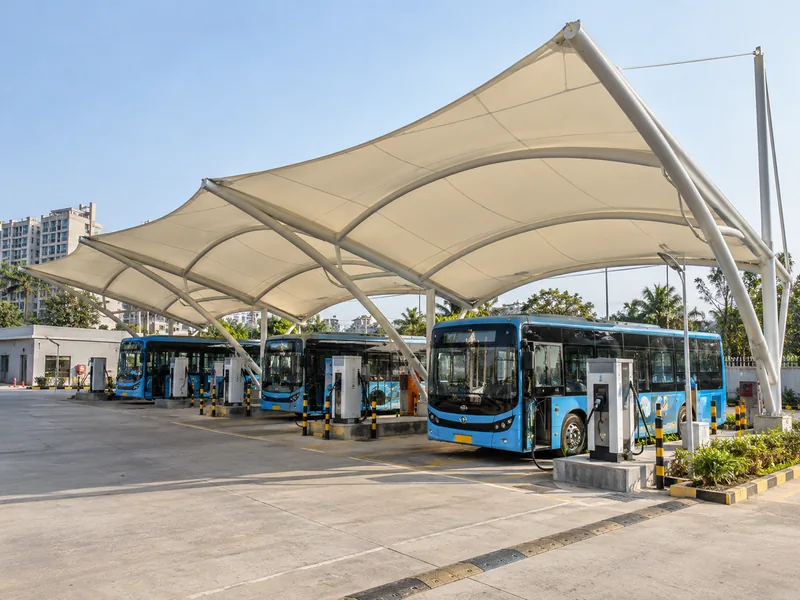
An EV charging station canopy is a fabric roof over electric vehicle chargers and charging bays that shelters cars, drivers and charging equipment. It is also known as an EV charger shade, electric vehicle charging canopy, EV charging shed or charging bay tensile roof. It is used at highway charging hubs, malls, offices, hotels, housing societies, fuel stations and e-bus depots.
ShadeCo India Private Limited is an EV charging station canopy manufacturer and supplier in India. We design, fabricate, supply and install single-bay charger canopies, multi-bay cantilever rows, drive-through charging canopies, e-bus depot canopies and two-wheeler charging shades. Fabric is chosen from PVC, PVDF and PTFE-coated fabric for rain cover, or HDPE shade net where only shade is needed.
Planning starts with the charger layout from the charge point operator. We note each charger's position, cable reach and the side of the vehicle where it plugs in. Then we route cables and place columns so drivers can park, plug in and walk around without obstacles.
EV Charging Station Canopy at a Glance
- Structure Types: Single-bay, multi-bay cantilever, drive-through, e-bus depot and two-wheeler charging canopies
- Fabric: PVC, PVDF or PTFE-coated fabric to keep chargers and plugs dry, or HDPE shade net for shade only
- Frame Material: Mild steel (MS) or galvanized steel (GI) columns and arms with cable trays or conduits built in
- Surface Finish: Powder coating or automotive paint in operator colours, with epoxy paint or hot-dip galvanizing options
- Suitable For: Highway charging hubs, malls, offices, hotels, housing societies, fuel stations and e-bus depots
- Service Area: EV charger canopies designed, supplied and installed across India
Why Choose an EV Charging Station Canopy
An EV charging station canopy keeps drivers dry while they plug in and keeps chargers, cables and connectors out of direct rain and sun. Charging takes longer than filling fuel, so drivers often wait beside their cars. Shade and shelter make that wait far more comfortable.
A cooler parked car also uses less energy for air conditioning when the driver returns. For charge point operators, a visible canopy marks the station from the road and carries their brand. Fabric gives a modern, light look that suits electric mobility.
Types of EV Charging Station Canopies
The right charging canopy depends on the number of chargers, the vehicles served and how bays are arranged.
Single-Bay Charger Canopy
A compact canopy covers one or two chargers and the bays beside them. It suits offices, hotels and housing societies adding their first chargers.
Multi-Bay Cantilever Row
Columns stand at the back of a row of charging bays, and the roof reaches over the cars. The front stays open for easy parking. It suits malls and office car parks.
Drive-Through Charging Canopy
A canopy covers lanes where cars drive in, charge and drive out without reversing. It suits highway charging hubs and fuel station charging zones. For canopies over fuel islands, see our petrol pump tensile canopies.
E-Bus Depot Charging Canopy
A high-clearance roof covers bus charging bays at depots and terminals. Chargers sit on plinths between bays, with cables reaching the bus charging port.
Two-Wheeler and E-Rickshaw Shade
A low canopy covers rows of charging points for scooters and e-rickshaws. It suits markets, colleges, metro stations and fleet hubs.
Custom EV Canopy Design: Charger Bays, Cable Routing and Driver Waiting Space
Columns are placed so they never block a charger's cable reach or a car door. We plan around the charger positions given by the operator, keeping space for both left and right charging ports. Wheel stops or bollards protect columns and chargers from bumps.
Power and data cables run in trays or conduits inside or along the columns. This keeps them out of sight and away from vehicles. Lighting, CCTV and signage points are added on the frame at the same time.
Drivers may wait for some time while charging, so we add shaded seating or a waiting area where space allows. The roof overhang keeps rain off the charger screen and plug. Water drains to gutters, away from charger plinths and cable pits.
Technical Specifications
These details are a general guide for charge point operators, property owners and fleet managers. The final layout, clearance and cable routes are confirmed against the charger supplier's layout.
Structural & Fabric Specifications
| Specification | Details |
|---|---|
| Structure Types | Single-Bay, Multi-Bay Cantilever, Drive-Through, E-Bus Depot, Two-Wheeler or Custom |
| Frame Material | Mild Steel (MS) or Galvanized Steel (GI) columns, arms and cable trays |
| Surface Finish | Automotive Paint, Epoxy Paint, Powder Coating or Hot-Dip Galvanizing |
| Cable Routing | Trays or conduits inside or along columns, coordinated with the charger layout |
| Fabric Types | PVC-Coated Polyester, PVDF-Coated Polyester, PTFE-Coated Glass Fibre or HDPE Shade Net |
| Fabric Weight | 750 – 900 GSM coated fabric for car bays; 1050 GSM or heavier for wide e-bus spans |
| Rain Protection | Waterproof with PVC, PVDF or PTFE over chargers and plugs; HDPE gives shade only |
| UV Protection | Up to 98% UV blocking, depending on the fabric |
| Temperature Resistance | −30°C to +70°C |
| Clearance | Set for cars, SUVs, vans or buses using the bays (Customizable) |
| Drainage | Gutters and downpipes discharging away from charger plinths and cable pits |
| Add-Ons | Provision for Lighting, CCTV, Signage and Waiting Seating |
| Wind Load Design | Columns, arms and footings designed as per IS 875 (Part 3) |
| Fabric Warranty | Up to 10 years on PVDF fabric, subject to manufacturer's terms |
Key Features
| Feature | Details |
|---|---|
| Waterproof PVC / PVDF / PTFE Fabric | Keeps charger screens, plugs and drivers dry while charging |
| UV-Resistant Coating | Blocks up to 98% of UV rays, depending on the fabric, over parked EVs |
| Anti-Wicking Fabric | Sealed edges stop rain wicking into the fabric above charger bays |
| Fungicide Finish | Limits mould on canopies over damp, tree-lined charging bays |
| Moisture and Corrosion Resistant | Galvanized or coated steel and cable trays resist rust outdoors |
| Dirt-Resistant Top Coat | PVDF top coat keeps operator colours and logos looking fresh |
| Flame-Retardant Grade Available | FR-grade fabric on request for public and fleet charging hubs |
| All-Weather Performance | Columns and arms designed for site wind loads as per IS 875 (Part 3) |
Benefits of EV Charging Station Canopies
A charging canopy makes the time spent charging safer and more comfortable for every driver.
- Dry Plug-In: Drivers connect and disconnect cables out of the rain.
- Protected Chargers: Screens and connectors face less direct sun and rain.
- Cooler Cars: Shaded EVs need less cooling when drivers return.
- Neat Cable Routes: Cables run in trays along columns, out of the way.
- Visible Brand: The canopy marks the station and carries operator colours.
- Comfortable Waiting: Shaded seating makes longer charging stops pleasant.
Applications of EV Charging Station Canopies
Charge point operators use canopies at highway hubs and city charging stations. Malls, offices and hotels cover their EV bays to attract and serve EV owners. For roofs over regular parked cars, see our parking shade structures.
Housing societies add canopies over shared chargers in visitor or resident parking. E-bus operators and transport departments cover depot charging bays. Fleet operators, e-rickshaw hubs and delivery companies shade their two-wheeler charging rows.
EV Charging Station Canopy Price in India: What Affects the Cost
The cost of an EV charging station canopy depends mainly on the number of bays and the canopy type. Cantilever rows need heavier columns than two-sided frames, and e-bus canopies need extra height.
Fabric type, cable trays, lighting, branding, finish and footings around cable pits change the figure. PTFE fabric is at the top of the cost range for EV canopies and HDPE at the bottom. Coordinating with charger installation can save repeat site work.
For a quotation, share the charger layout, the number of bays, vehicle types, site photographs and the location.
How We Design and Install an EV Charging Station Canopy
An EV canopy and its chargers share space, cables and foundations, so we plan both together with the operator.
- Step 1 – Site survey: We measure the bays, mark charger positions and cable routes, and check existing services underground.
- Step 2 – Layout and drawings: We propose the canopy type, column positions, clearance and cable trays, coordinated with the charger supplier.
- Step 3 – Engineering: Columns, arms and footings are designed for the site wind load as per IS 875 (Part 3), avoiding cable pits.
- Step 4 – Fabrication: Steel and cable trays are finished in our workshop, and fabric is cut to the bay layout.
- Step 5 – Installation: Footings and columns go in before or with charger work, then the roof, trays, lights and fabric are fitted.
- Step 6 – Handover: We check clearances, cable tray covers and drainage, and share care guidance.
EV Charging Station Canopy Design and Installation Solutions
ShadeCo India builds canopies for EV charging hubs, commercial car parks, housing societies and e-bus depots. Our team plans the canopy with the charger layout, so cables, columns and bays work together.
Why Work with ShadeCo India
ShadeCo India has worked on tensile structures since 2010, building more than 15 years of experience, and is ISO 9001:2015 certified. With engineers, fabricators and installers in-house, we coordinate closely with charger suppliers on shared foundations and cables.
Organizations we have served include Delhi Public School, Food Corporation of India, L&T, TATA, Adani, Al-Karim University, Indian Oil, Omaxe, VIVO, Lakhani, Indian Railways and Reliance. Our work also covers several other clients across India.
On every charging canopy, we check cable reach, column protection and drainage around chargers before handover. Delivery typically takes 3–6 weeks, depending on bay count and customization.
You can also see our driveway tensile canopies, car parking tensile structures and the full range of tensile structures.
Explore Our Projects & Design References
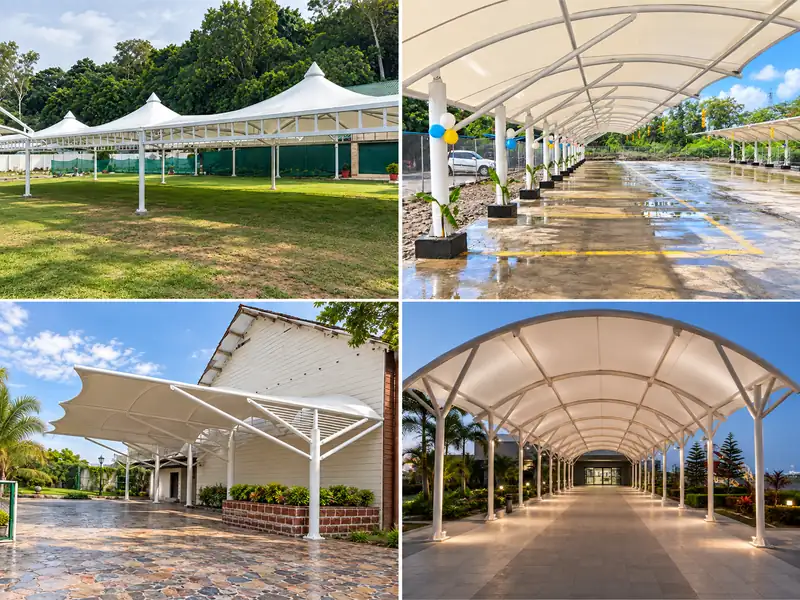
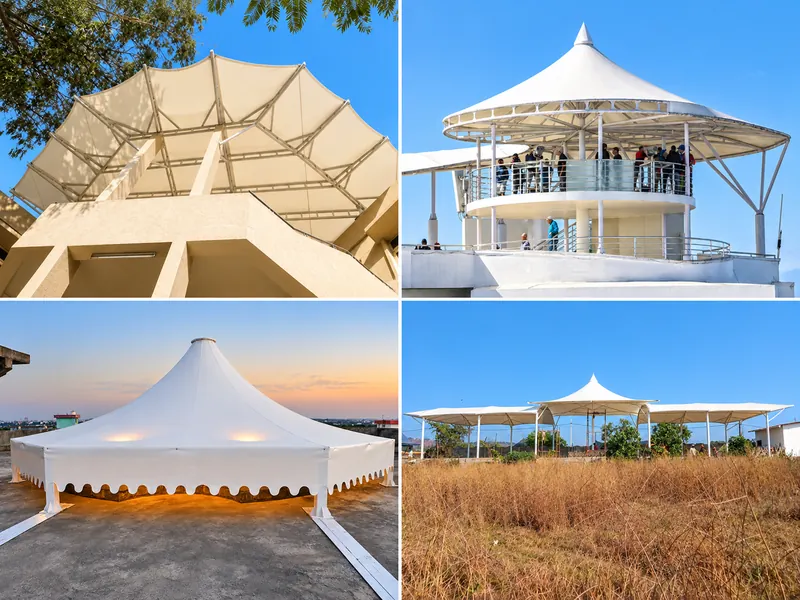
The images below show our canopies over parking, entrances, lawns and terraces. They help when comparing column styles and fabric colours for charging bays, while each EV canopy follows its own charger layout. View more ShadeCo India projects.
Service Availability Across India
ShadeCo India provides EV charging station canopy solutions across major cities and regions in India. Charging projects can be handled in Delhi, Gurugram, Faridabad, Noida, Lucknow, Chandigarh, Ludhiana, Jaipur, Jodhpur, Shimla, Dehradun, Haridwar, Bhopal, Indore, Gandhinagar, Ahmedabad, Patna, Muzaffarpur, Mumbai, Pune, Bengaluru, Hyderabad, Chennai and Kochi. Highway hubs and other sites are covered based on project scope and site requirements.
Each charging canopy is planned around local weather, the charger layout and the site's operating hours. We coordinate dates with the charger installer, so foundations and cables are laid once.
Planning an EV Charging Station Canopy?
If you are setting up EV chargers at a hub, mall, office, society or depot, ShadeCo India can advise on canopy type, clearance and cable routing.
We request you to share the charger layout, the number of bays, the vehicle types and site photographs. Please also mention the project location, so our team can propose a suitable canopy.
You may call +91-9873975818, email info@shadecoindia.com, or reach us through our contact page.
FAQ
Frequently Asked Questions - EV Charging Station Canopy
An EV charging station canopy is a fabric roof over electric vehicle chargers and charging bays. It keeps drivers, cars and charging equipment out of rain and sun. It is used at charging hubs, malls, offices, societies and e-bus depots.
The cost depends on bay count, canopy type, fabric, clearance, cable trays and lighting. PTFE fabric costs the most, and HDPE the least. ShadeCo India quotes from the charger layout, vehicle types and location.
PVC or PVDF-coated fabric is best because chargers and plugs need rain cover. PVDF keeps brand colours clean and has a warranty of up to 10 years. PTFE suits flagship hubs, and HDPE only gives shade.
Coated fabric with a good overhang keeps rain off charger screens and plugs. Gutters lead water away from plinths and cable pits. Columns and footings follow the site wind load as per IS 875 (Part 3).
An EV canopy frame in galvanized or coated steel is expected to serve 25–30 years with care. On charging canopies, PVDF fabric carries a warranty of up to 10 years, subject to the manufacturer's terms.
Height depends on the vehicles using the bays, from cars and SUVs to vans and buses. E-bus depots need much higher canopies than car bays. We confirm clearance with the operator before design.
An EV charging canopy is usually delivered in 3–6 weeks, depending on bay count and design. Timing it with charger installation saves repeat site work.
Solar panels are not fixed on the fabric itself. If solar is needed, panels can sit on a separate steel frame nearby or beside the fabric roof. We can plan the canopy so both work together on site.
