
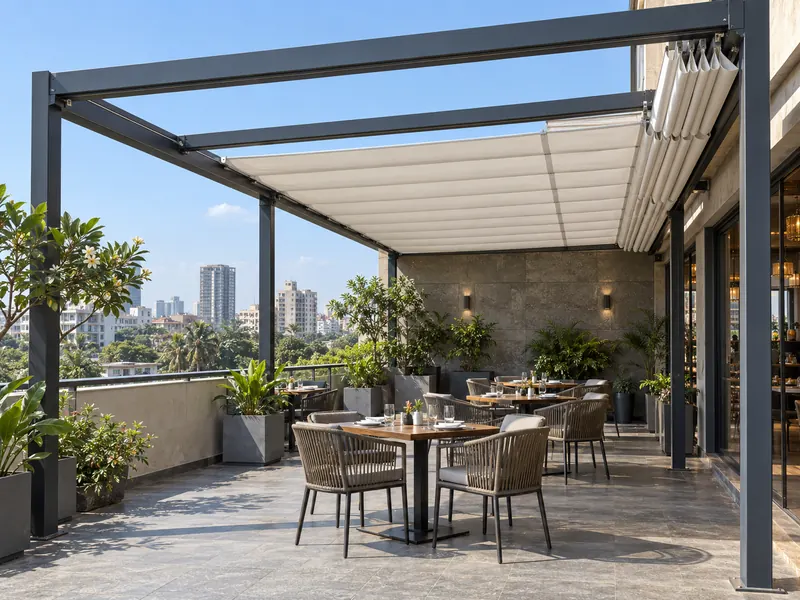
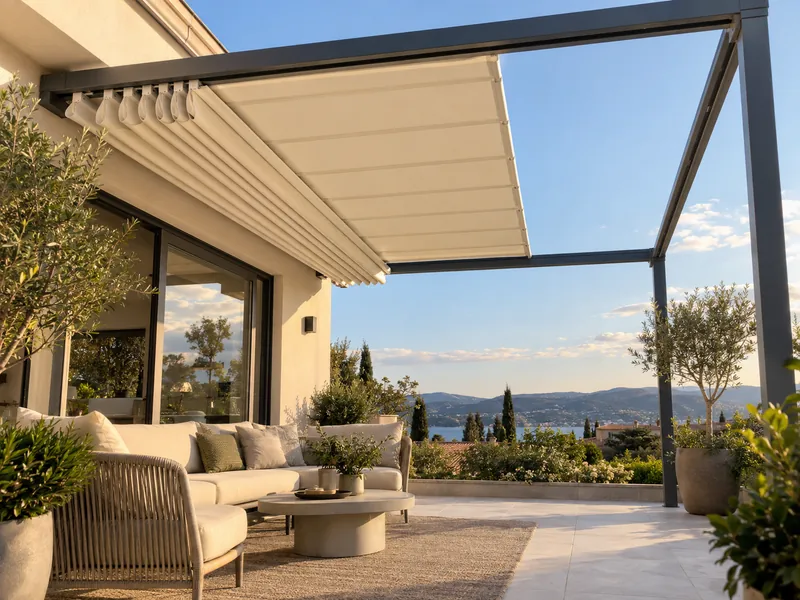
A retractable tensile roof, also known as a retractable fabric roof, sliding canopy, folding membrane roof or opening tensile roof, is a fabric cover that can be opened and closed as needed. The fabric runs along guide rails on a fixed frame and folds or rolls back to one side, so the same space can have shade and rain cover when required and open sky the rest of the time. It is used over restaurant terraces, café seating, hotel courtyards, rooftop lounges and residential patios.
ShadeCo India Private Limited is a retractable tensile roof manufacturer and supplier in India. We design, fabricate, supply and install folding retractable roofs, roll-back fabric canopies, wall-mounted retractable terrace roofs, freestanding retractable pergola roofs and multi-bay opening roofs, with manual or motorised operation as per project requirement.
Planning starts with how the space will be used and how often the roof will move. The size of the area, the side the fabric will fold towards, the space needed for the folded fabric and the route for rainwater are fixed first. For a motorised roof, the power point and the position of the motor and controls are planned at the same time, so they can be reached later for servicing.
Retractable Tensile Roof at a Glance
- Structure Types: Folding (pleated) roofs, roll-back canopies, wall-mounted, freestanding and multi-bay retractable roofs
- Fabric: PVC or PVDF-coated polyester chosen for repeated folding, with rain cover when the roof is closed
- Frame Material: Galvanized or powder-coated steel (MS/GI), with aluminium as per project requirement, and guide rails for the moving fabric
- Surface Finish: Automotive Paint, Epoxy Paint, Powder Coating or Hot-Dip Galvanizing
- Suitable For: Restaurant terraces, cafés, hotel courtyards, rooftop lounges, clubhouses and residential patios
- Service Area: Design, supply and installation across India
Why Choose a Retractable Tensile Roof
A fixed roof gives the same cover all year, even on pleasant evenings and winter afternoons when people would rather sit in the open. A retractable roof lets the owner decide. A café can keep its tables shaded at lunch and open the roof for dinner, and a family can close the patio roof in the monsoon and open it in winter to let sunlight reach the rooms inside.
For restaurants, hotels and rooftop venues, this means the outdoor area stays usable in more kinds of weather, without permanently blocking the view of the sky. The frame stays in place, so the space keeps a finished look whether the fabric is open or closed.
Types of Retractable Tensile Roofs
The right system depends on the size of the area, whether the roof can be fixed to the building and which way the fabric should open.
Folding (Pleated) Retractable Roof
Cross members carry the fabric along parallel guide rails, and the fabric gathers into neat folds at one end as the roof opens. This is the most common type for restaurant terraces and courtyards, and it can cover wider areas than a roll-back canopy.
Roll-Back Retractable Canopy
The fabric winds onto a roller inside a housing, and the front edge runs along side guides. It suits smaller patios, balconies and café fronts where the fabric needs to be stored neatly out of sight.
Wall-Mounted Retractable Roof
One side is fixed to the building wall and the other side rests on posts or a beam. It is used on terraces and patios next to a building, after the wall has been checked for the load and the joint has been sealed against water.
Freestanding Retractable Roof
The roof stands on its own frame, like a pergola with a moving fabric top. It suits garden seating, poolside areas and courtyards where the roof cannot be fixed to a wall.
Multi-Bay Retractable Roof
Large areas are divided into several bays, each with its own fabric run. Bays can be opened separately, so one part of a restaurant or lounge can stay shaded while the rest is open.
Custom Retractable Roof Design: Tracks, Folded Fabric and Drainage
The frame is laid out around the guide rails and the space the folded fabric will take up. Doors, lights, fans and signboards are kept out of the path of the moving fabric, and the drawings show the roof both fully closed and fully open, so the headroom under the folded stack is clear before fabrication starts.
For rain cover, the closed roof is given a slope towards gutters, with the joints between fabric panels and the wall detailed so water does not drip onto tables or doorways. Downpipes take the water away from seating and electrical points. The motor, controller and cable route are placed where they stay dry and can be reached for servicing, especially over a busy restaurant floor.
Technical Specifications
These details are a general guide for restaurant owners, architects and homeowners. The final size, fabric, moving system and operation are confirmed after we study the site, the building and how often the roof will be opened.
Structural & Fabric Specifications
| Specification | Details |
|---|---|
| Structure Types | Folding, Roll-Back, Wall-Mounted, Freestanding, Multi-Bay or Custom |
| Frame Material | Mild Steel (MS) or Galvanized Steel (GI); Aluminium as per project requirement |
| Surface Finish | Automotive Paint, Epoxy Paint, Powder Coating or Hot-Dip Galvanizing |
| Moving System | Fabric on guide rails, folding into a stack or rolling onto a roller |
| Operation | Manual or Motorised, as per project requirement |
| Fabric Types | PVC-Coated Polyester, PVDF-Coated Polyester or HDPE Shade Net |
| Fabric Grade | Selected for repeated folding and the required rain cover |
| Rain Protection | Waterproof when closed with PVC / PVDF; HDPE gives shade only |
| UV Protection | Up to 98% UV blocking, depending on the fabric |
| Temperature Resistance | −30°C to +70°C |
| Size and Opening Direction | Set by the area, the folded fabric stack and the side it opens towards (Customizable) |
| Drainage | Sloped closed roof with gutters and downpipes |
| Add-Ons | Provision for Lighting |
| Wind Load Design | Frame designed as per IS 875 (Part 3); the roof is operated within the wind limits of the system |
| Fabric Warranty | Up to 10 years on PVDF fabric, subject to manufacturer's terms |
Key Features
| Feature | Details |
|---|---|
| Waterproof PVC / PVDF Fabric | Keeps rain off tables and seating when the roof is fully closed |
| UV-Resistant Coating | Blocks up to 98% of UV rays, depending on the fabric, during the hottest hours |
| Anti-Wicking Fabric | Coated edges stop water soaking into the fabric where it folds and meets the rails |
| Fungicide Finish | Helps prevent mould if the folded fabric stays damp after rain |
| Moisture and Corrosion Resistant | Galvanized or powder-coated frame, rails and fittings for outdoor use |
| Dirt-Resistant Top Coat | PVDF top coat keeps the open and closed roof looking clean for longer |
| Flame-Retardant Grade Available | FR-grade fabric on request for restaurants, hotels and rooftop venues |
| All-Weather Performance | Frame and fixings designed for site wind loads as per IS 875 (Part 3) |
Benefits of Retractable Tensile Roofs
A retractable roof gives control over shade and open sky from the same space, through the day and across the seasons.
- Open or Closed as Needed: Shade and rain cover when required, and open sky on clear evenings and in winter.
- More Usable Outdoor Seating: Restaurant and café terraces can be used in more kinds of weather.
- Daylight for Rooms Inside: Opening the roof lets sunlight reach rooms next to a patio or terrace.
- Shade Where It Is Needed: On a multi-bay roof, only the bays over occupied tables need to be closed.
- A Neat Look Open or Closed: The frame and folded fabric are planned to look tidy in both positions.
- Easy to Operate: Manual or motorised operation is chosen to suit the size of the roof and how often it moves.
Applications of Retractable Tensile Roofs
Restaurants, cafés and bars use retractable roofs over terrace and rooftop seating, closing them for lunch-time sun or rain and opening them for evening service. Hotels, resorts and clubhouses fit them over courtyards, pool decks and lounges, and banquet venues use them over open-air dining areas. For a permanent cover over a courtyard, see our courtyard tensile structures.
Homeowners add retractable roofs to patios, terraces, balconies and farmhouse seating areas, so the space can be used in summer without losing winter sunlight. Offices and schools use them over cafeterias and breakout areas. For smaller covers fixed to a wall over a window or door, see our awnings and canopies.
Retractable Tensile Roof Price in India: What Affects the Cost
The cost of a retractable tensile roof depends mainly on the area to be covered and the distance the fabric has to travel. A larger roof needs longer guide rails, more fabric and a stronger frame, and a multi-bay roof adds a separate moving system for each bay.
Manual or motorised operation, the fabric grade, the frame material and finish, whether the roof is wall-mounted or freestanding, gutters and downpipes, lighting, electrical work and access at the site all change the final figure. A rooftop installation may also need lifting equipment or extra fixing work.
For a quotation, share the width and length of the area, the side the roof should open towards, photographs of the site, whether you prefer manual or motorised operation and the project location.
How We Design and Install a Retractable Tensile Roof
A retractable roof has to move smoothly for years, so the frame, rails, fabric and drive are planned together from the first visit.
- Step 1 – Site visit: We measure the area, check the walls, floor and existing structure, and note power points, doors and drainage.
- Step 2 – Layout and drawings: We propose the roof type, opening direction, fabric, colour and operation, and share drawings showing the roof open and closed.
- Step 3 – Engineering: The frame, rails, fixings and foundations are designed for the size of the roof and the site wind load as per IS 875 (Part 3).
- Step 4 – Fabrication: Steel members and rails are cut, welded and finished in our workshop, and the fabric is cut and welded to suit the folding or rolling system.
- Step 5 – Installation: The frame and rails are erected and aligned, the fabric is fitted, and the motor or manual drive is connected along with gutters and any lighting.
- Step 6 – Testing and handover: We test the roof through full opening and closing, check stopping positions and water flow, and show how to operate and care for it.
Retractable Tensile Roof Design and Installation Solutions
ShadeCo India builds retractable tensile roofs for restaurant terraces, rooftop lounges, hotel courtyards and home patios. Our team handles the design, the steel frame and rails, the fabric and the installation, so the moving parts and the fixed frame work as one system.
Why Work with ShadeCo India
ShadeCo India was established in 2010 and is ISO 9001:2015 certified, with more than 15 years of experience in tensile structures. Our in-house engineers, fabricators and installers plan the frame and the moving fabric together, which matters more on an opening roof than on a fixed one.
Organizations we have worked with include Delhi Public School, Food Corporation of India, L&T, TATA, Adani, Al-Karim University, Indian Oil, Omaxe, VIVO, Lakhani, Indian Railways, Reliance and several others across India.
On a retractable roof, we pay close attention to rail alignment, smooth folding of the fabric and a clear path for rainwater when the roof is closed. Every roof is tested through full opening and closing before handover, and delivery typically takes 3–6 weeks, depending on size and customization.
You can also explore our pergolas and outdoor living, shade sails and the full range of tensile structures.
Explore Our Projects & Design References
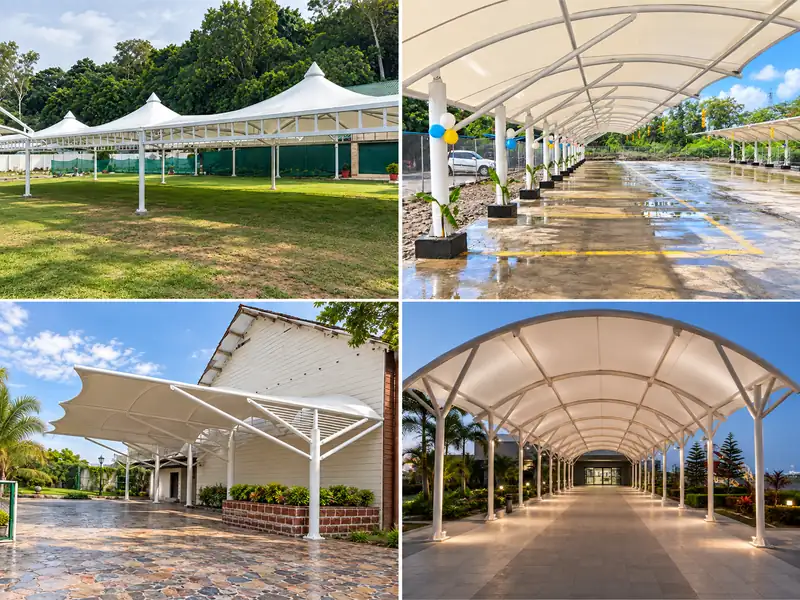
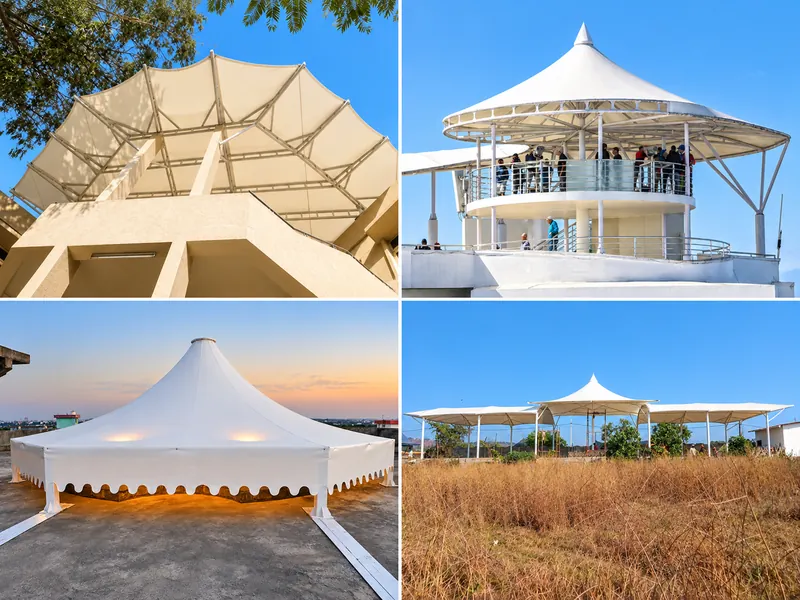
These references show tensile roofs we have built over lawns, terraces, entrances and parking areas. They help in choosing the frame layout and fabric shape for an opening roof; the rails and moving system of a retractable roof are designed separately for each project. View more ShadeCo India projects.
Service Availability Across India
ShadeCo India provides retractable tensile roof solutions across major cities and regions in India, including Delhi, Gurugram, Faridabad, Noida, Lucknow, Chandigarh, Ludhiana, Jaipur, Jodhpur, Shimla, Dehradun, Haridwar, Bhopal, Indore, Gandhinagar, Ahmedabad, Patna, Muzaffarpur, Mumbai, Pune, Bengaluru, Hyderabad, Chennai and Kochi, along with other locations based on project scope and site requirements.
Each roof is planned around the building, the size of the terrace or courtyard, local rainfall and wind, and the hours when work can be done without disturbing the restaurant, hotel or home. ShadeCo India can design, fabricate, supply and install retractable tensile roofs for restaurants, cafés, hotels, resorts, clubhouses, offices, farmhouses and residences.
Planning a Retractable Tensile Roof?
If you are planning an opening roof for a restaurant terrace, rooftop lounge, hotel courtyard, patio or balcony, ShadeCo India can advise on the roof type, opening direction, fabric and method of operation best suited to the space.
We request you to share the width and length of the area, the side towards which the roof should open, photographs of the site, any existing structure and the project location. Our team will review these details and recommend a retractable tensile roof that suits the space and the way it will be used.
You can reach us on +91-9873975818, by email at info@shadecoindia.com, or through our contact page.
FAQ
Frequently Asked Questions - Retractable Tensile Roof
A retractable tensile roof is a fabric roof that can be opened and closed. The fabric runs on guide rails fixed to a steel frame and folds or rolls back to one side, giving shade and rain cover when closed and open sky when open. It is used over terraces, restaurant seating, courtyards and patios.
The price is worked out for each project. It depends on the area to be covered, the opening distance, the number of bays, manual or motorised operation, the fabric grade, the frame, gutters, electrical work and the site location. ShadeCo India can quote once it has the roof size, site photos and location.
Yes, when it is fully closed and made with PVC or PVDF-coated fabric. The closed roof is sloped so water runs into gutters and downpipes. Rain blown in by strong wind can still enter from open sides, and the roof should not be opened or closed during a storm.
Yes. A retractable roof can be operated manually or by a motor, as per project requirement. Motorised operation is easier for larger roofs and roofs that are opened every day, while manual operation can suit smaller roofs.
In most cases, yes. The roof can be fixed to the wall or built on its own freestanding frame. ShadeCo India first checks the walls, slab and waterproofing, the drainage route and the space for the folded fabric before confirming the design.
The steel frame is expected to last 25–30 years with proper care. PVDF fabric comes with a warranty of up to 10 years, subject to the manufacturer's terms. Rails and moving parts should be cleaned and serviced periodically to keep the roof working smoothly.
No. In strong wind or a storm, the roof should be opened and stored as advised at handover, because a closed fabric roof catches the most wind. The frame and fixings are designed for the site wind load as per IS 875 (Part 3).
Delivery typically takes 3–6 weeks, depending on the size of the roof, the number of bays and the level of customization. This covers design approval, fabrication, installation and testing at site.
