
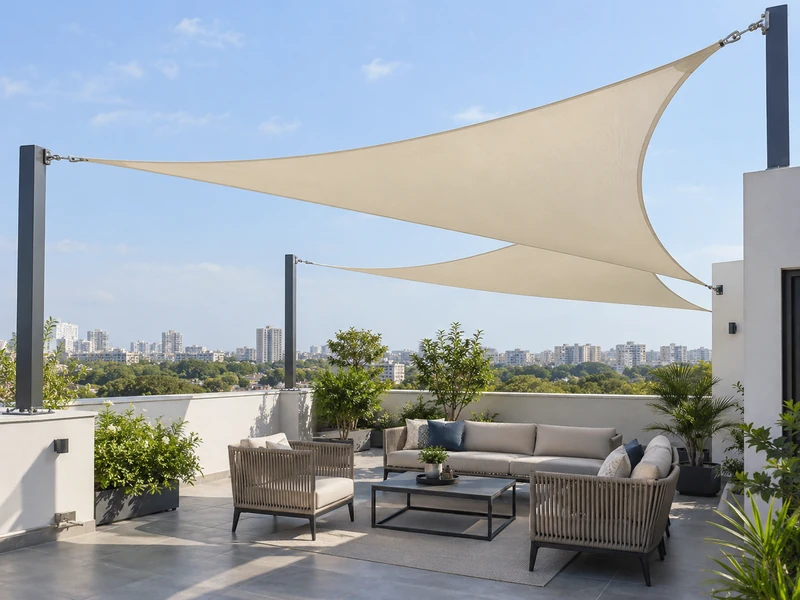
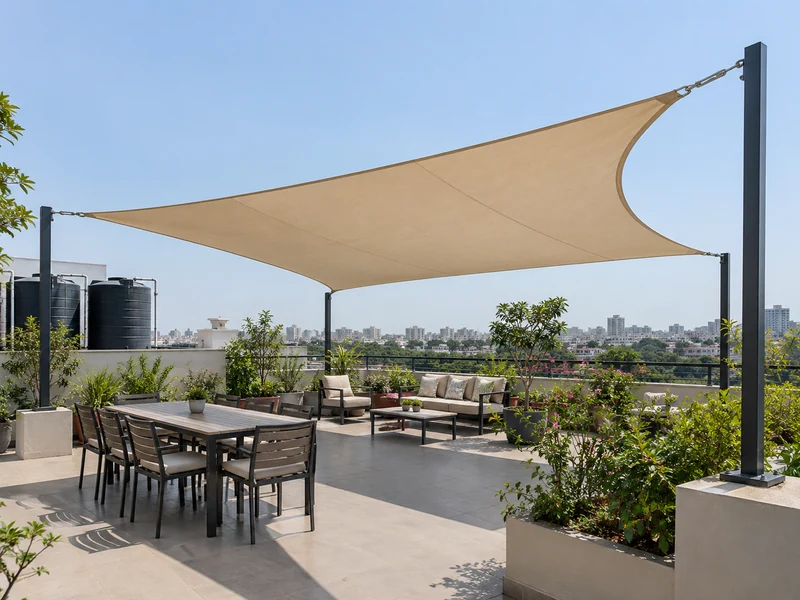
A terrace shade sail is a fabric sail fixed to posts on a roof slab or parapet to shade a rooftop terrace. It is also known as a rooftop shade sail, terrace sun sail, roof shade net sail or chhat shade sail. It is used on house terraces, apartment rooftops, roof gardens, rooftop cafés and office roofs.
ShadeCo India Private Limited is a terrace shade sail manufacturer and supplier in India. We design, fabricate, supply and install parapet-post sails, slab-mounted sails, stair-room wall sails, roof-garden sails and removable terrace sails. Breathable UV-stabilised HDPE suits most rooftops, while PVC-coated polyester is used where the terrace must stay dry.
The first check on any terrace is what the roof can carry. We find the beams, columns and strong parapet sections, and note the waterproofing and rain outlets. Fixings go only where the structure can take the corner load without harming the roof.
Terrace Shade Sail at a Glance
- Sail Shapes: Triangles, squares and twisted sails sized for rooftop corners and seating
- Fabric: Breathable HDPE that lets rooftop wind pass, or PVC-coated polyester for a dry terrace
- Posts and Fixings: Base-plate posts on beams or strong parapet sections, with stainless quick-release corners
- Surface Finish: Hot-dip galvanizing or powder coating for exposed roofs, with epoxy or automotive paint
- Suitable For: House terraces, apartment rooftops, roof gardens, rooftop cafés and office roofs
- Service Area: Rooftop sails planned and fitted across India
Why Choose a Terrace Shade Sail
A terrace shade sail turns a sun-baked roof into a usable space with very little added weight. Terraces take full sun all day, so most stay empty until late evening. A sail gives shade for morning tea, yoga, drying clothes or evening gatherings.
Sails are light and need only a few fixing points, which suits roofs that cannot take a heavy structure. They can also be unclipped before strong winds and refitted later. For many homes, this is the simplest way to use the roof more often.
Types of Terrace Shade Sails
The right terrace sail depends on the roof structure, the parapet and where you want to sit.
Parapet-Post Sail
Short posts fixed to strong parapet sections hold the sail corners. It keeps the middle of the terrace free for seating.
Slab-Mounted Sail
Base-plate posts fix over beams or columns on the roof slab. It allows a sail anywhere on a large terrace.
Stair-Room Wall Sail
High corners fix to the stair-room or lift-room wall, and low corners go to posts. It shades seating right outside the terrace door.
Roof-Garden Sail
A breathable HDPE sail shades planters and a small seating area while letting air and some light reach the plants.
Removable Terrace Sail
Quick-release corners let the sail come down before storms or in winter. Posts stay in place for refitting. For a fixed rooftop roof instead, see our terrace tensile structures.
Terrace Shade Sail Design: Fixing Points, Slope and Tension
Every base plate sits over a beam or column, not in the middle of a slab panel. We use chemical anchors and seal each fixing back into the roof waterproofing. Parapet posts are fixed only where the parapet is strong enough for the corner pull.
Wind is stronger on a roof than at ground level and rises at the building edge. We design for the building's height and exposure as per IS 875 (Part 3). Breathable HDPE is often preferred, because it lets some wind through and puts less load on the fixings.
Rain from a PVC sail is led to existing roof outlets without blocking them. Water tanks, solar panels and lift rooms stay outside the sail, with clear access. Tension is set firmly and re-checked after the first few weeks.
Technical Specifications
These details are a general guide for homeowners, apartment societies and rooftop café owners. The final fixing points, fabric and layout are confirmed after we inspect the roof.
Shade Sail Specifications
| Specification | Details |
|---|---|
| Sail Shapes | Triangle, square, rectangle or twisted sails for rooftop seating |
| Fabric Options | UV-stabilised HDPE shade fabric (breathable) or PVC-coated polyester (waterproof) |
| Edges | Catenary edges reinforced with webbing or edge cable |
| Corner Hardware | Stainless steel D-rings, turnbuckles, shackles and pad eyes, with quick-release options |
| Support Posts | Mild steel or galvanized steel base-plate posts over beams, columns or strong parapets |
| Surface Finish | Automotive paint, epoxy paint, powder coating or hot-dip galvanizing |
| Wall Fixings | Pad eyes on stair-room or parapet walls only at structurally suitable points |
| Foundation | Base plates with chemical anchors over beams, resealed into roof waterproofing |
| Slope and Drainage | Firm tension for rooftop wind; PVC runoff led to existing roof outlets |
| Colours | White, ivory, sand and a range of bright and neutral colours |
| UV Protection | Up to 98% UV blocking, depending on the fabric |
| Wind Load Design | Designed for building height and rooftop exposure as per IS 875 (Part 3) |
Key Features
| Feature | Details |
|---|---|
| Light on the Roof | Adds very little load to the building |
| UV-Stabilised Fabric | Made for the full-day sun on a rooftop |
| Breathable HDPE | Lets rooftop wind pass, easing load on fixings |
| Catenary Edges | Curved edges stay tight in gusty rooftop wind |
| Stainless Steel Hardware | Quick-release corners for taking the sail down |
| Sealed Roof Fixings | Anchors resealed into the waterproofing to stop leaks |
| Adjustable Tension | Turnbuckles keep the sail firm against wind |
| Wind-Checked Design | Designed for rooftop height as per IS 875 (Part 3) |
Benefits of Terrace Shade Sails
A terrace sail adds shade to your roof without adding a heavy structure.
- Usable Rooftop: Sit, dine or exercise on the terrace through the day.
- Cooler Top Floor: Shade on the roof slab can reduce heat in rooms below.
- Light Load: Suits roofs that cannot carry a framed structure.
- No Leaks: Fixings are sealed into the waterproofing.
- Removable: Sails can come down before storms.
- Low Cost: Far cheaper than a rooftop roof or shed.
Applications of Terrace Shade Sails
Homeowners shade terrace seating, drying areas and yoga spaces. Apartment societies shade common rooftops for gatherings. For lighter, breathable options, see our HDPE shade sails.
Rooftop cafés and restaurants use sails over tables for daytime service. Offices shade roof break areas, and hotels use sails over rooftop lounges. Roof gardens use HDPE sails to protect plants from the harshest sun.
Terrace Shade Sail Price in India: What Affects the Cost
The cost of a terrace shade sail depends mainly on the area shaded and the number of fixing points. Using the stair-room wall or strong parapets reduces the number of posts.
Base plates, chemical anchors and resealing the waterproofing are part of every rooftop job. Fabric type, post height, quick-release hardware and lifting material to the roof also affect the figure.
For a quotation, share terrace photos, the area to shade, the number of floors in the building and the location.
How We Plan and Install a Terrace Shade Sail
A terrace sail sits on a roof that keeps your home dry, so protecting the roof is part of every step.
- Step 1 – Site visit: We inspect the terrace, locate beams, columns, outlets, tanks and panels, and check the waterproofing and parapet.
- Step 2 – Layout: We propose sail shapes, fixing points and fabric, keeping service access to tanks and panels clear.
- Step 3 – Structural check: Fixings and posts are checked for corner loads and rooftop wind as per IS 875 (Part 3).
- Step 4 – Posts and foundations: Base-plate posts are anchored over beams or strong parapets, and every fixing is resealed into the waterproofing.
- Step 5 – Final measurement and fabrication: Each sail is measured between the installed fixings and made with quick-release corners where needed.
- Step 6 – Tensioning and handover: We tension the sails, test the outlets, show you how to take them down, and re-check tension after a few weeks.
Terrace Shade Sail Design and Installation Solutions
ShadeCo India installs terrace sails for houses, apartment rooftops, cafés and offices. Our team fixes every corner safely to the roof structure and seals it, so the terrace gets shade without leaks.
Why Work with ShadeCo India
ShadeCo India, set up in 2010, has more than 15 years of experience in fabric shade and tensile structures and is ISO 9001:2015 certified. Our in-house installers do the anchoring and resealing themselves, which matters on a roof.
Over the years we have worked for Delhi Public School, Food Corporation of India, L&T, TATA, Adani, Al-Karim University, Indian Oil, Omaxe, VIVO, Lakhani, Indian Railways and Reliance. Many other organizations across India are also our clients.
On every rooftop sail, we check anchor seals, outlet flow and quick-release fittings before handover. Terrace sails usually reach completion within 3–6 weeks, depending on layout and customization.
Explore Our Shade Sail Projects
ShadeCo India's projects page covers fabric structures across India, from hospital atrium roofs to entrance and event canopies. Several were built on or around existing buildings, where structure and waterproofing had to be respected.
That experience carries over to rooftops. On the projects page you can see how we fix steel to existing structures neatly and how our fabric finishes look from above and below.
Take a look at our projects, then share terrace photos with us. We will suggest fixing points that protect your roof and a sail that suits your terrace.
Service Availability Across India
ShadeCo India provides terrace shade sail solutions across major cities and regions in India. Rooftop sail work is carried out in Delhi, Gurugram, Faridabad, Noida, Lucknow, Chandigarh, Ludhiana, Jaipur, Jodhpur, Shimla, Dehradun, Haridwar, Bhopal, Indore, Gandhinagar, Ahmedabad, Patna, Muzaffarpur, Mumbai, Pune, Bengaluru, Hyderabad, Chennai and Kochi. Other towns are covered as per project scope and site requirements.
Each terrace sail is planned around building height, local wind and monsoon rain. In apartment buildings, we plan material lifting and drilling with the society to limit disturbance.
Planning a Terrace Shade Sail?
If you want shade on a house terrace, apartment rooftop or rooftop café, ShadeCo India can advise on safe fixing points, fabric and layout.
We request you to share terrace photographs, the area you want shaded and the number of floors in the building. Sharing the city helps our team plan rooftop wind and access.
Please contact us at +91-9873975818, by email at info@shadecoindia.com, or via our contact page.
FAQ
Frequently Asked Questions - Terrace Shade Sail
A terrace shade sail is a rooftop shade made of tensioned fabric, anchored over beams or strong parapets. It adds very little load to the building. Sails can be taken down before strong winds.
Price depends on the shaded area, fixing points, base plates, resealing, fabric and lifting work. Using strong walls and parapets reduces posts. ShadeCo India quotes after seeing terrace photos and knowing the floor count.
Breathable HDPE is often best on rooftops, as it lets wind through and costs less. PVC-coated polyester suits terraces that must stay dry. Both cut UV by up to 98%, depending on the fabric.
Yes, when designed for the building height and exposure as per IS 875 (Part 3). Fixings go over beams or strong parapets and are tensioned firmly. Sails can also be unclipped before storms.
On a rooftop, firm tension and taking the sail down before storms make the biggest difference. Stainless corners and galvanized or painted posts stand up to open-roof weather. Regular cleaning removes dust that builds up on roofs.
Not when done properly. We fix only over beams or columns, use chemical anchors and reseal every fixing into the waterproofing. Rain outlets are kept clear.
A terrace sail is usually ready in 3–6 weeks, depending on layout and design. Rooftop work is short, with material lifted in small parts.
Yes. Quick-release stainless corners let the sail come down easily. Posts stay fixed, so the sail can be refitted in minutes when needed.
