
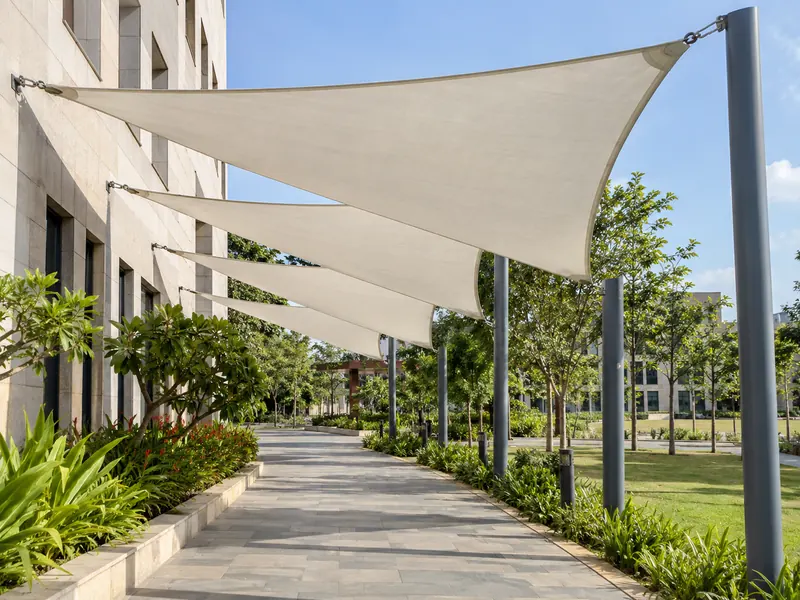
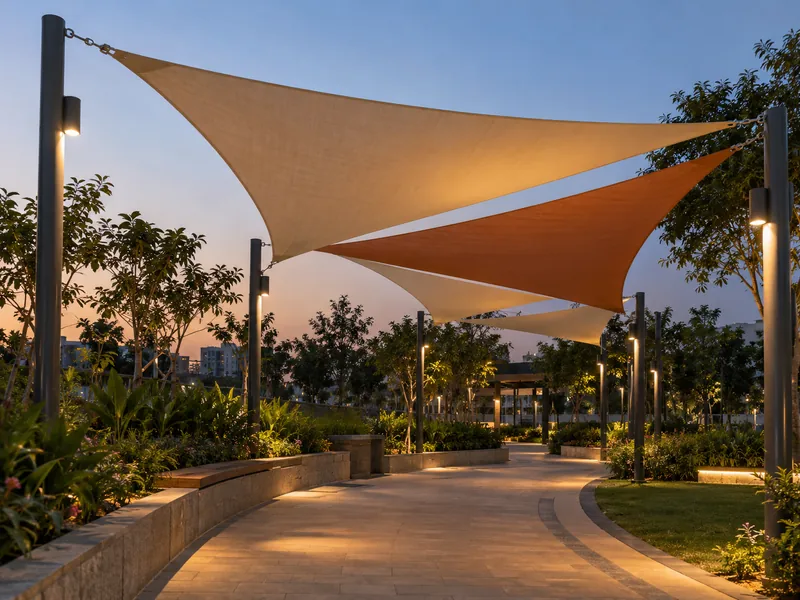
A walkway shade sail is one of a series of fabric sails fixed along a footpath to give shaded stretches without building a full roof. It is also known as a pathway shade sail, footpath sun sail, walkway shade net or trail shade sail. It is used on campus walkways, park trails, hospital paths, township footpaths, resort walks and parking-to-entrance routes.
ShadeCo India Private Limited is a walkway shade sail manufacturer and supplier in India. We design, fabricate, supply and install staggered sail rows, one-side post walkways, overlapping triangle sequences, path-crossing sails and seating-stop sails. Most walkway sails use breathable UV-stabilised HDPE, with PVC-coated polyester at stops where people wait.
Planning starts with the route itself. We walk the path, measure its width and mark bends, junctions and vehicle crossings. Posts then go along one or both sides, so the walking width stays fully clear.
Walkway Shade Sail at a Glance
- Sail Shapes: Staggered rectangles and overlapping triangles that follow straight runs and bends
- Fabric: Breathable HDPE for shade along the route, or PVC-coated polyester at waiting stops
- Posts and Fixings: Posts in a line along one or both path edges, joined by stainless corner hardware
- Surface Finish: Hot-dip galvanizing or powder coating for long outdoor runs, with epoxy or automotive paint
- Suitable For: Campus walkways, park trails, hospital paths, township footpaths and resort walks
- Service Area: Pathway sails installed across India
Why Choose a Walkway Shade Sail
A walkway shade sail gives people walking a long route regular patches of shade, at a fraction of the cost of a covered walkway. On open campuses and parks, the walk between buildings can be long and hot. Sails break that route into shaded sections.
Because sails share posts and need no roof frame, they are quick to install and easy to extend later. They also look light and modern along a path. Where rain cover is not essential, they are the most budget-friendly way to shade a route.
Layouts of Walkway Shade Sails
The right walkway layout depends on the path width, its bends and how much of the route needs shade.
Staggered Sail Row
Rectangular sails are set one after another, alternating high and low. The staggering keeps each sail tight and gives a rhythmic look along the path.
One-Side Post Walkway
All posts stand on one side of the path, with the sails reaching across. The other edge stays completely open for people and cycles.
Overlapping Triangle Sequence
Triangles overlap along the route, following curves and bends easily. This layout suits winding park trails.
Path-Crossing Sail
A single sail spans a junction or plaza where paths meet, giving a shaded resting point.
Seating-Stop Sail
A PVC sail covers benches or a bus stop along the walk, so people can wait out a shower. For continuous rain cover, see our walkway tensile structures.
Walkway Shade Sail Design: Fixing Points, Slope and Tension
Posts are set in a straight line along the path edge, with shared posts carrying the corners of two sails. This keeps the number of posts low. The path width stays fully clear for walkers, wheelchairs and cycles.
Sails alternate in height so each one has slope and twist to stay tight. Their lowest edges stay well above head height. At bends, sail shapes change to follow the curve instead of leaving gaps.
Where the route crosses a driveway, posts stand back from the road edge and sails rise higher for vehicles. Lights can be fixed to posts for evening use. Each sail is measured after the posts are set, and tension is re-checked after a few weeks.
Technical Specifications
These details are a general guide for campus planners, park authorities and township developers. The final route layout, heights and fabric are confirmed after we walk the path.
Shade Sail Specifications
| Specification | Details |
|---|---|
| Sail Shapes | Staggered rectangles, overlapping triangles and path-crossing sails |
| Fabric Options | UV-stabilised HDPE shade fabric (breathable) or PVC-coated polyester at stops |
| Edges | Catenary edges reinforced with webbing or edge cable |
| Corner Hardware | Stainless steel D-rings, turnbuckles, shackles and pad eyes |
| Support Posts | Mild steel or galvanized steel posts along one or both path edges, shared between sails |
| Surface Finish | Automotive paint, epoxy paint, powder coating or hot-dip galvanizing |
| Wall Fixings | Pad eyes on building walls at path ends only at structurally suitable points |
| Foundation | RCC footings designed for site soil and load, set beside the paving |
| Slope and Drainage | Alternating heights for slope and twist; HDPE lets rain pass |
| Colours | White, ivory, sand and a range of bright and neutral colours |
| UV Protection | Up to 98% UV blocking, depending on the fabric |
| Wind Load Design | Posts and footings checked for wind as per IS 875 (Part 3) |
Key Features
| Feature | Details |
|---|---|
| Shade Along the Route | Regular shaded stretches on long, open paths |
| UV-Stabilised Fabric | Made for all-day sun on campuses and parks |
| Breathable HDPE | Air moves freely, so paths stay cool |
| Catenary Edges | Tight curved edges look neat in a long row |
| Stainless Steel Hardware | Corner fittings resist rust along exposed routes |
| Shared Posts | One post carries two sails, keeping steel and cost low |
| Clear Walking Width | Posts stand at the path edge, never on it |
| Easy to Extend | More sails can be added as the route grows |
Benefits of Walkway Shade Sails
Walkway sails make long walks cooler without the cost of a covered walkway.
- Cooler Walks: Regular shade on long, open routes.
- Budget-Friendly: Far less steel than a framed walkway roof.
- Fast to Install: Posts and sails go up quickly along the path.
- Follows Any Route: Triangles and staggered sails handle bends.
- Clear Paths: Posts stay at the edges, leaving the full width open.
- Easy to Add On: Extend the row as campuses and parks grow.
Applications of Walkway Shade Sails
Colleges and schools shade walkways between classrooms, hostels and canteens. Hospitals shade paths from parking to OPD entrances. For roofs that also keep rain off, see our covered corridor tensile structures.
Parks and townships shade jogging tracks and walking trails. Resorts use sails along routes between cottages, pools and dining. Offices and IT parks shade walks from parking to the main building.
Walkway Shade Sail Price in India: What Affects the Cost
The cost of a walkway shade sail project depends mainly on the length of the route and how many sails and posts it needs. Shared posts between sails keep the cost per metre low.
Fabric type, post height at vehicle crossings, RCC footings, lighting on posts and colours affect the figure. HDPE is the economical choice for most routes, with PVC used only at stops.
For a quotation, share the path length and width, photos of the route, any road crossings and the location.
How We Plan and Install a Walkway Shade Sail
A walkway is in daily use, so we work section by section and keep the route open.
- Step 1 – Site visit: We walk the route, measure length and width, and mark bends, junctions, crossings and services.
- Step 2 – Layout: We propose the sail pattern, post spacing, heights and colours along the path.
- Step 3 – Structural check: Posts and footings are checked for shared corner loads and the site wind load as per IS 875 (Part 3).
- Step 4 – Posts and foundations: Posts are set on RCC footings beside the paving, one section at a time.
- Step 5 – Final measurement and fabrication: Sails are measured between the installed posts and made in order along the route.
- Step 6 – Tensioning and handover: We fit and tension the sails section by section, then re-check tension after a few weeks.
Walkway Shade Sail Design and Installation Solutions
ShadeCo India installs walkway sails for campuses, hospitals, parks and townships. Our team plans posts and sail patterns along each route, so walkers get shade and the path stays clear.
Why Work with ShadeCo India
Founded in 2010, ShadeCo India has more than 15 years of experience with shade and tensile structures and holds ISO 9001:2015 certification. Our in-house teams install long runs in sections, keeping paths open for users.
Campuses and companies such as Delhi Public School, Al-Karim University, Food Corporation of India, L&T, TATA, Adani, Indian Oil, Omaxe, VIVO, Lakhani, Indian Railways and Reliance have worked with us. So have several other organizations across India.
Before handover, we check post alignment, sail heights and tension along the whole route. A walkway sail project is generally delivered in 3–6 weeks, depending on route length and customization.
Explore Our Shade Sail Projects
Long, continuous structures feature on our projects page, including curved parking canopies running along site boundaries. ShadeCo India also lists entrance and event canopies built for schools, hospitals and industry.
For a walkway sail, those long runs show how we keep posts aligned and spacing even over a distance. The finishes on each project also show how our steel and fabric look along an open route.
View our project list, then send us the length and photos of your path. We will plan a sail sequence that shades it at a sensible cost.
Service Availability Across India
ShadeCo India provides walkway shade sail solutions across major cities and regions in India. Route shading projects are undertaken in Delhi, Gurugram, Faridabad, Noida, Lucknow, Chandigarh, Ludhiana, Jaipur, Jodhpur, Shimla, Dehradun, Haridwar, Bhopal, Indore, Gandhinagar, Ahmedabad, Patna, Muzaffarpur, Mumbai, Pune, Bengaluru, Hyderabad, Chennai and Kochi. Other cities are included based on project scope and site requirements.
Each walkway layout is planned around local sun direction, wind and how busy the path is. We work in sections and use barricades, so people can keep using the route.
Planning a Walkway Shade Sail?
If you want to shade a campus path, park trail or hospital walkway, ShadeCo India can advise on sail patterns, post spacing and fabric.
We request you to share the path length and width, route photographs and any road crossings. Knowing the city also helps our team plan the sail sequence.
To discuss your route, call +91-9873975818, email info@shadecoindia.com or visit our contact page.
FAQ
Frequently Asked Questions - Walkway Shade Sail
A walkway shade sail is part of a row of fabric sails that shades a footpath in sections. Posts run along the path edges, and sails reach across the route. It is a low-cost way to cool long walks.
Walkway sails are priced by route length, number of sails and posts, fabric and crossings. Shared posts keep the cost per metre low. ShadeCo India quotes from path length, photos and location.
Breathable HDPE is best for most walkways, as it keeps paths cool and costs less. PVC-coated polyester is used over benches or stops where people wait in rain. Either can block up to 98% of UV over walkers, depending on the fabric.
HDPE sails let rain through and give shade only. The row of posts and footings is designed for the site wind load as per IS 875 (Part 3). For full rain cover, a framed walkway roof is the better choice.
Long outdoor runs last best with firm tension and occasional cleaning. Stainless fittings and galvanized posts resist weather along open routes. Individual sails can be replaced without changing the posts.
Spacing depends on the sail sizes and the path layout. Shared posts carry two sails each, which keeps the count low. We set spacing after walking the route.
Walkway projects are usually delivered in 3–6 weeks, depending on route length and design. Site work runs in sections to keep the path open.
Sails are better for low-cost shade along long routes. A walkway tensile structure is better when the path needs continuous rain cover, such as between hospital blocks.
