
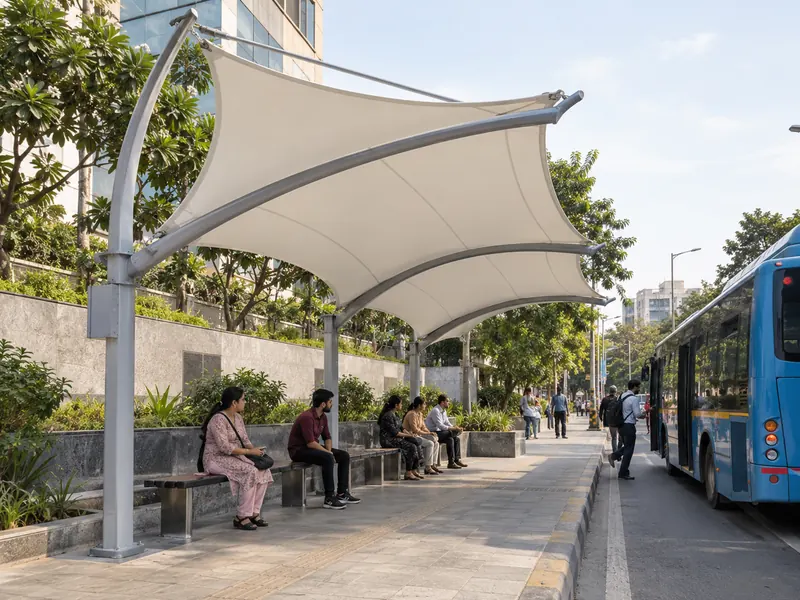
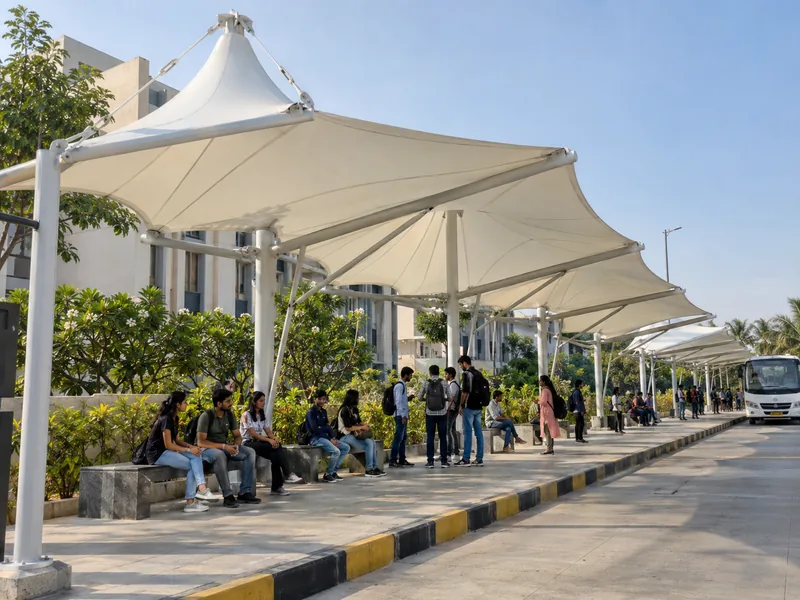
A bus stop tensile shelter is a fabric-roofed shelter on a steel frame where passengers wait for buses in shade and out of the rain. It is also known as a bus shelter canopy, bus queue shelter, tensile bus stand or bus bay shade. It is used on city roads, BRTS corridors, smart city streets, college and school campuses, industrial estates and corporate parks.
ShadeCo India Private Limited is a bus stop tensile shelter manufacturer and supplier in India. We design, fabricate, supply and install cantilever bus shelters, two-post canopy shelters, arched bus shelters, shelters with back and side panels and multi-bay campus bus canopies. Fabric is chosen from PVC, PVDF and PTFE-coated fabric for rain cover, or HDPE shade net for shade only.
Planning starts at the kerb. We check the footpath width, the bus stopping position and how far bus mirrors and doors swing over the kerb. Then we place the shelter so passengers can wait, sit and board without blocking people walking past.
Bus Stop Tensile Shelter at a Glance
- Structure Types: Cantilever, two-post, arched, panelled and multi-bay campus bus shelters
- Fabric: PVC, PVDF or PTFE-coated fabric for monsoon cover, or HDPE shade net for shade-only stops
- Frame Material: Mild steel (MS) or galvanized steel (GI) posts and arms with tamper-resistant fixings
- Surface Finish: Hot-dip galvanizing for roadside exposure, finished in powder coating, epoxy or automotive paint
- Suitable For: City roads, BRTS corridors, smart city streets, campuses, industrial estates and corporate parks
- Service Area: Bus shelters designed, supplied and installed across India
Why Choose a Bus Stop Tensile Shelter
A bus stop tensile shelter gives passengers shade and rain cover while they wait, which can be a long time on busy routes. Open stops leave elderly people, students and office workers standing in sun or rain. A shelter with seating makes public transport more comfortable to use.
Fabric shelters are light, quick to install and easy to shape. Cities and campuses can give every stop a common look, with fabric colours that match the route or brand. The slim frame also keeps footpaths open for pedestrians and wheelchairs.
Types of Bus Stop Tensile Shelters
The right bus shelter depends on the footpath width, the number of passengers and how exposed the stop is to wind and slanting rain.
Cantilever Bus Shelter
Posts stand at the back of the footpath, and the roof reaches toward the kerb. The front stays open for boarding and the kerb edge is free of posts. It suits narrow city footpaths.
Two-Post Canopy Shelter
A simple roof on two posts covers a bench and waiting area. It is quick to install and suits campuses, colony gates and low-traffic routes.
Arched Bus Shelter
A curved roof gives height in the middle and sheds rain to both sides. It looks modern on smart city streets and BRTS stations.
Panelled Bus Shelter
Back and side panels in fabric, mesh or sheet block slanting rain and wind. Route maps, timetables and advertising boards can fit into the panels.
Multi-Bay Campus Bus Canopy
A long canopy covers several bus bays at a college, factory or corporate park. For covered paths from the bus bay to buildings, see our walkway tensile structures.
Custom Bus Shelter Design: Kerb Clearance, Footpath Space and Vandal-Resistant Details
Buses lean and swing their mirrors over the kerb when they stop. We keep the roof edge and posts back from the kerb line, so mirrors and doors pass freely. The roof still reaches far enough to cover passengers stepping in.
A shelter must not block the footpath. We leave a clear walking path behind or in front of the seating, wide enough for wheelchairs and prams. Seating is placed so waiting passengers can see buses arriving.
Public shelters face rough use. We use tamper-resistant bolts, hidden anchors and fabric edges set out of reach. Lighting, route boards and CCTV points are planned on the frame for safety at night.
Technical Specifications
These details are a general guide for municipal bodies, smart city agencies, campuses and corporate parks. The final size, panels and fabric are confirmed after we see the stop and its passenger load.
Structural & Fabric Specifications
| Specification | Details |
|---|---|
| Structure Types | Cantilever, Two-Post, Arched, Panelled, Multi-Bay or Custom |
| Frame Material | Mild Steel (MS) or Galvanized Steel (GI) posts, arms and seating frames |
| Surface Finish | Automotive Paint, Epoxy Paint, Powder Coating or Hot-Dip Galvanizing |
| Kerb Clearance | Roof edge and posts kept clear of bus mirrors and doors |
| Vandal-Resistant Details | Tamper-resistant bolts, hidden anchors and fabric out of reach |
| Fabric Types | PVC-Coated Polyester, PVDF-Coated Polyester, PTFE-Coated Glass Fibre or HDPE Shade Net |
| Fabric Weight | 750 – 900 GSM coated fabric for street shelters; heavier grades for long campus bays |
| Rain Protection | Waterproof with PVC, PVDF or PTFE; side panels for slanting rain; HDPE gives shade only |
| UV Protection | Up to 98% UV blocking, depending on the fabric |
| Temperature Resistance | −30°C to +70°C |
| Size and Height | Set by footpath width, passenger numbers and bus type (Customizable) |
| Add-Ons | Provision for Lighting, Seating, Route Boards and CCTV |
| Wind Load Design | Posts, arms and footings designed as per IS 875 (Part 3) |
| Fabric Warranty | Up to 10 years on PVDF fabric, subject to manufacturer's terms |
Key Features
| Feature | Details |
|---|---|
| Waterproof PVC / PVDF / PTFE Fabric | Keeps waiting passengers and seats dry in the monsoon |
| UV-Resistant Coating | Blocks up to 98% of UV rays, depending on the fabric, during long waits |
| Anti-Wicking Fabric | Sealed edges stop rain wicking into the fabric near the kerb |
| Fungicide Finish | Limits mould on shelters under trees and near open drains |
| Moisture and Corrosion Resistant | Galvanized posts resist rust from road splash and dust |
| Dirt-Resistant Top Coat | PVDF top coat helps the shelter shed traffic dust and soot |
| Flame-Retardant Grade Available | FR-grade fabric on request for public transport projects |
| All-Weather Performance | Posts and footings designed for site wind loads as per IS 875 (Part 3) |
Benefits of Bus Stop Tensile Shelters
Good bus shelters make public transport easier and more pleasant to use every day.
- Comfortable Waiting: Passengers sit in shade and stay dry while they wait.
- Clear Footpaths: Slim posts and smart placement keep walking routes open.
- Safe Boarding: Roof edges and posts stay clear of bus mirrors and doors.
- Common City Look: Fabric colours and shapes can be repeated across a route.
- Fast Installation: Shop-made parts reduce work time on busy roads.
- Safe at Night: Built-in lighting and CCTV points improve passenger safety.
Applications of Bus Stop Tensile Shelters
Municipal corporations and smart city agencies use tensile bus shelters along main roads and BRTS corridors. Transport departments use them at depots and bus terminals. For one-sided roofs over long waiting areas, see our cantilever shade structures.
Colleges, schools and universities cover campus bus bays where students wait before and after classes. Factories, industrial estates and IT parks shade staff bus pick-up points. Housing townships add shelters at colony gates for residents.
Bus Stop Tensile Shelter Price in India: What Affects the Cost
The cost of a bus stop tensile shelter depends mainly on the shelter size and type. A single two-post shelter costs much less than a long multi-bay campus canopy.
Fabric type, panels, seating, lighting, route boards and the finish system change the figure. HDPE is the budget fabric for bus shelters, and PTFE the top-cost option. Ordering many identical shelters for one route lowers the cost per stop.
For a quotation, share the number of shelters, footpath photos, the passenger numbers expected, any panels or boards needed and the location.
How We Design and Install a Bus Stop Tensile Shelter
Bus stops sit on live roads, so we plan for quick, safe installation with little disruption.
- Step 1 – Site survey: We measure the footpath and kerb, note the bus stopping point and check drains, cables and trees.
- Step 2 – Layout and drawings: We propose the shelter type, size, seating and colours, with clearances to the kerb and footpath.
- Step 3 – Engineering: Posts, arms and footings are designed for the site wind load as per IS 875 (Part 3).
- Step 4 – Fabrication: Shelters are fabricated and finished in our workshop in identical kits for each route or campus.
- Step 5 – Installation: Footings are cast with barricades in place, then posts, roof, panels and seating are fixed quickly.
- Step 6 – Handover: We check clearances, bolts and lighting, and give a simple inspection list to the owner.
Bus Stop Tensile Shelter Design and Installation Solutions
ShadeCo India builds bus shelters for city roads, transport agencies, campuses and corporate parks. Our team plans each shelter around buses, passengers and pedestrians, so the stop works well for everyone.
Why Work with ShadeCo India
Since its founding in 2010, ShadeCo India has gained more than 15 years of tensile structure experience and is ISO 9001:2015 certified. Engineers, fabricators and installers all belong to our own team, which helps when many identical shelters must be made and fitted.
We have served Delhi Public School, Food Corporation of India, L&T, TATA, Adani, Al-Karim University, Indian Oil, Omaxe, VIVO, Lakhani, Indian Railways and Reliance. Several other organizations across India are also part of our client base.
On every shelter, we check kerb clearance, fixing security and lighting before handover. Delivery typically takes 3–6 weeks, depending on the number of shelters and customization.
Related options include our toll plaza tensile canopies, awnings and canopies and the full range of tensile structures.
Explore Our Projects & Design References
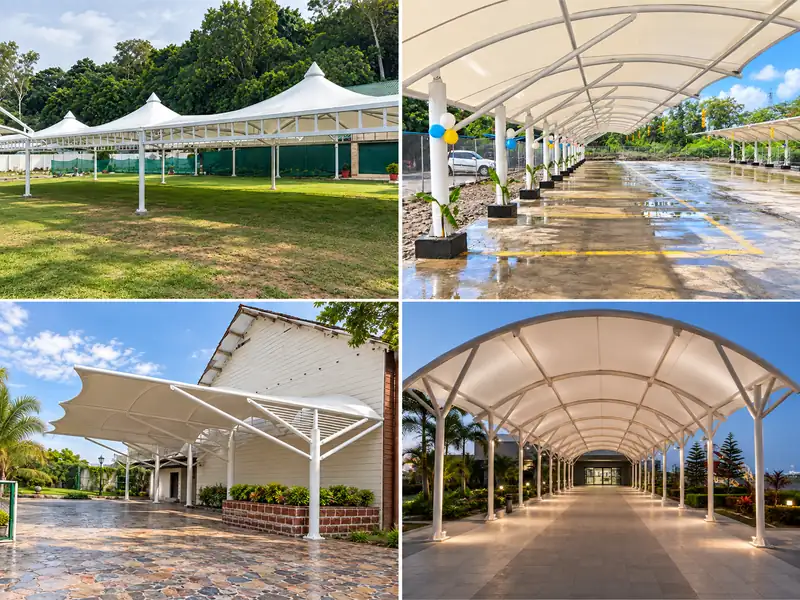
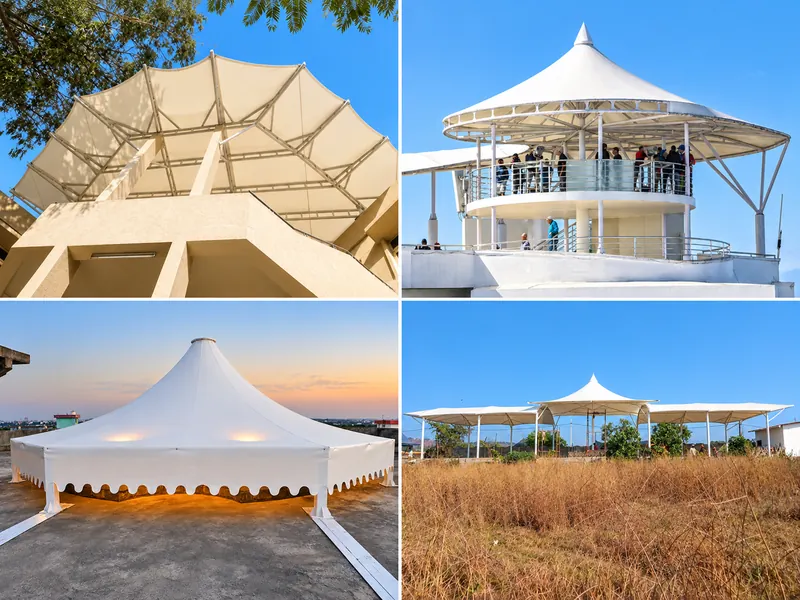
The images below show our canopies over entrances, parking, lawns and terraces. They help when choosing fabric colours and post finishes for bus shelters, while each shelter is sized for its own stop. View more ShadeCo India projects.
Service Availability Across India
ShadeCo India provides bus stop tensile shelter solutions across major cities and regions in India. Shelter projects are possible in Delhi, Gurugram, Faridabad, Noida, Lucknow, Chandigarh, Ludhiana, Jaipur, Jodhpur, Shimla, Dehradun, Haridwar, Bhopal, Indore, Gandhinagar, Ahmedabad, Patna, Muzaffarpur, Mumbai, Pune, Bengaluru, Hyderabad, Chennai and Kochi. Other towns and routes are taken up based on project scope and site requirements.
Each shelter is planned around local rain, wind and traffic on the road. We work in barricaded zones and off-peak hours, agreed with the traffic police or the campus.
Planning a Bus Stop Tensile Shelter?
If you are planning bus shelters for a city route, BRTS corridor, campus or corporate park, ShadeCo India can advise on shelter type, size and fabric.
We request you to share the number of shelters, footpath photographs, expected passenger numbers and any panels or boards required. Please also mention the location, so our team can propose a suitable design.
You can call +91-9873975818, email info@shadecoindia.com, or send your requirements through our contact page.
FAQ
Frequently Asked Questions - Bus Stop Tensile Shelter
A bus stop tensile shelter is a waiting shelter with a fabric roof on a steel frame. It gives passengers shade and rain cover, often with seating and route boards. Cities, campuses and corporate parks use it.
The cost depends on size, type, fabric, panels, seating and lighting. HDPE gives the lowest cost and PTFE the highest. Ordering many shelters together lowers the cost per stop, and ShadeCo India quotes on the full list.
PVC or PVDF-coated fabric is best for monsoon cover, and PVDF resists traffic dust better. PTFE suits flagship smart city shelters. HDPE suits campus stops that need shade only.
The coated fabric roof keeps rain off, and back or side panels stop slanting rain. Posts and footings follow the site wind load as per IS 875 (Part 3).
With routine checks, a galvanized bus shelter frame is expected to last 25–30 years. Shelter fabric in PVDF is under warranty for up to 10 years, subject to the manufacturer's terms.
Size depends on the footpath width and the number of people waiting at peak times. Campus bus bays may need long multi-bay canopies. We confirm the size after a site visit.
Shelters are made in our workshop and fitted quickly on site. A shelter order is usually delivered in 3–6 weeks, depending on quantity and design.
Yes. Back or side panels can hold advertising, route maps and timetables. We plan their size and fixing points in the frame, along with lighting if needed.
