
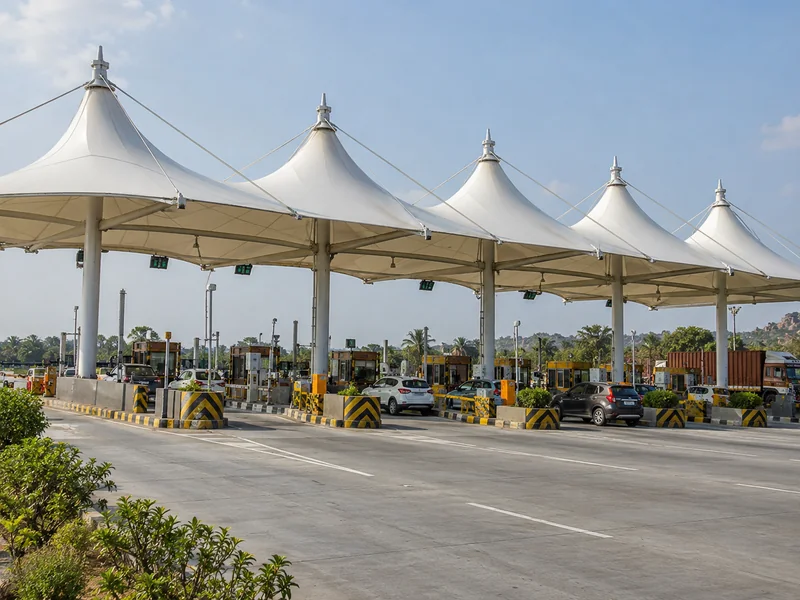
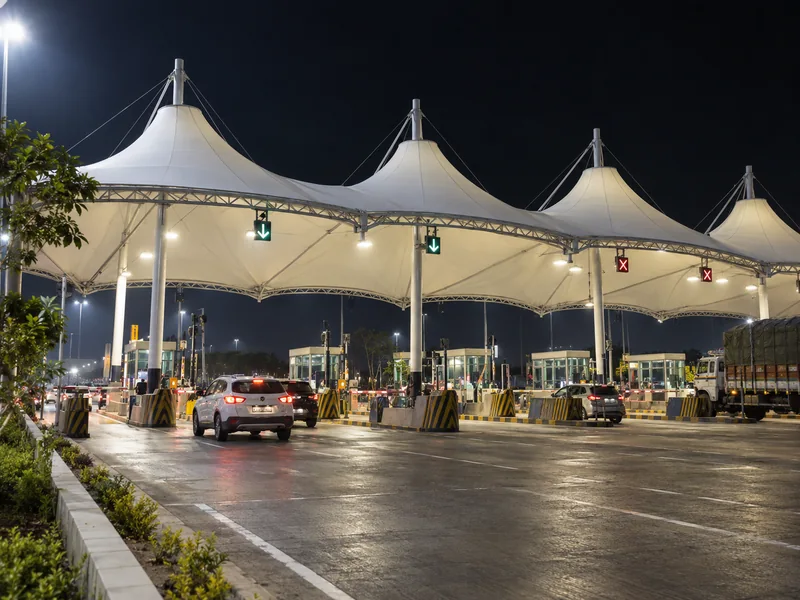
A toll plaza tensile canopy is a fabric roof over highway toll lanes and booths that shelters vehicles, toll staff and equipment from sun and rain. It is also known as a toll booth canopy, toll gate shade, toll lane membrane roof or highway toll canopy. It is used at national and state highway toll plazas, expressway entry points, bridge tolls and city entry gates.
ShadeCo India Private Limited is a toll plaza tensile canopy manufacturer and supplier in India. We design, fabricate, supply and install lane-island column canopies, full-width spans over all lanes, multi-cone landmark canopies, arched toll roofs and booth cantilever shades. Fabric options are PVC, PVDF and PTFE-coated fabric for rain cover, and HDPE shade net where only shade is needed.
Planning starts with the lane layout and the tallest vehicles that will pass. We record lane widths, island positions, booth sizes and the oversize lane for heavy trucks. Then we map the cameras, readers, barriers and signs that must fix to or stay clear of the canopy.
Toll Plaza Tensile Canopy at a Glance
- Structure Types: Lane-island column canopies, full-width spans, multi-cone, arched and booth cantilever canopies
- Fabric: PVC, PVDF or PTFE-coated fabric for all-weather lane cover, or HDPE shade net for booth shade only
- Frame Material: Mild steel (MS) or galvanized steel (GI) columns on lane islands with trusses or arches over lanes
- Surface Finish: Hot-dip galvanizing for highway exposure, with powder coating, epoxy or automotive paint in brand colours
- Suitable For: Highway and expressway toll plazas, bridge tolls, city entry gates and checkpost lanes
- Service Area: Toll lane canopies designed, supplied and installed across India
Why Choose a Toll Plaza Tensile Canopy
A toll plaza canopy keeps toll staff, payment equipment and drivers protected while vehicles stop at the booth. Toll lanes run day and night in every season. Without cover, staff work in direct sun and rain, and electronic readers face more weather exposure.
The canopy is also the face of the highway. A clean fabric roof with a strong outline makes the plaza easy to spot from a distance and helps drivers pick a lane early. Fabric weighs less than a steel-deck roof, so the columns on narrow lane islands can stay slim.
Types of Toll Plaza Tensile Canopies
The right toll canopy depends on the number of lanes, island widths, the clearance needed and how the operator wants the plaza to look.
Lane-Island Column Canopy
Columns stand on the islands between lanes, and each bay of fabric covers one or two lanes. It is the most common layout, with short spans and slim steel.
Full-Width Span Canopy
Large trusses or arches span all lanes with columns only at the outer edges. It keeps the islands free for booths and equipment and gives a clean look.
Multi-Cone Landmark Canopy
A row of fabric cones or peaks rises over the lanes, forming a landmark roof line. It suits expressway entries and city gates where visual identity matters.
Arched Toll Roof
Curved arches run across the lanes, giving height at the centre of each lane for tall trucks. It sheds rain to the islands, where gutters are easy to reach.
Booth Cantilever Shade
A smaller cantilever shade covers each booth and the payment window only. It suits smaller toll gates and checkposts. For other roof shapes with columns on one side, see our cantilever shade structures.
Custom Toll Canopy Design: Truck Clearance, Lane Equipment and Highway Wind
Clear height is set by the tallest loads using the plaza, with extra height over the oversize lane. We keep the lowest edge of the frame and any hanging signs above that line. Columns on islands get crash protection, since trucks pass very close to them.
Toll lanes carry cameras, FASTag readers, lane signals, barriers and lighting. We agree mounting points with the toll system supplier before fabrication. Cables run inside or along the columns, and nothing is fixed through the fabric.
Plazas stand on open highways, often on raised ground, so wind exposure is high. The frame and footings are designed for that exposure. Rain is led to gutters on the islands and into side drains, keeping water off the payment windows.
Technical Specifications
These details are a general guide for highway concessionaires, contractors and toll operators. The final span, clearance and equipment mounts are confirmed after we review the lane layout and the toll system design.
Structural & Fabric Specifications
| Specification | Details |
|---|---|
| Structure Types | Lane-Island, Full-Width Span, Multi-Cone, Arched, Booth Cantilever or Custom |
| Frame Material | Mild Steel (MS) or Galvanized Steel (GI) columns, trusses and arches |
| Surface Finish | Automotive Paint, Epoxy Paint, Powder Coating or Hot-Dip Galvanizing |
| Clearance | Set by the tallest vehicles, with extra height for the oversize lane |
| Equipment Mounts | Points for cameras, readers, signals, signs and lane lights agreed with the system supplier |
| Fabric Types | PVC-Coated Polyester, PVDF-Coated Polyester, PTFE-Coated Glass Fibre or HDPE Shade Net |
| Fabric Weight | 750 – 900 GSM coated fabric for booth shades; 1050 GSM or heavier for wide lane spans |
| Rain Protection | Waterproof with PVC, PVDF or PTFE; HDPE gives shade only |
| UV Protection | Up to 98% UV blocking, depending on the fabric |
| Temperature Resistance | −30°C to +70°C |
| Drainage | Gutters on lane islands discharging to side drains |
| Add-Ons | Provision for Lane Lighting, Signage and Column Crash Guards |
| Wind Load Design | Frame and footings designed for open highway exposure as per IS 875 (Part 3) |
| Fabric Warranty | Up to 10 years on PVDF fabric, subject to manufacturer's terms |
Key Features
| Feature | Details |
|---|---|
| Waterproof PVC / PVDF / PTFE Fabric | Keeps toll booths, payment windows and readers out of the rain |
| UV-Resistant Coating | Blocks up to 98% of UV rays, depending on the fabric, for staff on long shifts |
| Anti-Wicking Fabric | Sealed edges stop water wicking into the fabric along island gutters |
| Fungicide Finish | Resists mould in plazas near rivers, coasts and low-lying land |
| Moisture and Corrosion Resistant | Galvanized frame resists rust from diesel fumes, road dust and wet air |
| Dirt-Resistant Top Coat | PVDF top coat helps the roof shed exhaust soot and highway dust |
| Flame-Retardant Grade Available | FR-grade fabric on request for plazas near fuel stations or service areas |
| All-Weather Performance | Frame designed for open highway wind loads as per IS 875 (Part 3) |
Benefits of Toll Plaza Tensile Canopies
A toll canopy protects people and equipment that work in the lanes every hour of the year.
- Shelter for Toll Staff: Booth staff and marshals work in shade and stay dry.
- Protected Lane Equipment: Readers, cameras and barriers face less direct weather.
- Clear Lane Identity: A visible roof line helps drivers choose lanes early.
- Slim Island Columns: Light fabric keeps columns small on narrow islands.
- Bright at Night: Lane lights reflect off the fabric for even lighting.
- Fast to Build: Shop-made steel and fabric shorten lane closures on site.
Applications of Toll Plaza Tensile Canopies
Highway concessionaires and EPC contractors use tensile canopies at new toll plazas and when upgrading old ones. Expressways use landmark canopies at entry and exit plazas. For roofs over parked vehicles at service areas, see our car parking tensile structures.
Bridge tolls, city entry gates and municipal checkposts use smaller booth canopies. Industrial parks and ports use the same layouts at gate lanes for trucks. Weighbridges and inspection lanes also use high-clearance canopies.
Toll Plaza Tensile Canopy Price in India: What Affects the Cost
The cost of a toll plaza tensile canopy depends mainly on the number of lanes and the span between columns. Full-width spans need large trusses, while island columns keep spans short.
Clearance height, fabric type, equipment mounts, crash guards, lighting and the finish system change the figure. PTFE is the costliest fabric and HDPE the most economical. Night work and traffic diversions during installation also add cost.
For a quotation, share the plaza layout drawing, number of lanes, required clearance, equipment list and the location.
How We Design and Install a Toll Plaza Tensile Canopy
A toll plaza often stays open during work, so lane-by-lane planning shapes every stage.
- Step 1 – Plaza survey: We measure lanes, islands and booths, check existing foundations and record equipment positions.
- Step 2 – Layout and drawings: We propose the canopy form, column positions, clearance and equipment mounts, coordinated with the toll system supplier.
- Step 3 – Engineering: Frame, mounts and footings are designed for open highway exposure and the site wind load as per IS 875 (Part 3).
- Step 4 – Fabrication: Columns, trusses and arches are galvanized and painted in our workshop, and fabric is made to the lane bays.
- Step 5 – Installation: Work proceeds one lane or one bay at a time, with traffic diversion, and fabric is tensioned bay by bay.
- Step 6 – Handover: We check clearances, mounts, gutters and crash guards, and share an inspection schedule for the operator.
Toll Plaza Tensile Canopy Design and Installation Solutions
ShadeCo India builds canopies for toll plazas, checkposts and gate lanes. Our team plans clearance, equipment and lane-by-lane installation together, so traffic keeps moving during the work.
Why Work with ShadeCo India
Since 2010, ShadeCo India has built tensile structures for more than 15 years and is certified to ISO 9001:2015. Engineering, fabrication and installation all stay within our own team. That lets one team plan steel, fabric and lane closures for highway work.
We count Delhi Public School, Food Corporation of India, L&T, TATA, Adani, Al-Karim University, Indian Oil, Omaxe, VIVO, Lakhani, Indian Railways and Reliance among our clients. Several other organizations across India have worked with us as well.
On every toll canopy, we check vehicle clearance, equipment mounts and island drainage before handover. Delivery typically takes 3–6 weeks, depending on lane count and customization.
You can also see our barrel vault tensile structures, parking shade structures and the full range of tensile structures.
Explore Our Projects & Design References
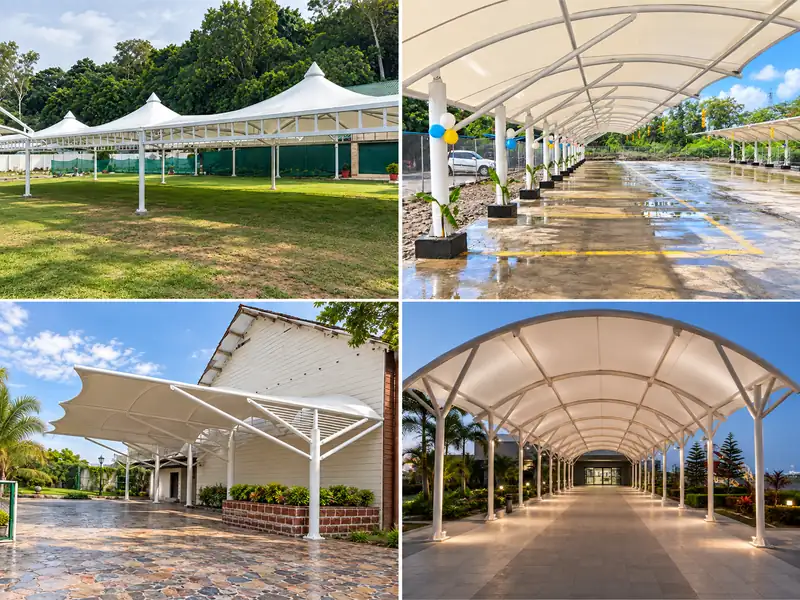
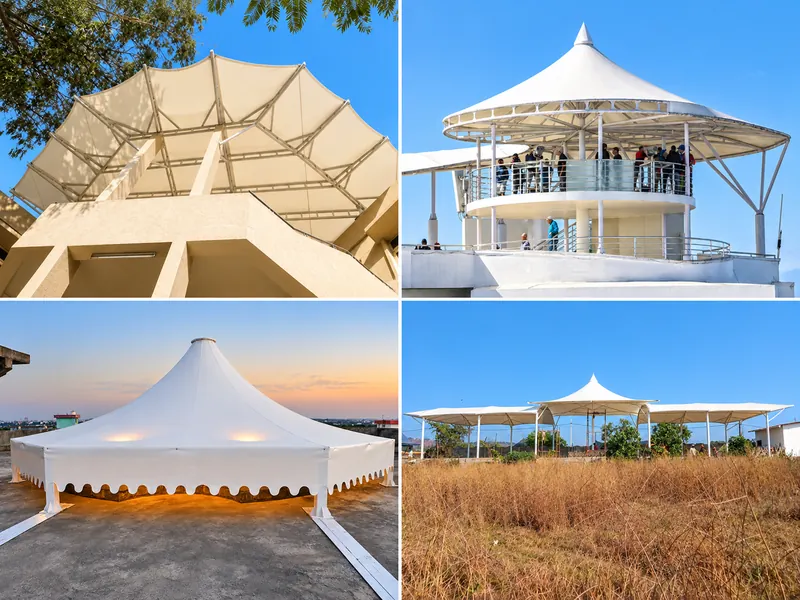
These references show tensile work we have built over parking, entrances, lawns and terraces. They help when comparing frame finishes and fabric colours for a plaza, while lane spans and clearances are designed for each toll site. View more ShadeCo India projects.
Service Availability Across India
ShadeCo India provides toll plaza tensile canopy solutions across major cities and regions in India. Highway projects can be taken up near Delhi, Gurugram, Faridabad, Noida, Lucknow, Chandigarh, Ludhiana, Jaipur, Jodhpur, Shimla, Dehradun, Haridwar, Bhopal, Indore, Gandhinagar, Ahmedabad, Patna, Muzaffarpur, Mumbai, Pune, Bengaluru, Hyderabad, Chennai and Kochi. Other highway locations are handled based on project scope and site requirements.
Each toll canopy is planned around local wind, rainfall and traffic volumes at the plaza. We agree work windows and diversions with the operator, so toll collection continues during installation.
Planning a Toll Plaza Tensile Canopy?
If you are building or upgrading a toll plaza, bridge toll or checkpost, ShadeCo India can advise on canopy form, clearance and equipment mounting.
We request you to share the plaza layout, the number of lanes, the required clearance and the toll equipment list. Please also share the project location, so our team can propose a suitable toll canopy.
You may contact us on +91-9873975818, by email at info@shadecoindia.com, or through our contact page.
FAQ
Frequently Asked Questions - Toll Plaza Tensile Canopy
A toll plaza tensile canopy is a fabric roof over toll lanes and booths on a steel frame. It shelters vehicles, toll staff and payment equipment from sun and rain. It is used at highway, expressway and bridge toll plazas.
The cost depends on lane count, span, clearance, fabric, equipment mounts and installation conditions. For a toll roof, PTFE fabric sits at the top of the price range and HDPE at the bottom. ShadeCo India quotes from the plaza layout, lane count and location.
PVDF-coated fabric is a strong choice because it sheds road dust and has a warranty of up to 10 years. PVC suits tighter budgets, and PTFE suits landmark expressway plazas. HDPE gives booth shade only.
Yes. The frame and footings are designed for open highway exposure as per IS 875 (Part 3). Coated fabric keeps rain off the booths, and island gutters carry water to side drains.
With regular inspection, the steel frame is expected to serve 25–30 years. For toll canopies, PVDF fabric is warranted for up to 10 years, subject to the manufacturer's terms.
Clearance is set by the tallest vehicles using the plaza, with extra height over the oversize lane. We confirm it with the highway authority or concessionaire before design. Signs and lights are kept above this line.
Yes. Work is done one lane or bay at a time, with diversions agreed with the operator. A complete toll canopy is typically delivered in 3–6 weeks, depending on lanes and design.
Yes, on mounting points built into the steel frame. We coordinate positions with the toll system supplier before fabrication, and cables run along the columns. Nothing is fixed through the fabric.
