
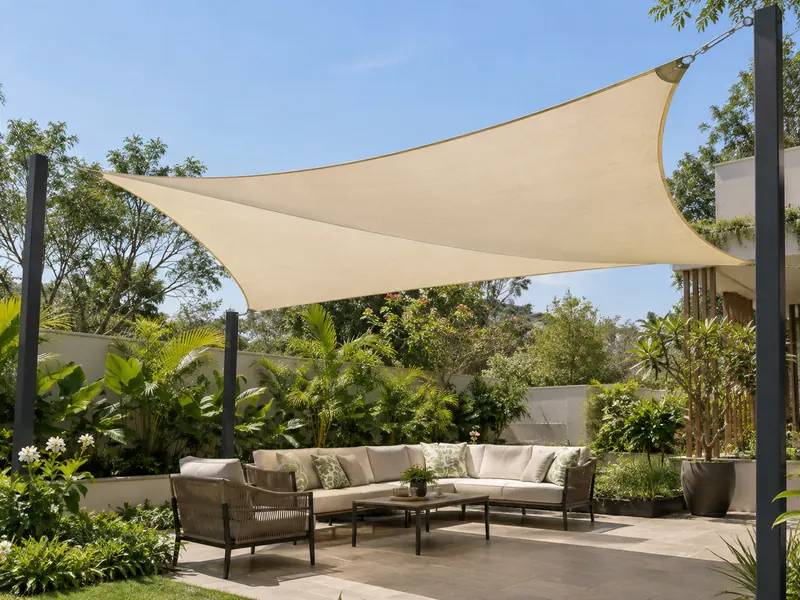
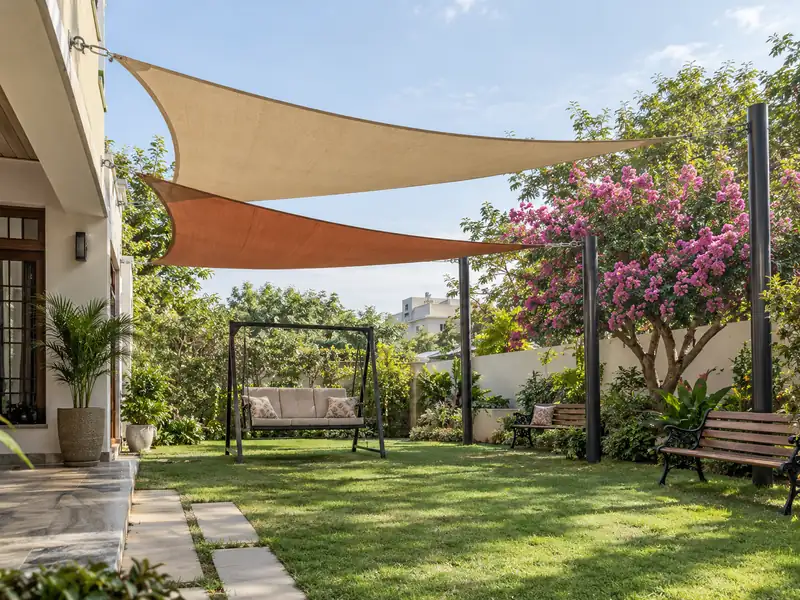
A garden shade sail is a fabric sail fixed to freestanding posts or garden walls to shade seating, lawns and paths in a landscaped space. It is also known as a lawn shade sail, backyard shade sail, landscape sun sail or garden sun shade. It is used in home gardens, farmhouse lawns, society gardens, resort landscapes, hotel lawns and office green areas.
ShadeCo India Private Limited is a garden shade sail manufacturer and supplier in India. We design, fabricate, supply and install freestanding garden sails, layered multi-height sails, lawn seating sails, garden path sails and boundary-wall sails. Breathable UV-stabilised HDPE is the usual choice in gardens, with PVC-coated polyester over seating that needs rain cover.
Planning starts with what is already growing. We note the trees, shrubs and beds, the lawn areas and the irrigation lines. Posts are placed where they avoid roots and pipes and sit naturally within the planting.
Garden Shade Sail at a Glance
- Sail Shapes: Triangles and squares at layered heights, shaped around trees and planting
- Fabric: Breathable HDPE that lets air and some light reach plants, or PVC-coated polyester over garden seating
- Posts and Fixings: Freestanding posts set in planting beds or lawn edges, with stainless corner fittings
- Surface Finish: Powder coating or automotive paint in dark garden tones, with galvanizing or epoxy paint options
- Suitable For: Home gardens, farmhouse lawns, society gardens, resort landscapes and office green areas
- Service Area: Landscape sails planned and installed across India
Why Choose a Garden Shade Sail
A garden shade sail adds shade to a lawn or seating area without the weight and permanence of a built roof. Many gardens have no cool spot for the afternoon, and young trees take years to give real shade. A sail fills that gap from the first day.
Sails also suit the soft look of a garden. Their curved edges and layered heights sit lightly among plants, and the posts can be painted to blend with planting. HDPE lets air pass, so the garden never feels closed in.
Types of Garden Shade Sails
The right garden sail depends on the size of the lawn, the trees and beds around it and where people sit.
Freestanding Garden Sail
All corners sit on posts, so the sail can stand in the middle of a lawn or bed. It needs no wall and can be placed exactly where shade is wanted.
Layered Multi-Height Sails
Two or three sails are set at different heights and overlap. The layers give a natural, relaxed look and shade a wider area.
Lawn Seating Sail
A sail shades a garden table, swing or set of benches. It is angled for the afternoon sun, when gardens are used most.
Garden Path Sail
A narrow sail shades a stretch of garden path or a pergola walk. It gives a shaded route between the house and a seating corner.
Boundary-Wall Sail
High corners fix to a strong boundary wall and low corners go to posts in the lawn. For sails fixed to the house itself, see our patio shade sails.
Garden Shade Sail Design: Fixing Points, Slope and Tension
Trees are never used as fixing points, because they move in wind and grow over time. Posts go in planting beds or at lawn edges, away from roots, irrigation pipes and mowing routes. Their RCC footings are finished below the soil so the planting can grow over them.
Plants under a sail still need light. HDPE lets some light and air through, which helps lawns and beds stay healthy. Where a PVC sail is used, its low corner drains into a bed or gravel strip that can take the water.
Sails are measured after the posts are set, then fitted and tensioned with stainless hardware. Falling leaves can gather on a slack sail, so we keep it taut and re-check tension after the first few weeks.
Technical Specifications
These details are a general guide for homeowners, landscape designers and estate managers. The final layout, heights and fabric are confirmed after we walk the garden.
Shade Sail Specifications
| Specification | Details |
|---|---|
| Sail Shapes | Triangle, square and layered multi-height layouts shaped around planting |
| Fabric Options | UV-stabilised HDPE shade fabric (breathable) or PVC-coated polyester (waterproof) |
| Edges | Catenary edges reinforced with webbing or edge cable |
| Corner Hardware | Stainless steel D-rings, turnbuckles, shackles and pad eyes |
| Support Posts | Mild steel or galvanized steel posts in beds or lawn edges; trees never used as fixings |
| Surface Finish | Automotive paint, epoxy paint, powder coating or hot-dip galvanizing |
| Wall Fixings | Pad eyes on boundary or garden walls only at structurally suitable points |
| Foundation | RCC footings designed for site soil and load, clear of roots and irrigation lines |
| Slope and Drainage | Raised corner or twist for tension; PVC runoff led into beds or gravel |
| Colours | White, ivory, sand and a range of bright and neutral colours |
| UV Protection | Up to 98% UV blocking, depending on the fabric |
| Wind Load Design | Posts and footings checked for wind as per IS 875 (Part 3) |
Key Features
| Feature | Details |
|---|---|
| Shade Without a Roof | Cool seating in the garden from the first day |
| UV-Stabilised Fabric | Holds up in open garden sun |
| Breathable HDPE | Air and some light reach the plants below |
| Catenary Edges | Soft curves suit a natural garden look |
| Stainless Steel Hardware | Resists rust from watering and damp soil |
| Posts Away from Roots | Footings avoid trees, roots and irrigation lines |
| Adjustable Tension | Keeps the sail taut so leaves do not collect |
| Layered Heights | Overlapping sails give depth to the landscape |
Benefits of Garden Shade Sails
Garden sails create cool outdoor rooms while keeping the garden open and green.
- Instant Shade: No waiting years for trees to grow.
- Fits the Landscape: Posts and sails are placed around trees and beds.
- Healthy Plants: HDPE lets air and some light pass through.
- Flexible Layout: Sails can go anywhere on posts, without walls.
- Soft, Natural Look: Curved edges and layered heights suit gardens.
- Easy to Remove: Sails can come down for winter or storms.
Applications of Garden Shade Sails
Homeowners use garden sails over lawn seating, swings and outdoor dining. Farmhouses shade large lawns for family gatherings. For a full guide to sails around the home, see our residential shade sails.
Housing societies shade garden benches and walking paths. Resorts and hotels use layered sails over lawn lounges and event corners. Offices shade green break areas for staff, and nurseries use HDPE sails to protect young plants.
Garden Shade Sail Price in India: What Affects the Cost
The cost of a garden shade sail depends mainly on the area to be shaded and the number of posts. Freestanding sails need more posts than sails fixed partly to a wall.
Fabric type, post height, RCC footings in soft soil, stainless hardware, colours and access for equipment across the lawn all affect the figure. HDPE is the most economical garden fabric. Layered layouts add sails and posts.
For a quotation, share photos of the garden, the area you want shaded, any walls that could take a fixing and the location.
How We Plan and Install a Garden Shade Sail
A garden is a living space, so we plan the sail around the plants and protect them during work.
- Step 1 – Site visit: We walk the garden, note trees, beds, lawns and irrigation, and mark where people sit.
- Step 2 – Layout: We propose sail shapes, layered heights, colours and post positions that sit naturally in the landscape.
- Step 3 – Structural check: Posts and footings are checked for corner loads in garden soil and for wind as per IS 875 (Part 3).
- Step 4 – Posts and foundations: Posts are set on RCC footings away from roots and pipes, with care to protect the lawn.
- Step 5 – Final measurement and fabrication: Each sail is measured between the installed posts and made to fit.
- Step 6 – Tensioning and handover: We fit and tension the sails, tidy the garden, and re-check tension after a few weeks.
Garden Shade Sail Design and Installation Solutions
ShadeCo India installs garden sails for homes, farmhouses, societies and resorts. Our team plans every post around trees and planting, so the sail adds shade without harming the garden.
Why Work with ShadeCo India
ShadeCo India began work in 2010 and has more than 15 years of experience with shade and tensile structures. We are ISO 9001:2015 certified, and our own installers handle every garden job with care for lawns and planting.
Delhi Public School, Food Corporation of India, L&T, TATA, Adani, Al-Karim University, Indian Oil, Omaxe, VIVO, Lakhani, Indian Railways and Reliance have used our services. We also work for several other organizations across India.
On every garden sail, we check post placement, sail tension and the state of the planting before handover. Delivery typically takes 3–6 weeks, depending on the layout and customization.
Explore Our Shade Sail Projects
Resort and landscape work appears on our projects page, including tensile canopies at Chandragiri Hills Resort in Nepal. ShadeCo India has also built covers for schools, hospitals and factories across India.
Resort projects show how fabric and steel can sit within a green setting without overpowering it. That balance is what a garden sail aims for too.
Browse our projects for ideas, then send us photos of your garden. We will suggest sail positions that work with your trees and planting.
Service Availability Across India
ShadeCo India provides garden shade sail solutions across major cities and regions in India. Garden sail projects are possible in Delhi, Gurugram, Faridabad, Noida, Lucknow, Chandigarh, Ludhiana, Jaipur, Jodhpur, Shimla, Dehradun, Haridwar, Bhopal, Indore, Gandhinagar, Ahmedabad, Patna, Muzaffarpur, Mumbai, Pune, Bengaluru, Hyderabad, Chennai and Kochi. Farmhouses and other locations are taken up based on project scope and site requirements.
Each garden sail is planned around local sun, wind and the growing season. We avoid working when beds are freshly planted, so new plants are not disturbed.
Planning a Garden Shade Sail?
If you want shade over garden seating, a lawn or a path, ShadeCo India can advise on sail positions, heights and fabric that suit your landscape.
We request you to share photos of the garden, the area you want shaded and any walls that could take a fixing. Please also mention the location, so our team can suggest a layout.
You may call +91-9873975818, email info@shadecoindia.com, or reach us via our contact page.
FAQ
Frequently Asked Questions - Garden Shade Sail
A garden shade sail is a fabric sail fixed to freestanding posts or garden walls to shade seating, lawns and paths. It is planned around trees and planting. Most garden sails use breathable HDPE fabric.
The cost depends on the shaded area, number of posts, footings, fabric and colours. Freestanding sails need more posts than wall-fixed ones. ShadeCo India quotes from garden photos and location.
UV-stabilised HDPE is usually best, as it lets air and some light reach plants and costs less. PVC-coated polyester suits garden seating that needs rain cover. Both block up to 98% of UV, depending on the fabric grade.
Yes, when posts are set on proper footings. They are checked for the site wind load as per IS 875 (Part 3). HDPE lets rain through, and PVC sails drain into a bed or gravel strip.
A garden sail lasts longest when it is kept tight, clean and out of severe storms. Keeping the sail taut stops leaves and water collecting. Stainless hardware and coated posts resist damp garden conditions.
No. Trees move in wind and grow, which can loosen the sail or harm the tree. We use freestanding posts or strong walls instead, placed away from the roots.
Garden sails are usually delivered in 3–6 weeks, depending on layout and design. Posts are set first, then each sail is made to the measured size.
HDPE sails let air and some light through, so most plants stay healthy. Footings are placed away from roots and pipes. We protect the lawn during installation and tidy up afterwards.
