
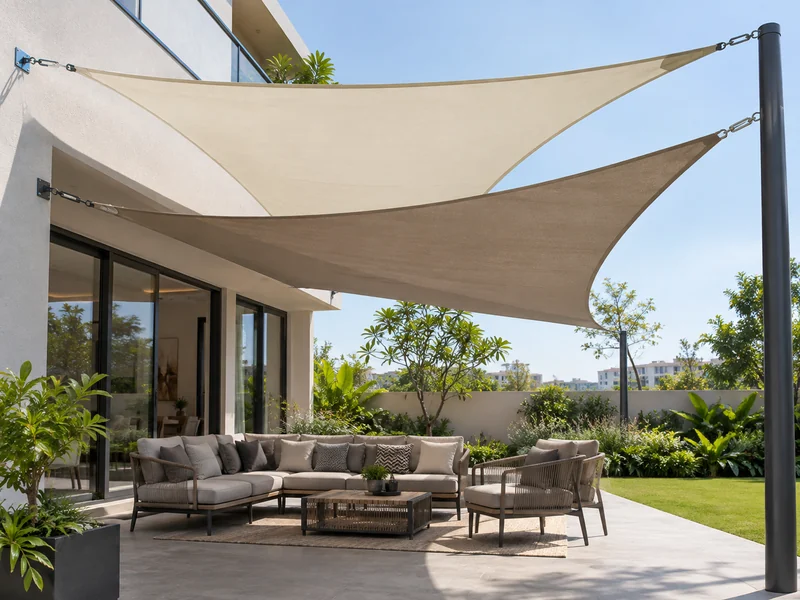
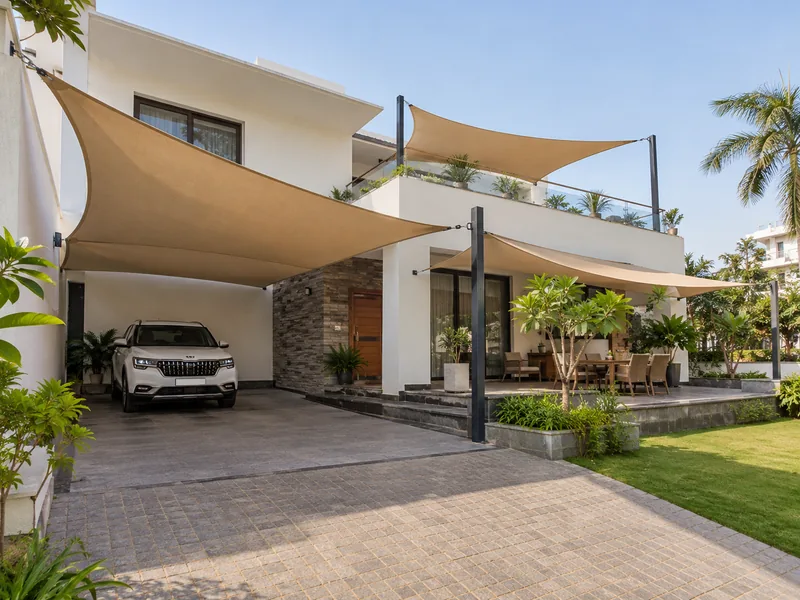
A residential shade sail is a fabric sail fixed to a house, boundary wall or posts to shade an outdoor part of the home. It is also known as a home shade sail, house shade sail, villa shade sail or domestic sun sail. It is used over car spots, balconies, patios, gardens, terraces and children's play corners at houses, villas and farmhouses.
ShadeCo India Private Limited is a residential shade sail manufacturer and supplier in India. We design, fabricate, supply and install sails for home parking, balcony sails, patio sails, garden sails and terrace sails. Each home sail is made in breathable UV-stabilised HDPE for cool shade, or PVC-coated polyester where the space should stay dry.
The best place to start is a walk around the house. We note which outdoor spaces get the harshest sun, which ones the family uses most and where strong walls or columns can hold a corner. Then we suggest one sail or a set of sails that suits the home.
Residential Shade Sail at a Glance
- Sail Shapes: Triangles, squares, rectangles and hypar sails, chosen for each part of the home
- Fabric: Breathable HDPE for most home spaces, or PVC-coated polyester for areas used in rain
- Posts and Fixings: House and boundary walls where strong enough, plus posts, with stainless corner fittings
- Surface Finish: Automotive paint or powder coating matched to the house, or epoxy paint and galvanizing
- Suitable For: Independent houses, villas, farmhouses, bungalows and ground-floor apartments
- Service Area: Home shade sails installed across India
Why Choose a Residential Shade Sail
A residential shade sail lets a family use the outdoor parts of the home through hot afternoons. Patios, terraces and gardens in Indian homes often sit empty until sunset. A sail creates a cool spot with very little building work.
Sails are also flexible for homeowners. They fix to the house or boundary wall where possible, so few posts are needed. They can be taken down for cleaning, and their colours can be chosen to match the house.
Residential Shade Sails by Part of the Home
Each part of a home has different needs, so the sail shape, fabric and fixing change from space to space.
Car Spot Sail
A sail over the driveway or car spot keeps the car cool and clean. Posts stand behind the car. See our car parking shade sails for details.
Balcony Sail
A small sail fixes between balcony walls or to a beam above, shading the balcony and the room behind it. Fixings go only into strong structure.
Patio Sail
One side fixes to the house and the other to posts, shading the patio from afternoon sun. See our patio shade sails.
Garden Sail
Freestanding sails shade lawn seating and play areas, placed around trees and planting. See our garden shade sails.
Terrace Sail
Sails on base-plate posts shade the rooftop, with fixings sealed into the waterproofing. See our terrace shade sails.
Residential Shade Sail Design: Fixing Points, Slope and Tension
In a home, the house itself is often the best fixing point. We look for RCC beams and columns, and check boundary walls before using them. Brick infill, plaster and railings are not used for sail corners.
Every home sail slopes away from doors and windows, so rain and leaves fall to the garden or drain. With PVC sails, the low corner is placed over planting or a drain. Sloping the sail outward also stops hot air gathering against the walls.
Final sizes are measured after the fixings and posts are in place. Stainless turnbuckles set the tension, and we re-check it after a few weeks. We also show the family how to take a sail down for cleaning or before a storm.
Technical Specifications
Use these details as a starting guide when planning sails around your home. The final shapes, fabric and fixings are confirmed after we walk around the home.
Shade Sail Specifications
| Specification | Details |
|---|---|
| Sail Shapes | Triangles, squares, rectangles and hypar sails, chosen per part of the home |
| Fabric Options | UV-stabilised HDPE shade fabric (breathable) or PVC-coated polyester (waterproof) |
| Edges | Catenary edges reinforced with webbing or edge cable |
| Corner Hardware | Stainless steel D-rings, turnbuckles, shackles and pad eyes |
| Support Posts | Mild steel or galvanized steel posts where walls cannot take a corner |
| Surface Finish | Automotive paint, epoxy paint, powder coating or hot-dip galvanizing |
| Wall Fixings | Pad eyes on RCC beams, columns or strong boundary walls only at structurally suitable points |
| Foundation | RCC footings or base plates designed for site soil, slab and load |
| Slope and Drainage | Slope away from doors and windows; PVC low corner over a drain or planting |
| Colours | White, ivory, sand and a range of bright and neutral colours |
| UV Protection | Up to 98% UV blocking, depending on the fabric |
| Wind Load Design | Fixings, posts and footings checked for wind as per IS 875 (Part 3) |
Key Features
| Feature | Details |
|---|---|
| One Plan for the Whole Home | Sails for parking, balcony, patio, garden and terrace planned together |
| UV-Stabilised Fabric | Shades family spaces through Indian summers |
| Breathable or Waterproof Option | HDPE for cool shade; PVC for areas used in rain |
| Catenary Edges | Neat curved edges suit modern homes |
| Stainless Steel Hardware | Fittings resist rust from rain and garden watering |
| Uses the House Structure | Beams and columns carry corners, so fewer posts are needed |
| Adjustable Tension | Easy to re-tighten, and sails can come down for cleaning |
| Colours to Match the House | Fabric and post colours chosen to suit the building |
Benefits of Residential Shade Sails
Home shade sails make outdoor spaces part of daily family life.
- More Usable Home: Patios, gardens and terraces stay cool through the day.
- Cooler Rooms: Shade on doors and windows keeps rooms behind them cooler.
- Few Posts: The house and walls carry many corners.
- Matches the House: Colours and shapes suit the home's style.
- Low Cost: Far cheaper than pergolas or built roofs.
- Easy Care: Sails can be taken down, washed and refitted.
Applications of Residential Shade Sails
Independent houses and villas use sails over car spots, patios and gardens. Farmhouses shade lawns, pool sides and outdoor kitchens. Ground-floor apartments shade private patios and balconies.
Families often start with one sail and add more later, using the same colours. For a rooftop, see our terrace shade sails, and for lawn seating, see our garden shade sails.
Residential Shade Sail Price in India: What Affects the Cost
The cost of a residential shade sail depends mainly on the number of sails, their sizes and how many posts are needed. Using the house and boundary walls for corners lowers the cost.
Fabric type, wall fixings, RCC footings, base plates on terraces, stainless hardware and colours affect the figure. HDPE costs less than PVC-coated polyester. Planning several sails together can save on site visits and posts.
For a quotation, share photos of each space you want shaded, rough sizes, your fabric preference and the location.
How We Plan and Install a Residential Shade Sail
Homes are lived in every day, so we plan neat, quick work that respects the family's routine.
- Step 1 – Site visit: We walk around the home, note the sunniest spaces and check walls, beams and ground for fixing points.
- Step 2 – Layout: We suggest sails for each space, with shapes, colours and fabric that suit the house.
- Step 3 – Structural check: Every house fixing, post and footing is checked for its corner load and the site wind as per IS 875 (Part 3).
- Step 4 – Posts and foundations: Wall fixings are sealed into the structure, and posts are set on RCC footings or base plates.
- Step 5 – Final measurement and fabrication: Each sail is measured between its installed fixings and made to fit.
- Step 6 – Tensioning and handover: We fit and tension the sails, show you how to remove them, and re-check tension after a few weeks.
Residential Shade Sail Design and Installation Solutions
ShadeCo India installs shade sails for houses, villas, farmhouses and apartments. Our team plans sails for each outdoor space of the home, so the whole house gets shade that looks like it belongs.
Why Work with ShadeCo India
ShadeCo India has built fabric shade and tensile structures since 2010, over 15 years, and is ISO 9001:2015 certified. Homeowners deal with one in-house team for survey, fixings and fitting.
Our project list includes work for Delhi Public School, Food Corporation of India, L&T, TATA, Adani, Al-Karim University, Indian Oil, Omaxe, VIVO, Lakhani, Indian Railways and Reliance. Several other organizations and many homeowners across India also work with us.
On every home sail, we check fixings, slope and tension before handover. Home sail orders usually take 3–6 weeks, depending on the number of sails and customization.
Explore Our Shade Sail Projects
Our projects page mostly shows larger fabric structures for schools, hospitals, resorts and businesses. Even so, it is a good guide to the workmanship that goes into a home sail.
Homeowners can compare fabric colours, post finishes and the neatness of our site work across those projects. The same team and standards apply when we install sails at your home.
Browse ShadeCo India's work, then send us photos of your outdoor spaces. We will suggest which sail suits each part of your home.
Service Availability Across India
ShadeCo India provides residential shade sail solutions across major cities and regions in India. Home sail projects are taken up in Delhi, Gurugram, Faridabad, Noida, Lucknow, Chandigarh, Ludhiana, Jaipur, Jodhpur, Shimla, Dehradun, Haridwar, Bhopal, Indore, Gandhinagar, Ahmedabad, Patna, Muzaffarpur, Mumbai, Pune, Bengaluru, Hyderabad, Chennai and Kochi. Houses outside these cities are covered based on project scope and site requirements.
Each home sail is planned around local heat, monsoon and the way the family uses the space. We keep work short and clean up fully at the end of each day.
Planning a Residential Shade Sail?
If you want shade over your car spot, balcony, patio, garden or terrace, ShadeCo India can suggest the right sail for each space.
We request you to share photos of the spaces you want shaded, rough sizes and your fabric preference. Please include the city, and our team will propose sails that suit your home.
Please call +91-9873975818, email info@shadecoindia.com, or reach out via our contact page.
FAQ
Frequently Asked Questions - Residential Shade Sail
It is a home shade made of tensioned fabric, fixed to the house, a boundary wall or posts. It shades outdoor spaces such as car spots, patios, gardens and terraces. Homes use HDPE for cool shade or PVC for rain cover.
The cost depends on the number of sails, sizes, posts, fixings and fabric. Using house walls for corners lowers the cost. ShadeCo India quotes from photos of each space and the location.
HDPE is best for most home spaces, as it keeps them cool and costs less. PVC-coated polyester suits patios or terraces used in the monsoon. Both cut UV by up to 98% at home, depending on the fabric.
Yes, when fixings and posts are designed for the site. Corner loads at home are checked against the site wind load as per IS 875 (Part 3). Sails can also be taken down before severe storms.
At home, keeping the sail tight, washing it now and then and removing it before storms all add to its life. Stainless corner fittings and painted or galvanized posts help them last outdoors.
Usually the space that gets the harshest afternoon sun and is used most, such as a west-facing patio or terrace. We walk around the home and suggest where a sail helps most.
Home sails are usually delivered in 3–6 weeks, depending on how many sails and the design. Each sail is fitted in a short site visit after the fixings are in.
Yes, to RCC beams or columns that can take the load. We check the wall first and seal each fixing. Brick infill and railings are not used as fixing points.
