
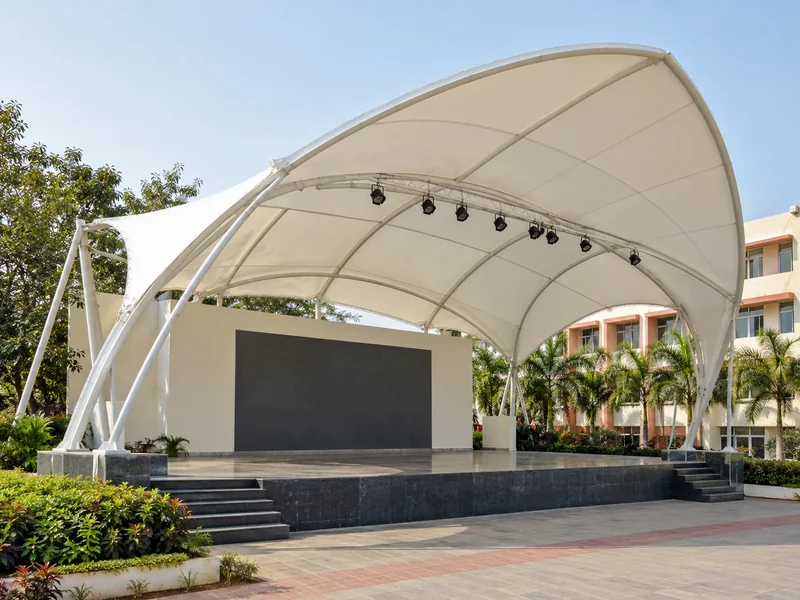
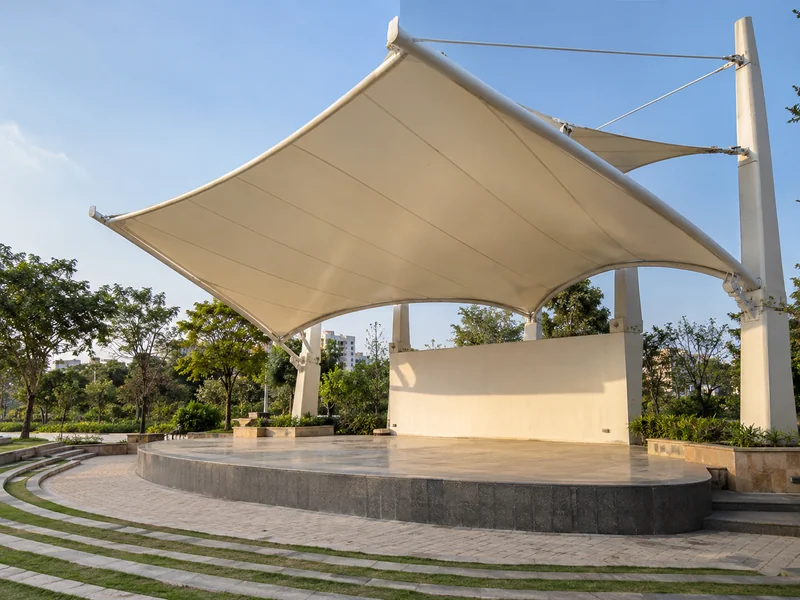
A stage cover tensile structure is a fabric roof built over an open-air stage to shelter performers, sets and equipment from sun and rain. It is also known as a stage canopy, open-air stage roof, outdoor stage shade or performance stage membrane. It is used at school and college grounds, parks, temples, community centres, clubs, resorts and event venues.
ShadeCo India Private Limited is a stage cover tensile structure manufacturer and supplier in India. We design, fabricate, supply and install shell-shaped stage covers, cantilever stage canopies, arched stage roofs, mast-supported stage roofs and wall-backed stage covers. We offer PVC, PVDF and PTFE-coated fabrics for rain cover, plus HDPE shade net for day-only shade.
The first thing we settle is what will hang from the roof. Lights, speakers and banners add load, so their weight and positions shape the frame design. We also confirm the stage size, the clear height needed for sets or LED screens and the audience sightlines.
Stage Cover Tensile Structure at a Glance
- Structure Types: Shell-shaped, cantilever, arched, mast-supported and wall-backed stage covers
- Fabric: PVC, PVDF or PTFE-coated fabric to keep the stage and equipment dry; HDPE shade net for daytime shade
- Frame Material: Mild steel (MS) or galvanized steel (GI) frame with rigging points for lights and sound
- Surface Finish: Automotive paint or epoxy paint in dark stage colours, or powder coating and hot-dip galvanizing
- Suitable For: Schools, colleges, parks, temples, community centres, clubs, resorts and event grounds
- Service Area: Stage covers designed, supplied and installed across India
Why Choose a Stage Cover Tensile Structure
A stage cover protects performers, musical instruments and electrical equipment, so events can go on in sun or light rain. Without a roof, every outdoor programme needs a hired tent or a backup date. A permanent fabric stage roof removes that cost and uncertainty for schools, parks and venues.
A fabric roof also frames the stage. Its shape draws the audience's eye to the performers, and its light colour reflects stage lights well at night. Since columns can stand behind or beside the stage, the audience view stays clear.
Types of Stage Cover Tensile Structures
The right stage cover depends on the stage size, where columns can stand without blocking the view and how much rigging is needed.
Shell-Shaped Stage Cover
The fabric curves up and outward toward the audience, like a shell. It frames the stage and gives a strong visual focus. It suits school grounds, parks and open-air theatres.
Cantilever Stage Canopy
Columns stand only at the back of the stage, and the roof reaches forward over it. The front stays completely open, so every seat has a clear view. Back columns can also carry a backdrop.
Arched Stage Roof
Steel arches span the stage width with columns at the sides. It gives good height across the full stage for sets, risers and LED walls.
Mast-Supported Stage Roof
Tall masts carry one or more fabric peaks over the stage. It gives a striking outline that people can see from far away, useful for festivals and resort events.
Wall-Backed Stage Cover
The roof is tied to a solid back wall or green-room building behind the stage. The wall blocks wind and holds the backdrop. For roofs over the seating area as well, see our amphitheater shade structures.
Custom Stage Cover Design: Rigging Loads, Clear Height and Weather Protection for Equipment
Lights, speakers, curtains and banners hang from the stage frame. We agree the rigging plan with the user first and design truss bars or pipe battens for those loads. Each rigging point is marked, so no one hangs heavy equipment from the fabric.
Clear height under the roof decides what can be staged. Dance shows need space for lifts, while concerts need room for speaker stacks and LED screens. We fix this height early and check sightlines from the back rows.
Rain blown onto a stage can damage sound and lighting equipment. The roof overhangs the stage edges, and gutters keep water away from cable trenches and power points. Back or side screens can be added on windy sites.
Technical Specifications
These details are a general guide for school managements, event organizers and venue owners. The final stage cover size, height and rigging are confirmed after we understand the events the stage will host.
Structural & Fabric Specifications
| Specification | Details |
|---|---|
| Structure Types | Shell-Shaped, Cantilever, Arched, Mast-Supported, Wall-Backed or Custom |
| Frame Material | Mild Steel (MS) or Galvanized Steel (GI) with truss or pipe rigging bars |
| Surface Finish | Automotive Paint, Epoxy Paint, Powder Coating or Hot-Dip Galvanizing |
| Rigging Provision | Marked points for lights, speakers and curtains, designed for agreed loads |
| Fabric Types | PVC-Coated Polyester, PVDF-Coated Polyester, PTFE-Coated Glass Fibre or HDPE Shade Net |
| Fabric Weight | 750 – 900 GSM coated fabric for small stages; 1050 GSM or heavier for large stage spans |
| Rain Protection | Waterproof with PVC, PVDF or PTFE, with overhang beyond the stage edge; HDPE gives shade only |
| UV Protection | Up to 98% UV blocking, depending on the fabric |
| Temperature Resistance | −30°C to +70°C |
| Stage Size and Height | Set by the stage area, sets, screens and audience sightlines (Customizable) |
| Drainage | Gutters and downpipes kept away from cable trenches and power points |
| Add-Ons | Provision for Stage Lighting, Speaker Mounts and Back Screens |
| Wind Load Design | Frame, rigging and footings designed as per IS 875 (Part 3) |
| Fabric Warranty | Up to 10 years on PVDF fabric, subject to manufacturer's terms |
Key Features
| Feature | Details |
|---|---|
| Waterproof PVC / PVDF / PTFE Fabric | Keeps instruments, sound desks and lights dry during an evening shower |
| UV-Resistant Coating | Blocks up to 98% of UV rays, depending on the fabric, during daytime rehearsals |
| Anti-Wicking Fabric | Sealed edges stop rain wicking toward the rigging bars and fittings |
| Fungicide Finish | Stops mould spots that would show under bright stage lights |
| Moisture and Corrosion Resistant | Frame and rigging fittings protected against rust between event seasons |
| Dirt-Resistant Top Coat | PVDF top coat keeps the stage roof looking bright in photos and videos |
| Flame-Retardant Grade Available | FR-grade fabric on request, recommended near stage lights and pyrotechnic effects |
| All-Weather Performance | Frame and rigging designed for site wind loads as per IS 875 (Part 3) |
Benefits of Stage Cover Tensile Structures
A permanent stage cover lets a venue plan events without depending on the weather.
- Events in Sun or Rain: Performers and equipment stay covered, so programmes run on schedule.
- No Tent Hire: A fixed roof removes the cost of hiring a shamiana for every event.
- Clear Audience View: Columns stand behind or beside the stage, not in front.
- Safe Rigging: Marked points carry lights and sound, with loads designed in.
- Striking Stage Frame: The roof shape gives the stage a clear focus by day and night.
- Year-Round Use: The stage can host assemblies, rehearsals and functions every week.
Applications of Stage Cover Tensile Structures
Schools and colleges use stage covers for annual days, assemblies, cultural fests and sports prize events. Parks and municipal grounds use them for public performances and festivals. For fabric roofs over tiered seating as well as the stage, see our amphitheater shade structures.
Temples and community centres use them for religious programmes, kathas and weddings. Resorts and clubs add stage covers at lawns for live music and events. For enclosed indoor-style halls, see our auditorium tensile structures.
Stage Cover Tensile Structure Price in India: What Affects the Cost
The cost of a stage cover tensile structure depends mainly on the stage size and the clear height required. A cantilever stage canopy needs heavier back columns and footings than a frame with side columns.
The rigging load, fabric type, side or back screens, finish and lighting provisions change the figure. Of the fabrics, HDPE is the cheapest and PTFE the dearest. Site access for cranes on a school or park ground also matters.
For a quotation, share the stage width and depth, the height needed, the equipment to be hung, site photographs and the location.
How We Design and Install a Stage Cover Tensile Structure
A stage roof carries equipment as well as weather loads, so rigging is planned from the first meeting.
- Step 1 – Site and event review: We measure the stage and seating area and discuss the events, equipment and audience size.
- Step 2 – Layout and rigging plan: We propose the roof shape, column positions, clear height and rigging points for approval.
- Step 3 – Engineering: Frame, rigging bars and footings are designed for equipment loads and the site wind load as per IS 875 (Part 3).
- Step 4 – Fabrication: Steel and rigging bars are fabricated and finished in our workshop, and fabric panels are cut to the roof shape.
- Step 5 – Installation: Footings are cast, the frame is erected and the fabric tensioned, then gutters, screens and lighting provisions are fitted.
- Step 6 – Handover: We mark safe rigging loads on the frame and explain how to hang equipment and care for the roof.
Stage Cover Tensile Structure Design and Installation Solutions
ShadeCo India builds stage covers for schools, parks, temples and event venues. Our team designs the roof and its rigging together, so the stage is ready for lights and sound from the first event.
Why Work with ShadeCo India
ShadeCo India has designed and built tensile structures since 2010, a span of more than 15 years. The company is ISO 9001:2015 certified. Engineers, fabricators and installers work in-house, so rigging details stay consistent from drawing to site.
Delhi Public School, Food Corporation of India, L&T, TATA, Adani, Al-Karim University, Indian Oil, Omaxe, VIVO, Lakhani, Indian Railways and Reliance are some of the organizations we have worked with. Several other clients across India also rely on us.
On every stage cover, we check rigging bars, sightlines and the water path around the stage before handover. Delivery typically takes 3–6 weeks, depending on stage size and customization.
You can also see our barrel vault tensile structures, pagoda tents and the full range of tensile structures.
Explore Our Projects & Design References
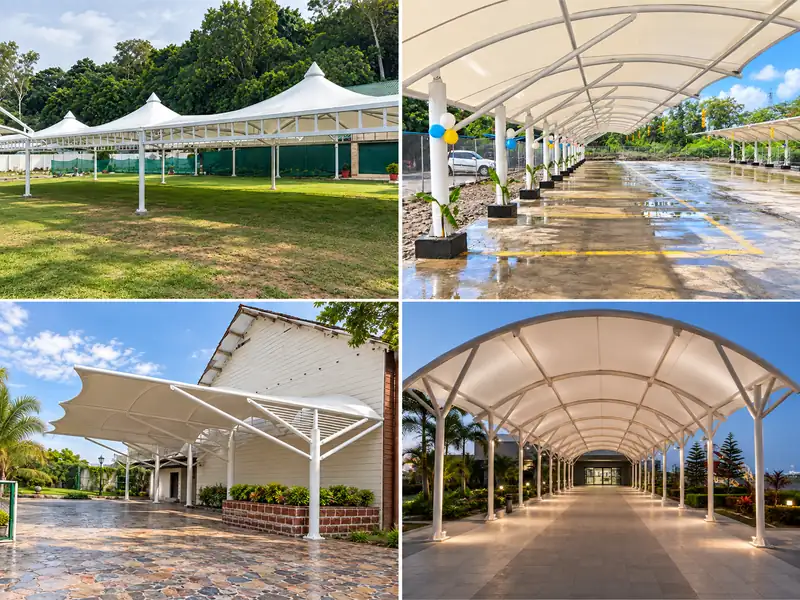
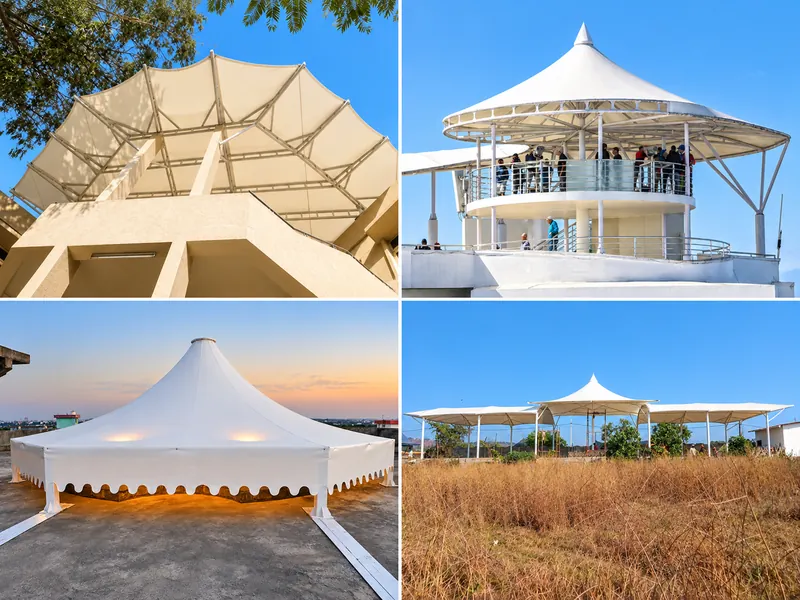
Our past canopies over lawns, entrances, parking and terraces appear below as references. They help when choosing roof shape and fabric colour for a stage, while rigging and stage clearances are designed for each venue. View more ShadeCo India projects.
Service Availability Across India
ShadeCo India provides stage cover tensile structure solutions across major cities and regions in India. Our stage projects can be taken up in Delhi, Gurugram, Faridabad, Noida, Lucknow, Chandigarh, Ludhiana, Jaipur, Jodhpur, Shimla, Dehradun, Haridwar, Bhopal, Indore, Gandhinagar, Ahmedabad, Patna, Muzaffarpur, Mumbai, Pune, Bengaluru, Hyderabad, Chennai and Kochi. Other places are possible based on project scope and site requirements.
Each stage cover is planned around the local wind, rainfall and the event calendar of the venue. We schedule site work between events, so annual days and festivals are not disturbed.
Planning a Stage Cover Tensile Structure?
If you are planning a permanent roof for a school stage, park stage, temple stage or event venue, ShadeCo India can advise on the roof shape, height and rigging.
We request you to share the stage width and depth, the clear height needed, the equipment you plan to hang and site photographs. Please also include the project location, and our team will suggest a suitable stage cover.
Please call +91-9873975818, email info@shadecoindia.com, or send your requirements through our contact page.
FAQ
Frequently Asked Questions - Stage Cover Tensile Structure
A stage cover tensile structure is a permanent fabric roof over an open-air stage. It protects performers, instruments and lighting from sun and rain. It is used at schools, parks, temples, resorts and event grounds.
Pricing depends on the stage size, clear height, rigging load, fabric and screens. HDPE is the most economical fabric and PTFE the most expensive. ShadeCo India quotes once it has the stage size, equipment list, photos and location.
PVC or PVDF-coated fabric keeps the stage dry, and PVDF looks cleaner under lights. PTFE suits long-life landmark stages. FR-grade fabric is advised near stage lights, and HDPE only suits daytime shade.
Coated fabric with an overhang keeps light rain off the stage, and back or side screens help on windy sites. The frame, rigging and footings follow the site wind load as per IS 875 (Part 3). Equipment should still be covered in storms.
A stage cover frame in steel is expected to serve 25–30 years if maintained. On a stage roof, PVDF fabric has a warranty of up to 10 years, subject to the manufacturer's terms.
Yes, from rigging bars built into the frame, never from the fabric. We design these bars for the agreed loads and mark safe points at handover. Heavier rigs must be discussed before design.
A stage cover is usually delivered within 3–6 weeks, based on its size and design. Site work can be fitted between scheduled events.
Height depends on the sets, risers, LED screens and speaker stacks used. A taller roof also helps sightlines from the back rows. We confirm the clear height after discussing the events the stage will host.
