
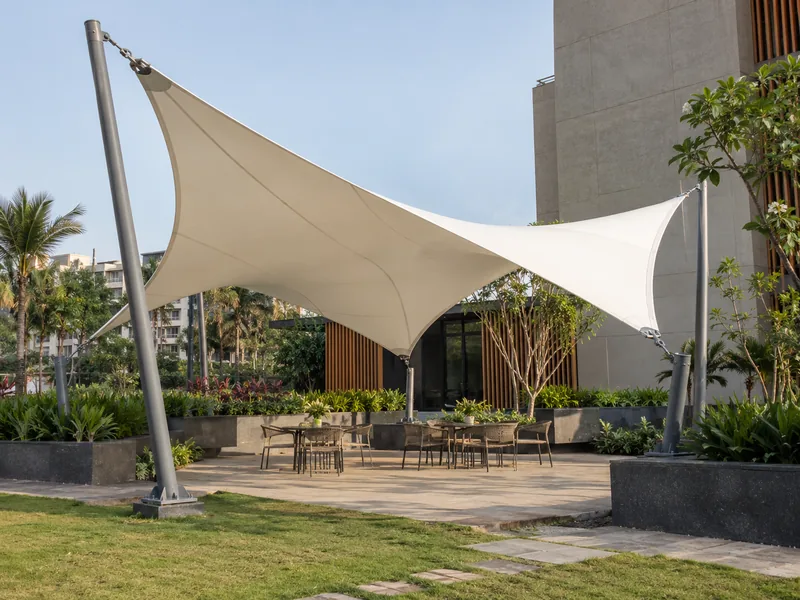
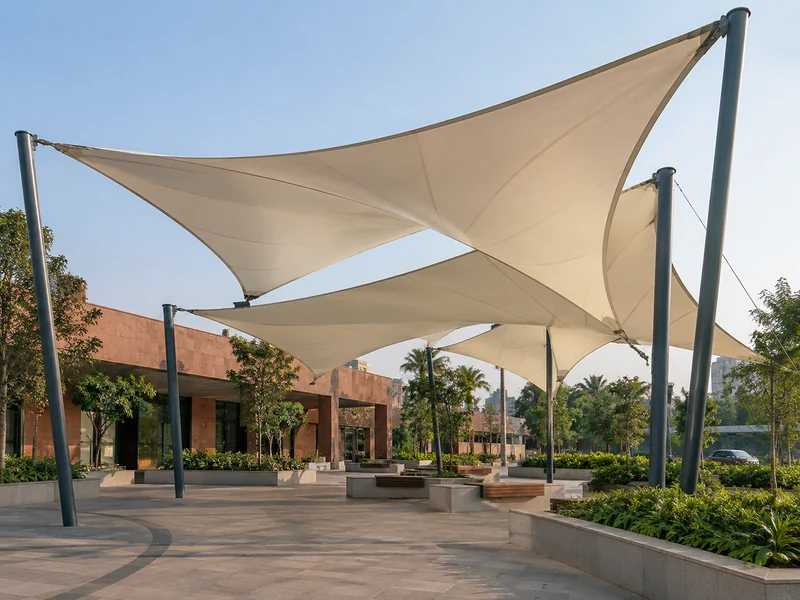
A hypar tensile structure is a fabric canopy fixed at alternate high and low corners, so the surface twists into a saddle shape. It is also known as a hyperbolic paraboloid tensile structure, saddle tensile canopy, twisted membrane canopy or four-point tensile structure. It is used over garden seating, plazas, building forecourts, café terraces, school grounds and park pathways.
ShadeCo India Private Limited is a hypar tensile structure manufacturer and supplier in India. We design, fabricate, supply and install single four-point hypars, wall-fixed hypar canopies, overlapping hypar clusters, multi-point saddle roofs and HDPE hypar shade canopies. The fabric is PVC or PVDF-coated polyester or PTFE-coated glass fibre for rain cover, or HDPE shade net where only shade is needed.
Planning a hypar starts with its corners. We decide which two points will be high, which two will be low and where each mast or wall fixing can stand. The low corners also need a safe place for rainwater to land, away from seats, doors and walking routes.
Hypar Tensile Structure at a Glance
- Structure Types: Single four-point, wall-fixed, overlapping cluster, multi-point and HDPE hypar canopies
- Fabric: PVC, PVDF or PTFE-coated fabric for shade and rain, or HDPE shade net for shade with airflow
- Frame Material: Mild steel (MS) or galvanized steel (GI) masts, corner plates, edge cables and tie-backs
- Surface Finish: Powder coating, hot-dip galvanizing, epoxy paint or automotive paint for masts and plates
- Suitable For: Gardens, plazas, forecourts, café terraces, school grounds, parks and outdoor waiting areas
- Service Area: Hypar canopies designed, supplied and installed across India
Why Choose a Hypar Tensile Structure
A hypar gives a strong, tight canopy with very little steel, because the twist itself holds the fabric in shape. The surface curves up in one direction and down in the other. That double curve keeps the fabric from flapping, so the canopy needs only a mast or fixing at each corner.
For a garden, plaza or forecourt, this means shade without a heavy roof frame overhead. The open sides keep views and breeze, and the raised corners give the space a clear visual mark. Several hypars at different heights can cover an irregular area that a flat roof would not suit.
Types of Hypar Tensile Structures
The right hypar depends on the number of fixing points available, the shape of the area and whether the canopy must keep out rain.
Single Four-Point Hypar
Four masts hold the fabric, two tall and two short, set diagonally opposite each other. It is the simplest hypar and suits a seating group, a sand pit or a garden corner. Water runs down to the two low corners.
Wall-Fixed Hypar Canopy
One or two corners are fixed to a building wall or column, and the rest stand on masts. It shades a doorway, a terrace edge or a café front without masts on the building side. The wall fixing is checked for the corner pull before the design is final.
Overlapping Hypar Cluster
Two or more hypars are set at different heights, with their edges overlapping slightly. Together they cover a larger or odd-shaped area such as a plaza or a park seating zone. The gaps between layers let hot air escape, and each canopy drains to its own low corners.
Multi-Point Saddle Roof
Five, six or more corners alternate between high and low, giving a wider twisted roof. It is used where one canopy must cover a bigger seating area with fewer joints. Each extra corner adds a mast and a footing, so the layout is planned with the paving and services.
HDPE Hypar Shade Canopy
The same twisted form is made in breathable HDPE shade net for sun cover only. Air and light rain pass through, which keeps the space under it cooler on hot afternoons. For lighter, sail-style versions on simple posts, see our custom shade sails.
Custom Hypar Design: Corner Heights, Twist and Low-Corner Drainage
The height difference between the high and low corners sets the amount of twist. More twist makes the fabric stiffer and sheds water faster, while too little leaves a flat panel that can pond. We choose corner heights so the low edge still clears people walking underneath.
The edges of a hypar curve inwards between corners, held by edge cables. So the shaded area is smaller than the square formed by the masts. We plot the shadow for the hours the space is used and turn the canopy so the high side faces away from the afternoon sun.
With coated PVC, PVDF or PTFE fabric, almost all rain leaves from the two low corners in a steady stream. We place those corners over planting, gravel or a drain point, never over a step or a bench. Tall masts lean slightly outwards and are held by tie-back cables or heavier footings.
Technical Specifications
These details are a general guide for landscape architects, developers and property owners. The final corner heights, fabric and footings are confirmed once we have the site layout and know where the masts can stand.
Structural & Fabric Specifications
| Specification | Details |
|---|---|
| Structure Types | Four-Point, Wall-Fixed, Overlapping Cluster, Multi-Point, HDPE Shade or Custom |
| Frame Material | Mild Steel (MS) or Galvanized Steel (GI) masts, corner plates and tie-backs |
| Surface Finish | Automotive Paint, Epoxy Paint, Powder Coating or Hot-Dip Galvanizing |
| Support System | Corner masts with edge cables, tie-back cables or wall brackets |
| Fabric Types | PVC-Coated Polyester, PVDF-Coated Polyester, PTFE-Coated Glass Fibre or HDPE Shade Net |
| Fabric Weight | 750 – 900 GSM coated fabric for single hypars; 1050 GSM or heavier for large multi-point roofs |
| Rain Protection | Waterproof with PVC, PVDF or PTFE, draining at the low corners; HDPE gives shade only |
| UV Protection | Up to 98% UV blocking, depending on the fabric |
| Temperature Resistance | −30°C to +70°C |
| Corner Heights and Size | Set by the shaded area, headroom at the low corners and sun direction (Customizable) |
| Drainage | Water collects at the low corners onto planting, gravel or a drain point |
| Add-Ons | Provision for Uplighting at Masts |
| Wind Load Design | Masts, cables, plates and footings designed as per IS 875 (Part 3) |
| Fabric Warranty | Up to 10 years on PVDF fabric, subject to manufacturer's terms |
Key Features
| Feature | Details |
|---|---|
| Waterproof PVC / PVDF / PTFE Fabric | Sends rain to two low corners instead of along every edge of the canopy |
| UV-Resistant Coating | Blocks up to 98% of UV rays, depending on the fabric, over open-air seating |
| Anti-Wicking Fabric | Sealed edges stop water creeping into the fabric along the edge-cable pockets |
| Fungicide Finish | Prevents mould where the low corners stay wet longer after rain |
| Moisture and Corrosion Resistant | Masts, corner plates and cable fittings protected against rust in garden and poolside air |
| Dirt-Resistant Top Coat | PVDF top coat helps the curved surface rinse clean in rain |
| Flame-Retardant Grade Available | FR-grade fabric on request for school grounds, malls and public plazas |
| All-Weather Performance | Twisted shape and masts designed together for site wind loads as per IS 875 (Part 3) |
Benefits of Hypar Tensile Structures
A hypar delivers firm, eye-catching shade from a handful of fixing points.
- Very Little Steel: The twist keeps the fabric tight, so only corner masts or fixings are needed.
- Stable in Wind: Double curvature stops the fabric from flapping or fluttering in gusts.
- Controlled Run-Off: Rain leaves from known low points, so drains can be placed exactly there.
- Fits Odd Spaces: Single or overlapping hypars can follow corners, curves and gaps in a site plan.
- Open on All Sides: No walls or beams block views, light or breeze across the space.
- A Clear Landmark: The raised corners make an entrance, plaza or play area easy to spot.
Applications of Hypar Tensile Structures
Hotels, resorts and housing societies use hypars over garden seating, sit-outs and poolside lounges. Schools and parks place them over play areas, sand pits and benches, often in HDPE for cooler shade. Office campuses and malls put them over forecourts, smoking zones and waiting points near entrances.
Architects use clusters of hypars to give plazas, food courts and exhibition grounds a strong outline. Cafés and restaurants fix them to a wall to shade front seating. Where the brief calls for a larger or more sculptural roof, see our architectural tensile structures.
Hypar Tensile Structure Price in India: What Affects the Cost
The cost of a hypar tensile structure depends mainly on its size, the number of corners and the height of the tallest masts. Taller masts carry more overturning force, so they need thicker sections and larger footings.
Fabric choice changes the figure too, with HDPE costing less than PVC and PVDF. Tie-back cables, wall brackets, the surface finish, uplighting and drain points at the low corners add to the work. Footings in existing paving or on a podium slab may need extra cutting and checks.
For a quotation, share a sketch or photo of the area, the rough size, any walls that can take a fixing, whether you need rain cover or shade only, and the location.
How We Design and Install a Hypar Tensile Structure
A hypar is only as good as its corner positions, so most of the work is done before any steel is cut.
- Step 1 – Site visit: We mark possible mast points, check walls for fixings and note pipes, cables and trees below ground.
- Step 2 – Form and shadow study: We set the high and low corners, check headroom and plot the shade for the busy hours.
- Step 3 – Engineering: Fabric tension, masts, cables, plates and footings are designed for the site wind load as per IS 875 (Part 3).
- Step 4 – Fabrication: Masts and corner plates are made and finished in our workshop, and the fabric is patterned to the twisted shape.
- Step 5 – Installation: Footings are cast, masts are set at their lean, and the fabric is fitted and tensioned corner by corner.
- Step 6 – Handover: We check the twist, edge cables and drain points, and explain how to inspect tension after storms.
Hypar Tensile Structure Design and Installation Solutions
ShadeCo India builds hypar canopies for gardens, plazas, school grounds and building forecourts. Our team handles the form study, steel masts, fabric patterning and tensioning, so the finished twist matches the approved drawing.
Why Work with ShadeCo India
Since its start in 2010, ShadeCo India has spent more than 15 years designing and building tensile structures. We are ISO 9001:2015 certified. Engineers, fabricators and installers all work in-house, which helps on a hypar, where the fabric pattern and mast lean must agree exactly.
Delhi Public School, Food Corporation of India, L&T, TATA, Adani, Al-Karim University, Indian Oil, Omaxe, VIVO, Lakhani, Indian Railways and Reliance are among our clients. We have also served several other organizations across India.
For every hypar, we check corner heights, edge-cable sag and the water path from each low corner before handover. Delivery typically takes 3–6 weeks, depending on the number of canopies, their size and customization.
You can also see our conical tensile structures, barrel vault tensile structures and the full range of tensile structures.
Explore Our Projects & Design References
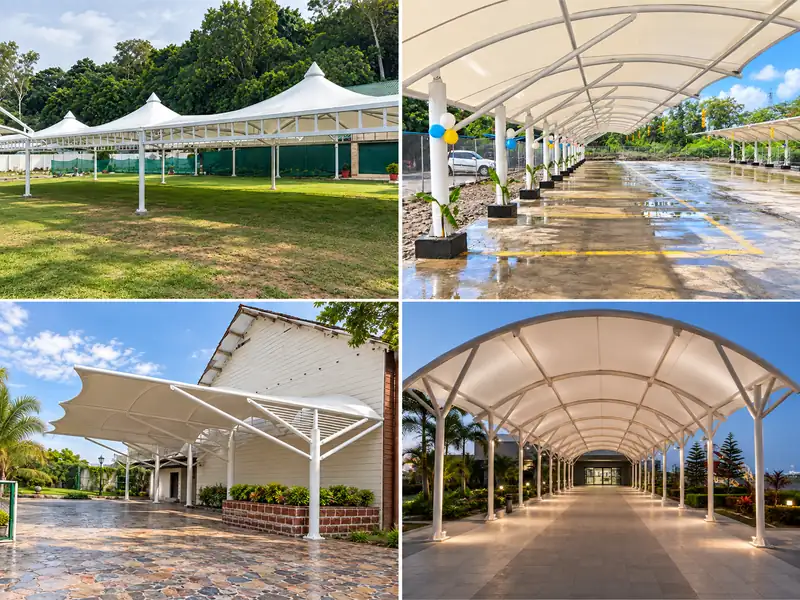
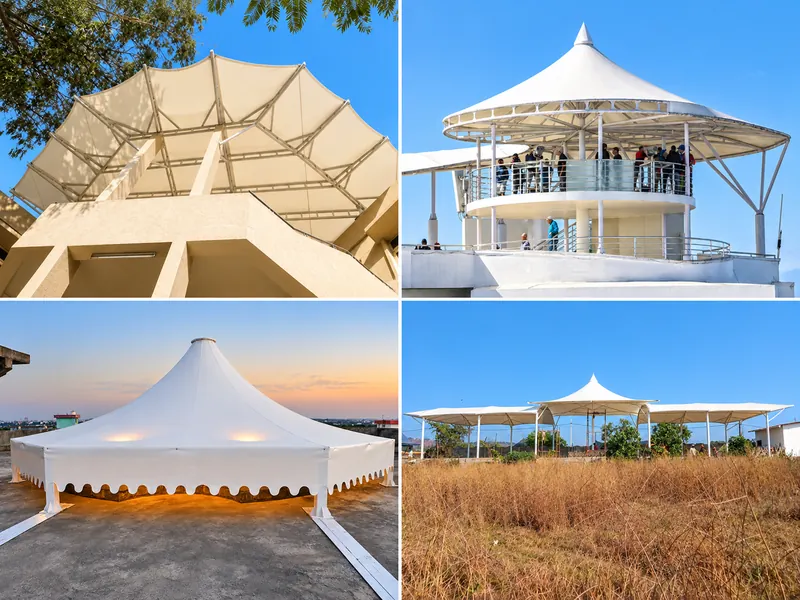
These references show membrane canopies we have built over lawns, entrances, parking areas and terraces. They are useful for comparing fabric colours and mast finishes, while the corner heights of each hypar are set for its own site. View more ShadeCo India projects.
Service Availability Across India
ShadeCo India provides hypar tensile structure solutions across major cities and regions in India. Our coverage includes Delhi, Gurugram, Faridabad, Noida, Lucknow, Chandigarh, Ludhiana, Jaipur, Jodhpur, Shimla, Dehradun, Haridwar, Bhopal, Indore, Gandhinagar, Ahmedabad, Patna, Muzaffarpur, Mumbai, Pune, Bengaluru, Hyderabad, Chennai and Kochi. Other locations are taken up based on project scope and site requirements.
Each hypar is planned around the local sun path, wind exposure and the soil or slab where the masts will stand. In parks, schools and hotels, we fence off the mast area while footings cure, so visitors and children stay clear.
Planning a Hypar Tensile Structure?
If you are planning shade for a garden, plaza, forecourt, play area or café front, ShadeCo India can help with the hypar form. We advise on corner positions, mast heights and the right fabric for the space.
We request you to share a site plan or photographs, the approximate area, the points where masts or wall fixings are possible and the project location. Our team will review these details and propose a hypar layout with suitable heights and drainage.
Kindly call us on +91-9873975818, email info@shadecoindia.com, or use our contact page to send your requirements.
FAQ
Frequently Asked Questions - Hypar Tensile Structure
A hypar tensile structure is a fabric canopy fixed at alternating high and low corners, which twists the surface into a saddle shape. The name comes from the hyperbolic paraboloid, the geometric form it follows. It shades seating, plazas and forecourts using only corner masts or wall fixings.
Each hypar is quoted on its own design. Size, number of corners, mast height, fabric type, footings and finish all affect the price, and HDPE costs less than PVC or PVDF. ShadeCo India can quote once it has the area, site photos and location.
Choose PVC or PVDF-coated polyester if the hypar must keep out rain. PVDF stays cleaner and carries a warranty of up to 10 years. PTFE-coated glass fibre costs more and suits long-life permanent canopies. HDPE shade net is breathable and cooler underneath but gives shade only, so it suits play areas and gardens.
With PVC, PVDF or PTFE fabric, a hypar is waterproof and drains to its two low corners, though open sides let slanting rain in. The twisted shape resists flapping in wind. Masts, cables and footings are designed for the site wind load as per IS 875 (Part 3).
Steel masts and fittings have an expected service life of 25–30 years when maintained. PVDF fabric has a warranty of up to 10 years, subject to the manufacturer's terms. Checking cable tension and corner fittings once a year keeps the twist in shape.
The size is set by the mast positions, the corner heights and the fabric. Because the edges curve inwards, the shaded area is smaller than the square between the masts. Larger areas are usually covered with a multi-point roof or a cluster of overlapping hypars.
Delivery typically takes 3–6 weeks, depending on the number of hypars, their size and customization. That period covers the form study, mast fabrication, fabric patterning and fitting at site. Footings are cast first and allowed to gain strength before the fabric is tensioned.
Both use the same twisted four-corner shape. A hypar tensile structure is an engineered canopy with designed masts, edge cables and footings, often in waterproof PVC or PVDF. A hypar shade sail is a lighter sail, usually in shade net, fixed to simpler posts or walls.
