
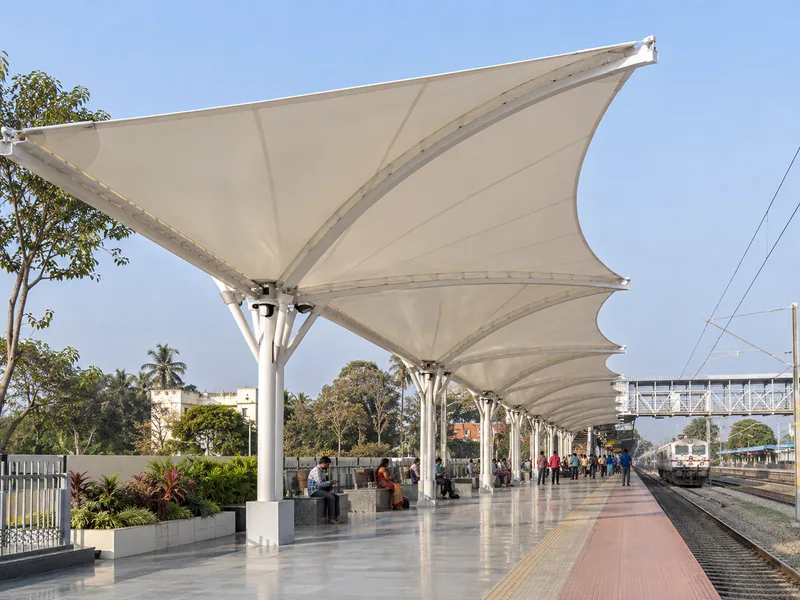
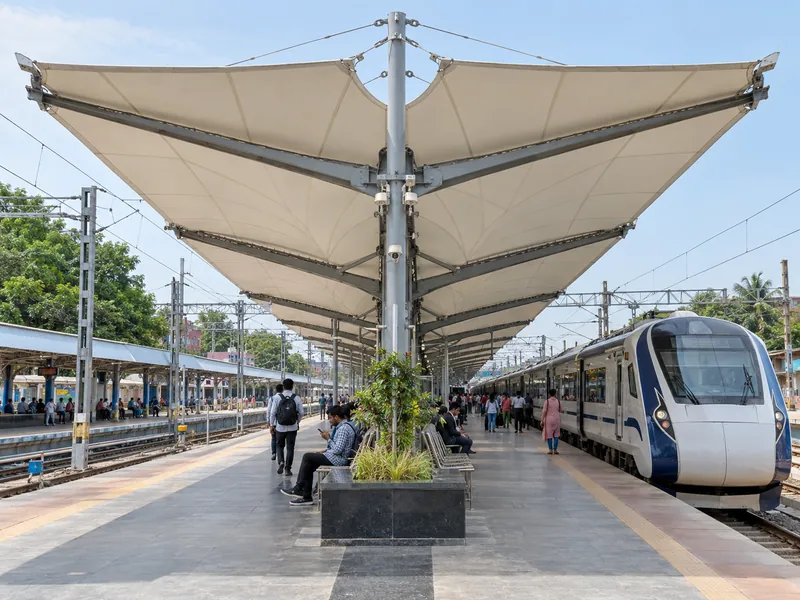
A railway platform tensile roof is a fabric roof on steel columns that shelters passengers along a station platform. It is also known as a platform shelter, railway platform canopy, platform shed membrane or station platform roof. It is used at railway stations, halt stations, suburban stations, freight terminals and station foot overbridges.
ShadeCo India Private Limited is a railway platform tensile roof manufacturer and supplier in India. We design, fabricate, supply and install centre-column butterfly roofs, single-side cantilever roofs, arched platform canopies, island platform double cantilevers and foot overbridge covers. Fabric options are PVC, PVDF and PTFE-coated fabric for rain cover, with FR grade available, and HDPE shade net for shade-only areas.
Planning starts with the platform's clearance limits set by the railway. We check the distance to the track, the platform edge and the overhead electric lines, because no part of the roof may enter those zones. Then we mark passenger waiting zones, coach positions, foot overbridges and display boards.
Railway Platform Tensile Roof at a Glance
- Structure Types: Centre-column butterfly, single-side cantilever, arched, island double cantilever and FOB covers
- Fabric: PVC, PVDF or PTFE-coated fabric with FR grade available, or HDPE shade net for shade-only stretches
- Frame Material: Mild steel (MS) or galvanized steel (GI) columns along the platform with cantilever arms or arches
- Surface Finish: Hot-dip galvanizing or epoxy paint for station exposure, with powder coating or automotive paint options
- Suitable For: Railway stations, suburban and halt stations, freight terminals and foot overbridges
- Service Area: Platform shelters designed, supplied and installed across India
Why Choose a Railway Platform Tensile Roof
A railway platform tensile roof gives waiting passengers shade and rain cover along the length of the platform. Many platforms have cover only near the station building, so passengers boarding at the far coaches stand in the open. A fabric roof can extend cover quickly with slim columns.
Fabric is light, so columns and foundations stay small on existing platforms. Parts are made off site and fitted in short work windows, which suits running stations. The bright fabric also lifts the look of older stations.
Types of Railway Platform Tensile Roofs
The right platform roof depends on the platform width, whether it is a side or island platform and the clearances to the tracks.
Centre-Column Butterfly Roof
A single row of columns runs along the platform centre, and the roof slopes in to a central gutter. Rain drains down the columns, away from the tracks and passengers.
Single-Side Cantilever Roof
Columns stand at the back of a side platform, and the roof reaches toward the track. The platform edge stays free of columns for boarding.
Arched Platform Canopy
Curved arches span the platform width, giving height in the middle. It suits wide platforms and gives the station a modern look.
Island Platform Double Cantilever
Central columns carry arms on both sides, covering passengers boarding trains on either track. It is common on island platforms between two lines.
Foot Overbridge Cover
A fabric roof covers the stairs and deck of a foot overbridge. For covered links between station buildings and parking, see our walkway tensile structures.
Custom Platform Design: Track Clearances, Passenger Flow and Block-Time Installation
Railway clearances come first. Every column, arm and fabric edge is checked against the railway's schedule of dimensions for the track and overhead electric lines. The roof is designed so wind cannot push the fabric into those zones.
Passengers need clear space to walk, wait and board. Columns stand in line with benches, stalls and display boards, leaving open lanes along the platform. Fans, lights, PA speakers and train display boards fix to the steel frame.
Most station work happens during short traffic blocks. We make parts in the workshop and size them for quick lifting and bolting. Rainwater is led into platform drains, never onto the track bed.
Technical Specifications
These details are a general guide for railway engineers, contractors and station developers. The final layout, clearances and fabric are confirmed against the railway's approved drawings and site conditions.
Structural & Fabric Specifications
| Specification | Details |
|---|---|
| Structure Types | Centre-Column Butterfly, Cantilever, Arched, Island Double Cantilever, FOB Cover or Custom |
| Frame Material | Mild Steel (MS) or Galvanized Steel (GI) columns, arms and arches |
| Surface Finish | Automotive Paint, Epoxy Paint, Powder Coating or Hot-Dip Galvanizing |
| Railway Clearances | Checked against the schedule of dimensions for tracks and overhead electric lines |
| Fabric Types | PVC-Coated Polyester, PVDF-Coated Polyester, PTFE-Coated Glass Fibre or HDPE Shade Net |
| Fabric Grade | FR grade available; 750 – 900 GSM coated fabric for short bays, 1050 GSM or heavier for wide platform spans |
| Rain Protection | Waterproof with PVC, PVDF or PTFE; HDPE gives shade only |
| UV Protection | Up to 98% UV blocking, depending on the fabric |
| Temperature Resistance | −30°C to +70°C |
| Length and Width | Set by platform length, width and coach positions (Customizable) |
| Drainage | Central or edge gutters to platform drains, away from the track |
| Add-Ons | Provision for Lights, Fans, PA Speakers and Train Display Boards |
| Wind Load Design | Columns, arms and foundations designed as per IS 875 (Part 3) |
| Fabric Warranty | Up to 10 years on PVDF fabric, subject to manufacturer's terms |
Key Features
| Feature | Details |
|---|---|
| Waterproof PVC / PVDF / PTFE Fabric | Keeps waiting passengers and luggage dry along the platform |
| UV-Resistant Coating | Blocks up to 98% of UV rays, depending on the fabric, on open platforms |
| Anti-Wicking Fabric | Sealed edges stop rain wicking into the fabric at gutters and arms |
| Fungicide Finish | Prevents mould on platforms near water bodies and humid coastal lines |
| Moisture and Corrosion Resistant | Galvanized or epoxy-painted steel resists rust from rain and brake dust |
| Dirt-Resistant Top Coat | PVDF top coat helps the roof shed diesel soot and dust |
| Flame-Retardant Grade Available | FR-grade fabric available for station projects |
| All-Weather Performance | Columns and arms designed for site wind loads as per IS 875 (Part 3) |
Benefits of Railway Platform Tensile Roofs
A platform roof gives every passenger shelter, not only those near the station building.
- Full-Length Shelter: Cover reaches the far coaches where passengers often wait in the open.
- Clear Boarding: Columns stay back from the platform edge.
- Quick to Install: Off-site fabrication fits short railway traffic blocks.
- Light on Platforms: Fabric keeps columns and foundations small.
- Bright Stations: Light fabric brightens platforms in the day.
- Room for Station Services: Fans, lights, PA and display boards fix to the frame.
Applications of Railway Platform Tensile Roofs
Railway stations use tensile roofs to extend platform cover along the full train length. Suburban and halt stations use them as complete platform shelters. For roofs held from one side over long waiting areas, see our cantilever shade structures.
Station redevelopment projects use fabric roofs over forecourts, foot overbridges and concourses. Freight terminals cover loading platforms and parcel areas. Metro and bus terminals use similar roofs at their own platforms and bays.
Railway Platform Tensile Roof Price in India: What Affects the Cost
The cost of a railway platform tensile roof depends mainly on the length and width of platform to be covered. Centre-column roofs use fewer columns than two-sided frames on the same platform.
Fabric grade, FR requirements, roof form, fans, lights, display board fixings, finish and foundations change the figure. On platform roofs, PTFE fabric is the most costly option and HDPE the least. Work in short traffic blocks also affects the schedule and cost.
For a quotation, share the platform length and width, the type of platform, any railway drawings, site photographs and the station location.
How We Design and Install a Railway Platform Tensile Roof
Platform work happens beside running trains, so clearances and block planning guide every step.
- Step 1 – Platform survey: We measure the platform, record track and overhead line clearances, and mark drains, cables and existing structures.
- Step 2 – Layout and drawings: We propose the roof form, column positions and drainage, checked against the railway's clearance limits.
- Step 3 – Engineering: Columns, arms and foundations are designed for platform loads and the site wind load as per IS 875 (Part 3).
- Step 4 – Fabrication: Steel is galvanized or painted in our workshop and made in parts sized for quick lifting.
- Step 5 – Installation: Foundations and columns are fixed in agreed work windows, then arms, fabric and gutters are fitted in sections.
- Step 6 – Handover: We check clearances, gutters and fixings, and share an inspection schedule with the station team.
Railway Platform Tensile Roof Design and Installation Solutions
ShadeCo India builds platform roofs for railway stations, halt stations and freight terminals. Our team plans each roof around railway clearances and work windows, so passengers get cover without disrupting trains.
Why Work with ShadeCo India
ShadeCo India was established in 2010 and has more than 15 years of tensile structure work behind it. It is ISO 9001:2015 certified, with its own engineers, fabricators and installers. This lets one team handle clearance checks, fabrication and block-time erection.
Indian Railways is among our clients, along with Delhi Public School, Food Corporation of India, L&T, TATA, Adani, Al-Karim University, Indian Oil, Omaxe, VIVO, Lakhani and Reliance. We have also worked for several other organizations across India.
On every platform roof, we check clearances to tracks and overhead lines, gutters and fixings before handover. Delivery typically takes 3–6 weeks, depending on platform length and customization.
You can also see our bus stop tensile shelters, covered corridor tensile structures and the full range of tensile structures.
Explore Our Projects & Design References
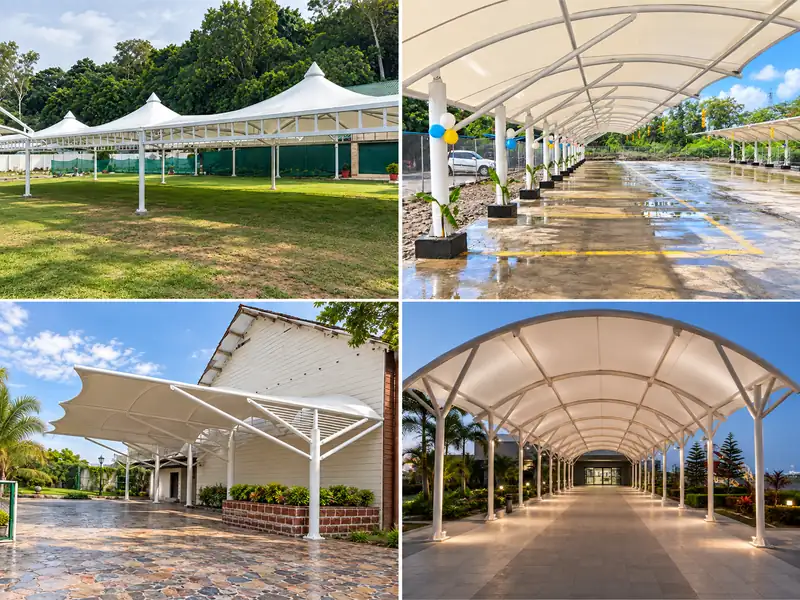
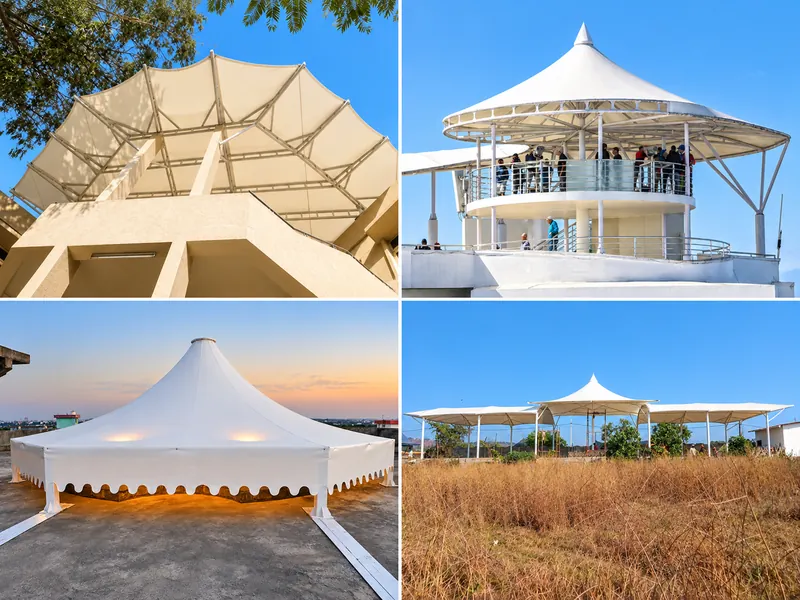
Below are our canopies over parking, entrances, lawns and terraces. They help when comparing column finishes and fabric forms for a platform, while each platform roof follows railway clearances. View more ShadeCo India projects.
Service Availability Across India
ShadeCo India provides railway platform tensile roof solutions across major cities and regions in India. Station projects can be taken up in Delhi, Gurugram, Faridabad, Noida, Lucknow, Chandigarh, Ludhiana, Jaipur, Jodhpur, Shimla, Dehradun, Haridwar, Bhopal, Indore, Gandhinagar, Ahmedabad, Patna, Muzaffarpur, Mumbai, Pune, Bengaluru, Hyderabad, Chennai and Kochi. Other stations are considered based on project scope and site requirements.
Each platform roof is planned around local rainfall, wind and the station's train timetable. We agree traffic blocks and safety arrangements with the railway before site work starts.
Planning a Railway Platform Tensile Roof?
If you are planning platform shelters, FOB covers or station forecourt roofs, ShadeCo India can advise on roof form, clearances and fabric.
We request you to share the platform length and width, platform type, any railway drawings and site photographs. Please also mention the station location, so our team can propose a suitable roof.
Please contact us on +91-9873975818, email info@shadecoindia.com, or send your details through our contact page.
FAQ
Frequently Asked Questions - Railway Platform Tensile Roof
A railway platform tensile roof is a tensioned fabric shelter on steel columns that protects people waiting on a station platform. It covers waiting and boarding areas from sun and rain. It is designed within the railway's clearances to tracks and overhead lines.
Cost depends on platform length and width, roof form, fabric, FR grade and fittings for fans and boards. PTFE is the highest-cost fabric, and HDPE the lowest. ShadeCo India quotes from platform size, drawings and location.
PVC or PVDF-coated fabric is usual for platforms that need rain cover, and FR grade is available. PVDF sheds soot and dust better and has a warranty of up to 10 years. PTFE suits flagship stations, and HDPE only gives shade.
Yes, when designed within the railway's clearance limits. Every part is checked against the schedule of dimensions, and the fabric is tensioned so wind cannot push it into those zones. Wind load follows IS 875 (Part 3).
Galvanized or painted platform columns and arms are expected to last 25–30 years with checks. PVDF fabric on platform roofs is warranted for up to 10 years, subject to the manufacturer's terms.
Yes. Parts are made off site, and site work is done in short traffic blocks agreed with the railway. Columns and roof sections are fixed in stages along the platform.
A platform roof is usually delivered in 3–6 weeks, depending on length and design. Site work time also depends on the traffic blocks available.
A centre-column double cantilever is common, as one row of columns covers boarding on both tracks. A butterfly roof drains rain to the centre, keeping water off the tracks. The choice depends on width and clearances.
