
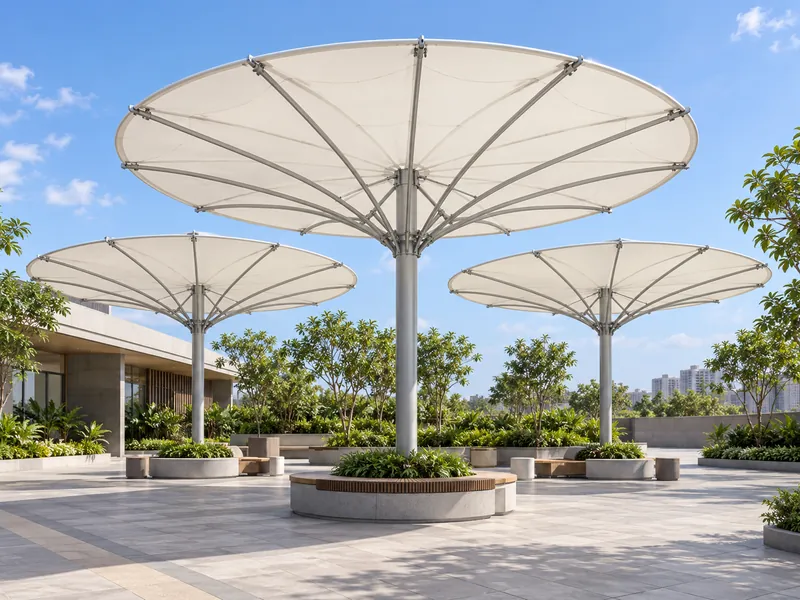
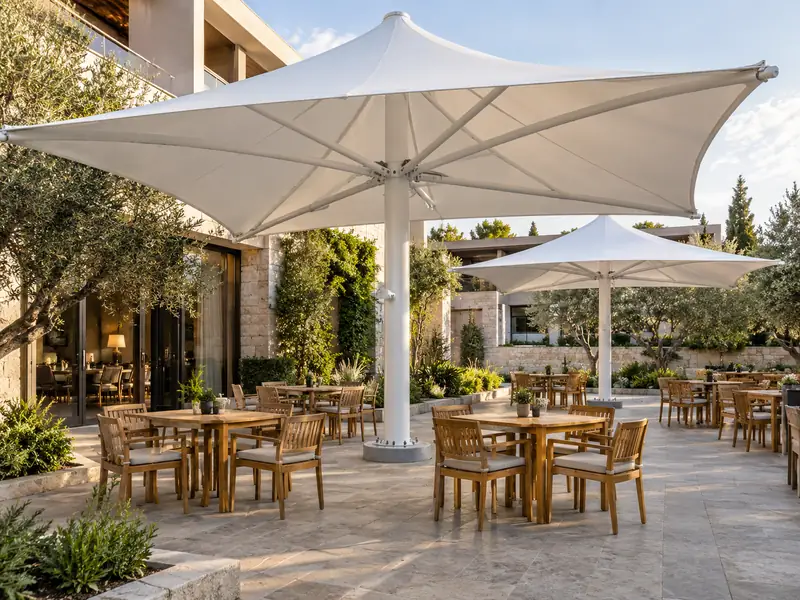
An architectural umbrella structure, also known as a tensile umbrella, umbrella canopy, membrane umbrella or umbrella shade structure, is a fabric roof supported by a central mast and arms that spread out beneath the cover. It creates a shaded seating or waiting area with open sides and few supports at ground level. These structures are used in plazas, café seating areas, hotel gardens, poolside decks and public spaces.
ShadeCo India Private Limited is an architectural umbrella structure manufacturer and supplier in India. We design, fabricate, supply and install circular, square, side-post and grouped tensile umbrellas, with fabric, colours and frame finishes selected for the site. A single umbrella can cover a seating island, while a group can shade several tables or rest areas across a larger space.
The first decision is where the mast will stand. It can sit in the middle of a table or seating island, or to one side where the floor needs to stay clear. We then plan the roof size, edge height and rainwater outlet around the furniture, paths and nearby buildings.
Architectural Umbrella Structures at a Glance
- Structure Types: Central-mast, square, circular, side-post, inverted and grouped umbrella canopies
- Fabric: PVC or PVDF-coated polyester for shade and rain cover, or HDPE shade net for shade only
- Frame Material: Mild steel (MS) or galvanized steel (GI) mast, radial arms and connections
- Surface Finish: Automotive paint, epoxy paint, powder coating or hot-dip galvanizing
- Suitable For: Plazas, cafés, resorts, gardens, pool decks, campuses and outdoor waiting areas
- Service Area: Design, supply and installation across India
Why Choose an Architectural Umbrella Structure
A central-mast umbrella keeps the outer edge free of columns, so chairs and people can move around the seating area. In a plaza, the mast can be built into a planter or a circular bench. At a café, tables can sit around it without a row of posts along the front.
The shape also suits spaces that need separate pockets of shade. Instead of covering the whole courtyard, umbrellas can be placed over occupied areas while leaving paths and planted spaces open. The roof outline, fabric colour and frame finish can be matched to the building.
Types of Architectural Umbrella Structures
The right umbrella depends on where the mast can stand, the shape of the seating area and whether rainwater should fall at the edge or in the centre.
Central-Mast Circular Umbrella
A round or multi-sided membrane is carried by arms connected to a mast in the centre. It works well over circular benches, garden seating and meeting points where people approach from different directions.
Square or Rectangular Umbrella Canopy
Straight-sided umbrellas fit rows of tables, paved seating bays and spaces beside buildings. Several units can be placed side by side, and where continuous rain cover is needed, gutters are added between them.
Side-Post Umbrella Structure
The mast stands to one side of the covered area, so the space under the roof stays open for tables or loungers. It is useful beside a pool or over a café table, and the mast, arm and foundation are made heavier because they hold the roof from one side.
Inverted Umbrella
The fabric falls towards the centre instead of rising to a peak. Water is collected at the middle and can drain through the support column. This arrangement suits plazas where rainwater should not fall from the outer edge. See our inverted umbrella structures for this roof form.
Grouped Umbrella Canopies
Two or more umbrellas can shade a food court, a campus rest area or a long seating zone. Their spacing is planned around the furniture and the direction of the sun, and they can stand as separate units or be linked with gutters between them.
Custom Umbrella Design: Mast Position, Shade and Drainage
The shade on the ground moves with the sun, so we look at the hours when the area is busy and where the afternoon sun comes from. The canopy is usually made a little larger than the seating below it, with enough height at the edge for people to walk underneath comfortably.
On a standard umbrella, rain runs off at the outer edge, so the umbrella is placed where that water will not fall on doors or seating, or gutters are added. An inverted umbrella collects water in the centre and drains it down through the mast, with an outlet that can be reached for cleaning.
Each mast sits on its own foundation or is bolted to the existing slab after a structural check. On terraces and pool decks, we check the slab, the waterproofing and any pipes or cables below before marking fixing points. Lighting cables can run inside or along the mast.
Technical Specifications
These details are a general guide for architects, facility teams and site owners. The final umbrella size, fabric grade, mast and foundation are confirmed after we study the seating layout and the site.
Structural & Fabric Specifications
| Specification | Details |
|---|---|
| Structure Types | Central-Mast, Circular, Square, Rectangular, Side-Post, Inverted or Grouped |
| Frame Material | Mild Steel (MS) or Galvanized Steel (GI) |
| Surface Finish | Automotive Paint, Epoxy Paint, Powder Coating or Hot-Dip Galvanizing |
| Support System | Central Mast with Radial Arms, or Side-Post (Cantilever) Mast |
| Fabric Types | PVC-Coated Polyester, PVDF-Coated Polyester or HDPE Shade Net |
| Fabric Weight | 750 – 900 GSM for coated fabrics, chosen by umbrella size |
| Rain Protection | Waterproof with PVC / PVDF; HDPE gives shade only |
| UV Protection | Up to 98% UV blocking, depending on the fabric |
| Temperature Resistance | −30°C to +70°C |
| Size and Edge Height | Set by the seating, paths and area to be shaded (Customizable) |
| Drainage | Outer edge or gutters for standard umbrellas; through the mast for inverted umbrellas |
| Add-Ons | Provision for Lighting and Seating Around the Mast |
| Wind Load Design | Mast, arms, fixings and foundation designed for the site as per IS 875 (Part 3) |
| Fabric Warranty | Up to 10 years on PVDF fabric, subject to manufacturer's terms |
Key Features
| Feature | Details |
|---|---|
| Waterproof PVC / PVDF Fabric | Keeps rain off the tables and benches under each umbrella |
| UV-Resistant Coating | Blocks up to 98% of UV rays, depending on the fabric, over seating and waiting areas |
| Anti-Wicking Fabric | Coated edges stop water from travelling into the fabric at the arm and corner fixings |
| Fungicide Finish | Helps keep the underside free of mould spots in humid garden and poolside settings |
| Moisture and Corrosion Resistant | Mast, arms and fittings protected by galvanizing, powder coating, epoxy or automotive paint |
| Dirt-Resistant Top Coat | PVDF top coat keeps light-coloured umbrellas looking clean for longer |
| Flame-Retardant Grade Available | FR-grade fabric on request for hotels, food courts and public spaces |
| All-Weather Performance | Mast, arms and foundation designed for site wind loads as per IS 875 (Part 3) |
Benefits of Architectural Umbrella Structures
Umbrella canopies give shade exactly where people sit, without closing in the space around them.
- Fewer Posts Around Seating: A central mast leaves the canopy edge open for chairs and circulation.
- Shade in Separate Areas: Individual umbrellas cover tables or benches without roofing the entire site.
- Open Views: Open sides keep the garden, pool or plaza visible from under the canopy.
- Flexible Layout: Circular and square modules can follow seating islands, pathways or outdoor dining rows.
- Space Around the Mast: The base can be incorporated into a table, planter or bench, with maintenance access retained.
- Choice of Appearance: Fabric colour and steel finish can match the surrounding building and furniture.
Applications of Architectural Umbrella Structures
Cafés, restaurants and food courts use umbrella canopies to shade groups of tables. Hotels and resorts place them beside pools, on lawns and near outdoor lounges. Side-post layouts are useful where a central pole would interrupt a dining table or a row of loungers.
In public plazas, business parks and campuses, central-mast umbrellas cover benches and waiting points. Housing societies can use them near clubhouse gardens and shared seating. For a shelter with columns around its edge, explore our gazebo tensile structures; for a wider choice of roof shapes, see architectural tensile structures.
Architectural Umbrella Structure Price in India: What Affects the Cost
The cost of an architectural umbrella depends mainly on its size, the number of units and the fabric grade. A side-post umbrella needs a heavier mast and foundation than a central-mast umbrella of the same size, and fixing to a terrace slab or working in a tight space can add to the work.
The surface finish, gutters, central drainage for inverted umbrellas, lighting and seating around the base also change the final figure.
For a quotation, share the number of umbrellas, the approximate width or diameter, the seating layout, site photographs and the location.
How We Design and Install an Architectural Umbrella Structure
Each umbrella stands on a single support, so the mast position and foundation get the most attention at every stage.
- Step 1 – Site visit: Measure the seating area, identify paths and services, and check where the mast can stand.
- Step 2 – Layout and drawings: Agree the roof shape, covered area, mast position, edge height and colours.
- Step 3 – Engineering: Design the membrane, radial arms, mast, anchors and foundation for the site wind load as per IS 875 (Part 3).
- Step 4 – Fabrication: Prepare and finish the steel frame, then cut and join the membrane panels to the approved pattern.
- Step 5 – Installation: Fix the mast, assemble the arms, fit and tension the fabric, and connect any drainage or lighting.
- Step 6 – Handover: Check the fixings, fabric tension and water outlets, and explain cleaning and inspection requirements.
Architectural Umbrella Structure Design and Installation Solutions
ShadeCo India supplies umbrella structures for outdoor dining, garden seating and shared public spaces. Our team plans the canopy and the space beneath it together, so the mast does not block a walkway and roof water does not discharge onto a table.
Why Work with ShadeCo India
ShadeCo India was established in 2010 and is ISO 9001:2015 certified, with more than 15 years of work on tensile structures. Our in-house engineers, fabricators and installers take each umbrella from the approved layout to installation, and the frame finish, fabric grade and fixing details are agreed before fabrication starts.
Organizations we have worked with include Delhi Public School, Food Corporation of India, L&T, TATA, Adani, Al-Karim University, Indian Oil, Omaxe, VIVO, Lakhani, Indian Railways, Reliance and several other organizations across India.
For umbrella roofs, we check the mast position, arm connections, edge clearance and fabric tension before handover. Delivery typically takes 3–6 weeks, depending on the number of units, size and customization. You can also explore our conical tensile structures and the full tensile structures range.
Explore Our Projects & Design References
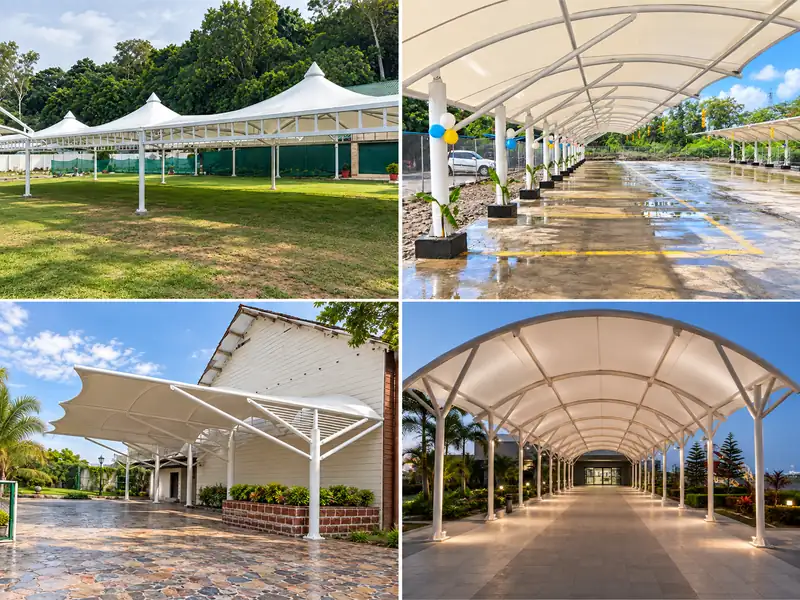
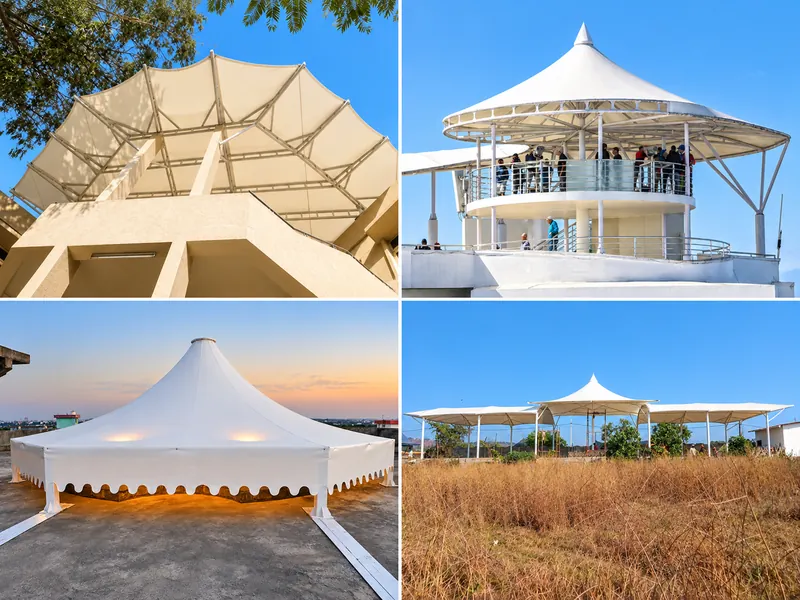
These project collages show different membrane roofs and supporting frames. The pavilion and canopy examples help explain roof shapes and steel connections when planning an umbrella structure. View more ShadeCo India projects.
Service Availability Across India
ShadeCo India provides architectural umbrella structure solutions across major cities and regions in India, including Delhi, Gurugram, Faridabad, Noida, Lucknow, Chandigarh, Ludhiana, Jaipur, Jodhpur, Shimla, Dehradun, Haridwar, Bhopal, Indore, Gandhinagar, Ahmedabad, Patna, Muzaffarpur, Mumbai, Pune, Bengaluru, Hyderabad, Chennai and Kochi, along with other locations based on project scope and site requirements.
The layout is planned around the seating, sun exposure and local weather. We also check access for the mast and frame, particularly where installation is inside an operating hotel, campus or commercial courtyard.
Planning an Architectural Umbrella Structure?
If you are planning shade for a café, plaza, pool deck, hotel garden or campus seating area, ShadeCo India can advise on the umbrella type, size, fabric and mast position best suited to the space.
We request you to share the number of seating areas to be covered, whether the mast can stand in the middle, an approximate width or diameter, site photographs and the project location. Our team will review these details and recommend a suitable umbrella layout.
Please call +91-9873975818, write to info@shadecoindia.com, or send your requirements through our contact page.
FAQ
Frequently Asked Questions - Architectural Umbrella Structure
An architectural umbrella structure is a permanent fabric canopy held up by a steel mast and arms under the roof. Most have a central mast, while side-post versions keep the middle open. They are used to shade seating, dining and waiting areas in plazas, cafés, gardens and pool decks.
The price depends on the umbrella size, the number of units, the fabric, the frame finish, foundations and site access. A side-post umbrella costs more than a central-mast one of the same size because of its heavier mast and foundation. Send the size, photographs and location to ShadeCo India for a quotation.
A garden umbrella is portable and stands on a movable base. An architectural umbrella is a fixed structure with a steel mast, tensioned fabric and a proper foundation, designed for the site and the local wind. It stays in place all year and covers a much larger area.
Yes. A side-post or cantilever umbrella has its mast beside the covered area, so the space under the roof stays clear for tables or loungers. The mast, arm and foundation are made stronger to hold the roof from one side.
Yes, when it is made with PVC or PVDF-coated fabric with welded seams. HDPE shade net gives shade only and is not waterproof. Because the sides are open, rain blown by strong wind can still reach seating near the edge.
Fabric options are PVC-coated polyester, PVDF-coated polyester and HDPE shade net, in a range of colours. The steel frame can be finished with automotive paint, epoxy paint, powder coating or hot-dip galvanizing. PVDF fabric comes with a warranty of up to 10 years.
Yes. ShadeCo India designs the mast, arms, fabric and foundation for the wind load at the site as per IS 875 (Part 3). The fabric is tensioned so it does not flap, and the fixings and tension should be checked periodically and after a storm.
Delivery typically takes 3–6 weeks, depending on the size, the number of umbrellas and the level of customization. The time includes design approval, workshop fabrication and fixing the umbrellas on site.
