
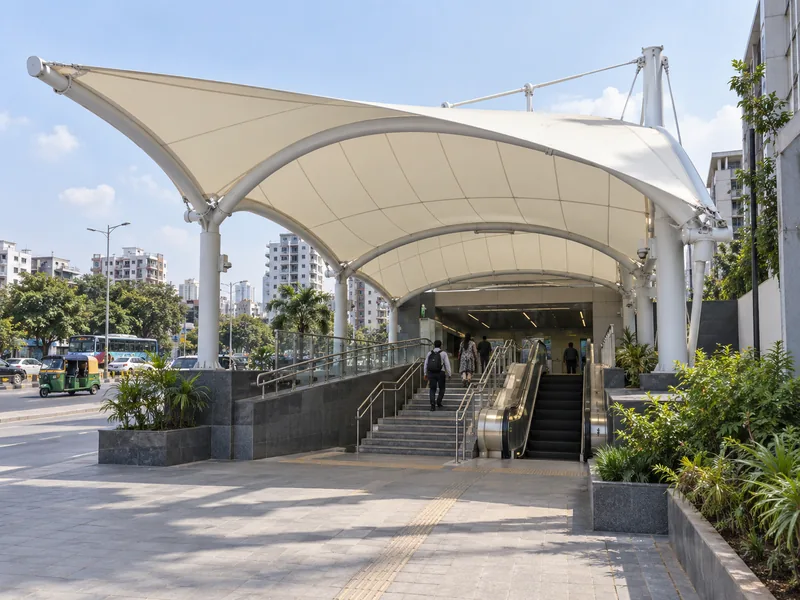
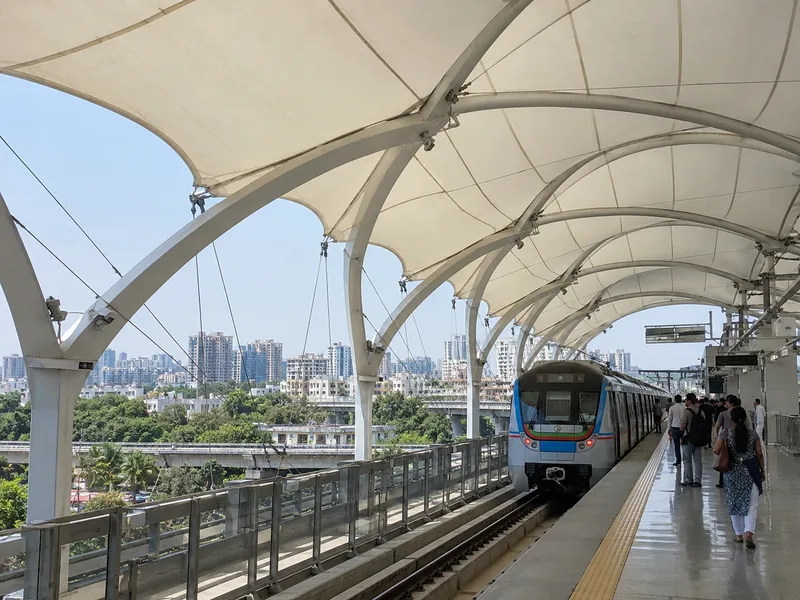
A metro station tensile structure is a fabric roof that covers metro entries, escalators, elevated platforms or station forecourts. It is also known as a metro entry canopy, metro escalator cover, metro platform membrane roof or station tensile canopy. It is used at elevated and underground metro stations, rapid rail stations, monorail stops and multimodal transit hubs.
ShadeCo India Private Limited is a metro station tensile structure manufacturer and supplier in India. We design, fabricate, supply and install entry and exit staircase canopies, escalator covers, elevated platform roofs, forecourt canopies and feeder bus bay covers. Fabric is chosen from PVC, PVDF and PTFE-coated fabric with FR grade for station use, and HDPE shade net for open shade areas only.
Planning begins with the station's design limits from the metro authority. We review the station drawings, clearances, fire rules and the zones that must stay open for passengers. Then we fit the canopy around stairs, escalators, lifts and the street outside.
Metro Station Tensile Structure at a Glance
- Structure Types: Entry staircase canopies, escalator covers, elevated platform roofs, forecourt canopies and feeder bay covers
- Fabric: FR-grade PVC, PVDF or PTFE-coated fabric for station areas, or HDPE shade net for open forecourt shade
- Frame Material: Mild steel (MS) or galvanized steel (GI) arches and frames coordinated with station structure
- Surface Finish: Epoxy paint or powder coating in station colours, over hot-dip galvanizing for exposed locations
- Suitable For: Elevated and underground metro stations, rapid rail stations, monorail stops and transit hubs
- Service Area: Metro station canopies designed, supplied and installed across India
Why Choose a Metro Station Tensile Structure
A metro station tensile structure keeps rain off stairs and escalators, where wet steps and water in escalator pits cause slips and breakdowns. It also shades passengers queuing at entries in summer. Fabric does this with a light frame that fits narrow footpaths.
Metro stations are city landmarks, and fabric gives them a modern, recognisable outline. Parts are made off site and fixed in short night windows, which suits busy stations. Light fabric also brings soft daylight into entries and concourses.
Types of Metro Station Tensile Structures
The right metro canopy depends on whether it covers an entry, an escalator, a platform or a forecourt.
Entry and Exit Staircase Canopy
A curved or arched canopy covers the stairs from the street to the concourse. It keeps steps dry and marks the entry clearly from the road.
Escalator Cover
A canopy over a street-level escalator keeps rain out of the steps and pit. This reduces breakdowns and slips during the monsoon.
Elevated Platform Roof
A fabric roof covers passengers on an elevated platform, fixed to the station frame. It must handle high wind on the viaduct. For roofs at railway platforms, see our railway platform tensile roofs.
Station Forecourt Canopy
A canopy shades the area outside the station where passengers wait, meet or queue for transport.
Feeder Bus Bay Cover
Canopies cover feeder bus bays, auto stands and walkways that link the station to nearby areas. For standalone bus shelters, see our bus stop tensile shelters.
Custom Metro Canopy Design: Entry Clearances, Viaduct Wind and Night-Window Installation
Entries sit on busy footpaths, so canopies must keep passenger flow open. We set headroom over stairs and escalators and keep supports out of queues and exits. The canopy is also kept clear of street trees and signals.
Elevated stations stand high above the street and face strong wind. Frames and fixings are designed for that exposure and checked with the station structure. Fabric is tensioned firmly, so it does not flap near trains or overhead equipment.
Metro work is usually allowed only at night, after services stop. We make parts off site in sizes that can be lifted and fixed within those hours. Drainage is led to station drains, never into escalator pits or stairwells.
Technical Specifications
These details are a general guide for metro authorities, EPC contractors and station architects. The final design, fabric and fixing details are confirmed against the metro authority's drawings and rules.
Structural & Fabric Specifications
| Specification | Details |
|---|---|
| Structure Types | Entry Canopy, Escalator Cover, Elevated Platform Roof, Forecourt Canopy, Feeder Bay Cover or Custom |
| Frame Material | Mild Steel (MS) or Galvanized Steel (GI) arches and frames |
| Surface Finish | Automotive Paint, Epoxy Paint, Powder Coating or Hot-Dip Galvanizing |
| Clearances | Headroom over stairs and escalators; supports kept out of passenger flow |
| Fabric Types | PVC-Coated Polyester, PVDF-Coated Polyester, PTFE-Coated Glass Fibre or HDPE Shade Net |
| Fabric Grade | FR grade for station areas; 750 – 900 GSM coated fabric for entries, 1050 GSM or heavier for platform spans |
| Rain Protection | Waterproof with PVC, PVDF or PTFE; HDPE gives shade only |
| UV Protection | Up to 98% UV blocking, depending on the fabric |
| Temperature Resistance | −30°C to +70°C |
| Size and Height | Set by stair, escalator and platform layout (Customizable) |
| Drainage | Gutters to station drains, away from escalator pits and stairwells |
| Add-Ons | Provision for Lighting, Signage and CCTV |
| Wind Load Design | Designed for elevated and street-level exposure as per IS 875 (Part 3) |
| Fabric Warranty | Up to 10 years on PVDF fabric, subject to manufacturer's terms |
Key Features
| Feature | Details |
|---|---|
| Waterproof PVC / PVDF / PTFE Fabric | Keeps stairs, escalators and platforms dry for passengers |
| UV-Resistant Coating | Blocks up to 98% of UV rays, depending on the fabric, at busy entries |
| Anti-Wicking Fabric | Sealed edges stop rain wicking into the fabric above escalators |
| Fungicide Finish | Resists mould in shaded entries and humid underground exits |
| Moisture and Corrosion Resistant | Galvanized and painted steel resists rust on busy streets |
| Dirt-Resistant Top Coat | PVDF top coat helps the canopy shed city dust and soot |
| Flame-Retardant Grade Available | FR-grade fabric for metro station use |
| All-Weather Performance | Frames designed for viaduct and street wind loads as per IS 875 (Part 3) |
Benefits of Metro Station Tensile Structures
Metro canopies protect passengers and equipment at the busiest points of a station.
- Dry Stairs and Escalators: Fewer slips and escalator faults in the monsoon.
- Shaded Queues: Passengers wait at entries in shade.
- Landmark Entries: A clear fabric outline makes entries easy to find.
- Night-Window Install: Off-site parts fit short work windows.
- Light on Structures: Fabric adds little load to stations and viaducts.
- Bright Entries: Daylight passes softly into stairs and concourses.
Applications of Metro Station Tensile Structures
Metro authorities use tensile canopies over street-level entries, exits and escalators. Elevated stations use them over platforms and concourse openings. For covered links between stations and nearby buildings, see our covered corridor tensile structures.
Rapid rail and monorail projects use similar canopies at their stations. Multimodal hubs cover forecourts, feeder bus bays and auto stands. Malls and offices linked to metro stations add canopies over their connecting entries.
Metro Station Tensile Structure Price in India: What Affects the Cost
The cost of a metro station tensile structure depends mainly on the area covered and the type of canopy. Elevated platform roofs need more engineering than street-level entry canopies.
FR-grade fabric, finish, lighting, signage, CCTV fixings and night-only work change the figure. Among the fabrics for metro canopies, PTFE is the most expensive and HDPE the least. Coordination with the metro authority also affects the schedule.
For a quotation, share the station drawings, the entries or areas to be covered, the metro authority's requirements and the location.
How We Design and Install a Metro Station Tensile Structure
Metro stations run every day, so design approvals and night work windows shape the whole process.
- Step 1 – Drawing review and survey: We study station drawings, clearances and rules, and survey entries, escalators and platforms on site.
- Step 2 – Layout and approvals: We prepare canopy layouts and details for the metro authority's review and approval.
- Step 3 – Engineering: Frames, fixings and footings are designed for the exposure and the site wind load as per IS 875 (Part 3).
- Step 4 – Fabrication: Steel and FR-grade fabric are made in our workshop in parts sized for night-time lifting.
- Step 5 – Installation: Work is done in approved night windows, with barricades and safety staff at each entry.
- Step 6 – Handover: We check clearances, drainage and fixings, and share inspection guidance with the station team.
Metro Station Tensile Structure Design and Installation Solutions
ShadeCo India builds canopies for metro entries, escalators, platforms and transit forecourts. Our team works to the metro authority's rules and night windows, so passengers get cover without service disruption.
Why Work with ShadeCo India
ShadeCo India has built tensile structures since 2010, more than 15 years, and is ISO 9001:2015 certified. Our in-house engineers, fabricators and installers handle approvals, fabrication and night-window erection as one team.
Indian Railways, L&T, TATA, Adani, Reliance, Indian Oil, Food Corporation of India, Omaxe, VIVO, Lakhani, Delhi Public School and Al-Karim University are among those we have worked with. Our clients also include several other organizations across India.
On every metro canopy, we check clearances, drainage away from escalators and fixing security before handover. Delivery typically takes 3–6 weeks, depending on scope and customization.
You can also see our public plaza shade structures, translucent membrane roofs and the full range of tensile structures.
Explore Our Projects & Design References
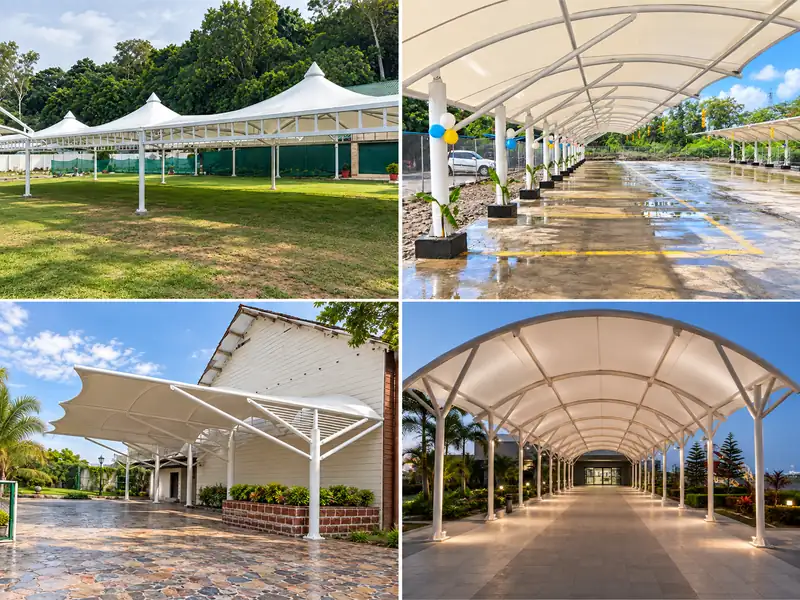
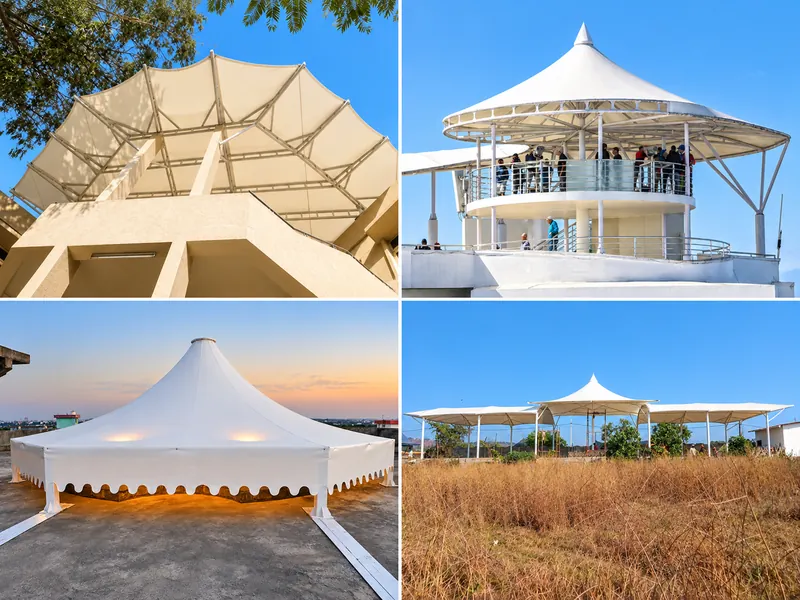
Shown below are our canopies over parking, entrances, lawns and terraces. They help when comparing frame finishes and fabric forms for transit spaces, while each metro canopy follows its station drawings. View more ShadeCo India projects.
Service Availability Across India
ShadeCo India provides metro station tensile structure solutions across major cities and regions in India. Transit projects can be supported in Delhi, Gurugram, Faridabad, Noida, Lucknow, Chandigarh, Ludhiana, Jaipur, Jodhpur, Shimla, Dehradun, Haridwar, Bhopal, Indore, Gandhinagar, Ahmedabad, Patna, Muzaffarpur, Mumbai, Pune, Bengaluru, Hyderabad, Chennai and Kochi. Other metro cities are served based on project scope and site requirements.
Each metro canopy is planned around local weather, station traffic and the authority's work windows. We plan night work, barricades and safety staff before mobilising to site.
Planning a Metro Station Tensile Structure?
If you are planning covers for metro entries, escalators, platforms or forecourts, ShadeCo India can advise on canopy form, fabric and fixing.
We request you to share the station drawings, the areas to be covered and the metro authority's requirements. Please also mention the location, so our team can plan a suitable canopy.
You may contact us on +91-9873975818, email info@shadecoindia.com, or reach us through our contact page.
FAQ
Frequently Asked Questions - Metro Station Tensile Structure
A metro station tensile structure is a fabric roof over metro entries, escalators, platforms or forecourts. It keeps passengers and equipment dry and shaded. It is designed to the metro authority's clearances and fire rules.
Cost depends on the area, canopy type, FR fabric, finish and night-work conditions. PTFE is the costliest fabric and HDPE the cheapest. ShadeCo India quotes from station drawings, scope and location.
FR-grade PVC, PVDF or PTFE-coated fabric is used for station areas. PVDF sheds city dust and is warranted for up to 10 years. PTFE suits long-life landmark stations, and HDPE only suits open forecourt shade.
Yes. Frames and fixings are designed for elevated and street exposure as per IS 875 (Part 3). Coated fabric keeps rain off stairs and escalators, with water led to station drains.
Metro canopy frames in galvanized and painted steel are expected to last 25–30 years with inspection. PVDF fabric at metro stations carries a warranty of up to 10 years, subject to the manufacturer's terms.
Rain on open escalators makes steps slippery and can cause breakdowns. A canopy keeps water out of the steps and pit. It also shades passengers using the escalator.
Yes. Parts are made off site and fixed in night windows after services stop. A metro canopy package is usually delivered in 3–6 weeks, depending on scope and approvals.
Yes. Designs follow the metro authority's drawings, clearances and fire rules. We prepare layouts and details for review and work only after approval.
