
By Akram Ansari, Founder, ShadeCo India · Published: · Updated:
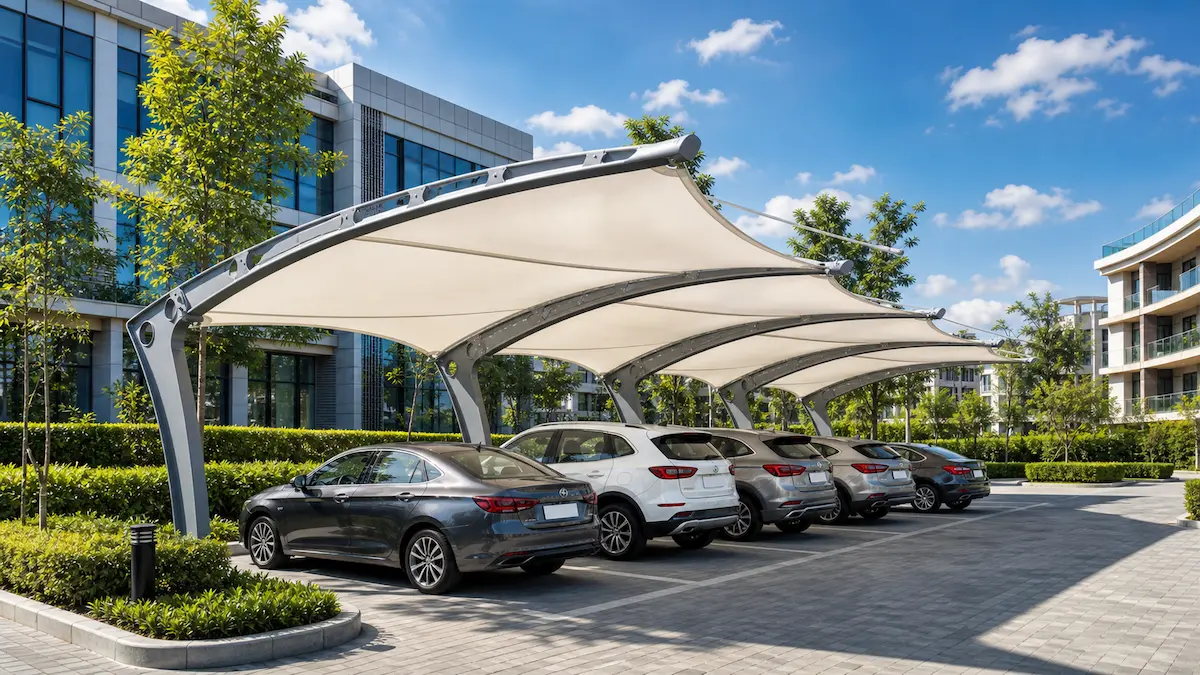
A car parking shade for residential and commercial spaces is one of the most practical ways to protect cars from strong sun, heat, rain, dust, bird droppings and changing weather. People also call it a home carport, a society parking shed, an office parking canopy or a commercial car shade. Whether the parking belongs to a home, villa, housing society, office, mall, school, hospital, hotel, factory or public car park, a well-designed shade makes the space more comfortable, safer and better looking.
In India, cars parked in the open face long hours of direct sun, seasonal rain, dust and swings in temperature. Over time, this harms the paint, the seats, the dashboard and the comfort inside the car. A strong car parking shade cuts this down and makes the parking area neater for daily users.
Yet a shade for one villa and a shade for a 500-car office campus are very different jobs. They differ in size, users, approvals, budget and what the owner cares about most. This guide looks at those differences, so you can plan the right shade for your own type of property.
A good car parking shade is not only a roof over vehicles. It is a planned structure where layout, clearance, column position, fabric slope, drainage and wind resistance work together for long-term performance.
At ShadeCo India Private Limited, we design, make and install car parking shades for homes, housing societies, offices, schools, hospitals, factories and public spaces across India. Every project, from a single carport to a car park with hundreds of bays, is planned by our own engineers and built by our own fabricators and installers. That keeps the design, the parts and the site work in step, whatever the size of the job. This guide shares what we have learned about planning parking shades for both homes and businesses.
Why Car Parking Shade Is Important
Open parking may look simple, but it leaves cars in sun, rain and dirt every day. A well-designed car parking shade keeps the car cooler, protects its outside and makes getting in and out more comfortable.
- Sun cover: Helps protect paint, dashboard, seats and inside parts from direct sun. Depending on its grade, the fabric stops as much as 98% of UV.
- Less heat: Keeps the inside of the car cooler on hot days. Drivers can get in without waiting for the seats and steering wheel to cool down.
- Rain cover: Keeps rain off the car and makes parking easier in the monsoon. People can get in and out, and load bags or children, without getting wet.
- Cleaner cars: Keeps off dust, leaves and bird droppings. Cars under a shade need washing far less often, which matters in societies and offices with many cars.
- Better look: Gives the parking area a clean, planned and professional look. A neat row of canopies makes the whole property look well kept.
For businesses, schools and hospitals, a car parking shade also makes arrival nicer for visitors. A covered parking area shows good planning and gives customers, staff, guests and residents a more comfortable start to their visit.
Residential vs Commercial Parking Shades: Key Differences
Both settings use the same basic structure. But the priorities change with the size of the site and the people who use it.
| Factor | Residential | Commercial |
|---|---|---|
| Size | One car to a few rows of society parking | Dozens to hundreds of bays |
| Users | The same residents every day | Staff, visitors, customers and fleets |
| Usual design | Cantilever from a wall, carport or a few modular bays | Double-sided and multi-bay rows |
| Main goal | Looks, quiet in rain, matching the house | Traffic flow, number of bays, long life |
| Who decides | The owner, or the society committee | Facility manager, architect or management |
| Extras | Lights, matching colours | Lights, EV chargers, signs, walkways |
| Upkeep | Cleaning now and then, often by the owner | Planned visits under a maintenance contract |
Car Parking Shade for Residential Spaces
Home parking needs a shade that is practical, compact and suits the look of the property. A residential car parking shade keeps cars safe from daily weather and makes the parking area more comfortable and neat.
- Homes and villas: Small shades for one or more cars. A cantilever frame fixed to a boundary wall, or a stand-alone carport canopy, keeps the driveway open and the front of the house uncluttered.
- Housing societies: Modular shades for residents and visitors. One design repeated across all blocks keeps the campus uniform. Visitor parking near the gate can be covered first and extended later.
- Apartments: Neat covered parking for cars, SUVs and two-wheelers. A separate low two-wheeler parking shed uses space well and stops bikes from crowding the car bays.
- Farmhouses: Strong shades for open parking areas. Open land faces stronger wind, so the frame and footings are designed with extra care for uplift.
- Luxury homes: Modern tensile designs that match the house. Fabric colour, column finish and lights can be chosen to suit the front of the house and the garden.
In housing societies, the managing committee usually picks one design and shares the cost among residents. It helps to agree on one layout and colour for the whole campus at the start, instead of letting each block add its own shade over time. Check any society rules and local building norms before work begins.
For homes, ShadeCo India focuses on neat design, enough height, low-upkeep materials and a style that blends with the house, society or apartment.
Car Parking Shade for Commercial Spaces
Business car parks handle more cars and more movement, so the shade must be strong, well planned and easy to use. A commercial parking shade makes visits nicer and gives the property a professional look.
- Offices: Neat covered parking for staff, clients and managers. Long rows of multi-bay parking sheds cover the most cars for the least steel. Visitor bays near the door can use a bolder shape.
- Malls and shops: Comfortable parking for customers and visitors. Clear signs, wide lanes and well-lit bays matter here, because many drivers use the car park for the first time.
- Hotels and resorts: Shades for guest and staff cars. Guest parking often uses curved tensile shapes that match the hotel's look, while staff parking can be simpler.
- Schools and colleges: Covered parking for cars, buses, staff vehicles and two-wheelers. School buses need much more height, so bus parking sheds are planned apart from car and bike parking.
- Hospitals: Covered parking for patients, visitors, doctors and staff. Covered drop-off points and clear routes from parking to the door help patients and wheelchair users.
- Factories and warehouses: Strong shades for staff parking, fleet parking and work vehicles. Industrial parking sheds often use a heavier frame and a simpler roof for low upkeep.
On large business sites, parking shades are often built in stages. The first rows can be covered before the rest of the car park is ready, and the same bay can be added later without changing the design. Space for lights, EV chargers and walkways is much easier to plan at the start than to add afterwards.
Choosing the Right Structure Type for Your Space
Different sites need different parking shades. The right one depends on the space you have, how cars move, the number of cars, your budget, the look you want and the site itself.
- One car at home: A cantilever shade or carport canopy keeps columns away from car doors and the driveway.
- Society or office rows: A double-sided or multi-bay shade covers two rows of cars from one column line. This is the cheapest layout per car for many bays.
- Entrance and visitor parking: A conical, pyramid or umbrella parking shade gives a bolder look where first impressions count.
- Bright parking areas: Polycarbonate sheet roofing suits homes and small offices that want more daylight under the roof.
- Large or growing sites: A modular parking shade structure can be extended bay by bay as more parking is needed.
For a closer look at design points, materials and roof options, read our guide on car parking shade design, materials and installation.
Benefits of Tensile Car Parking Shade
Tensile car parking shades are popular at both homes and businesses, because they mix strength, style and flexibility. The tight fabric gives a pleasing shape while it protects the cars below.
- Light frame: Tensile shades are lighter than many standard roofs. This often means slimmer columns and smaller footings than a sheet roof of the same size.
- Modern look: Curved fabric shapes make the parking area look better. At a villa or hotel, the shade can look like part of the design, not an add-on.
- Made to fit: Shape, size, colour and layout are planned for each site. Odd-shaped plots and curved driveways can be covered as easily as straight rows.
- Quick to install: Steel and fabric parts made in the workshop cut down time on site. This keeps disruption short for residents and businesses that park there every day.
- Weather cover: Coated fabric keeps sun and rain off the cars and works between −30°C and +70°C. A light-coloured fabric also keeps the area below cooler than a metal roof.
- Low upkeep: Cleaning and checks now and then keep the shade in good shape. PVDF-coated fabric stays cleaner and carries a warranty of up to 10 years.
Installing a Parking Shade on a Site That Stays Open
Unlike a new building, most parking shades are added to sites that are already busy every day. Residents still need to park, and offices and hospitals cannot close their car parks for long. Planning the work around these users matters as much as the structure itself.
- Work in zones: The car park is split into zones, and only one zone is closed at a time while the rest stay open.
- Agreed timings: Noisy work, crane lifts and deliveries happen at hours agreed with the society or facility manager.
- Fenced work area: The active zone is barricaded, so cars and people stay clear of lifting and drilling.
- Footings first: Footings and anchor bolts are finished zone by zone, and steel comes in only when its zone is ready.
- Safe work at height: The crew works from lifts or scaffolding with full-body harnesses and PPE, under a site supervisor.
- Handover by zone: Each finished zone is checked for drainage, fixings and tension, then opened again for parking.
Our installation teams often work at schools, hospitals and societies that stay open during the work.
Maintenance of Car Parking Shade
Car parking shades are usually easy to look after when good materials and proper installation are used. The main difference between homes and businesses is who takes care of them.
- Homes: Owners can rinse the fabric with water and a soft brush a few times a year, and ask for a check after a big storm.
- Housing societies: A yearly visit before the monsoon, arranged by the committee, keeps all blocks in the same good condition.
- Business sites: Facility managers usually prefer an annual maintenance contract with planned cleaning, gutter clearing, and bolt and tension checks.
- For everyone: Do not hang banners, lights or cables on the frame without approval, and treat any rust spots early.
Our cleaning and maintenance service offers one-time visits as well as AMC plans for societies and business car parks.
Why Choose ShadeCo India for Car Parking Shade
From the first drawing to the final bolt, ShadeCo India handles every part of a parking shade job for homes and businesses alike. Our team knows the practical needs of a site, such as car height, column position, drainage, wind load, fabric behaviour and a clean finish.
- One team for all sizes: The same in-house team handles a single villa carport and a large business car park.
- Strong frames: Wind load follows IS 875 (Part 3), and the frame is galvanized or powder-coated for a structural life of 25 to 30 years.
- Own workshop: Fabric and steel are made in our own workshop under an ISO 9001:2015 quality system.
- Busy-site experience: Work is done in stages around residents, staff and visitors, so parking stays usable during installation.
- After-sales care: Cleaning, maintenance and repair services are available once the shade is in use.
Frequently Asked Questions
Common questions about car parking shades for homes, housing societies, offices and other business spaces.
For most homes, a cantilever car parking shade or a stand-alone carport canopy works best. A cantilever frame can be fixed along a boundary wall, so no columns stand near the car doors or driveway. A carport canopy suits open driveways with space on both sides. Tensile fabric gives a curved, modern look that suits villas, while polycarbonate sheet suits owners who want a brighter parking area.
In most housing societies, a parking shade needs approval from the managing committee, because it is built in a common area and the cost is usually shared. Some cities and development authorities also have rules about structures in open parking areas or setbacks. It is best to check the society by-laws and local building norms first, and to agree on one design and colour for all blocks.
For offices and business sites, double-sided or multi-bay parking shades are usually the best choice. One central line of columns covers two rows of cars, which gives the most covered bays for the least steel and footing work. Visitor parking near the entrance can use a bolder conical or tensile shape, while staff and fleet parking can use simple repeated bays that are easy to extend.
Yes, you can usually keep using most of the car park while the shade is built, if the work is planned in stages. The site is split into zones, and only one zone is closed and fenced at a time. Crane lifts and noisy work happen at agreed hours, and each zone opens again once it is finished and checked. This suits societies, offices and hospitals that cannot shut their parking.
Yes, EV chargers can be added under a car parking shade, and it is easiest when they are planned at the design stage. Cable routes, charger spots and lights can then be set out with the column layout and footings. Adding chargers later is also possible. But any brackets or cables fixed to the frame should be approved first, so the extra weight and fixings do not affect the structure.
Yes, one site can have car, bike and bus parking sheds side by side, and many schools, factories and apartments need all three. Each shed is sized for its own vehicles. Bike sheds are low, with columns close together, while bus sheds need much more height and wider spans. Planning them together keeps the look uniform and lets the sheds share drains, lights and walkways.
The cost per covered bay is usually higher for a single home than for a large business site. A one-car shade still needs its own design, columns and footings. Long rows of business bays share columns and repeat the same parts, which lowers the cost per car. For both, the final cost depends on the number of bays, height, roof material, steel finish and site conditions.
A society or office should look after its parking shades with planned visits, not wait for damage. One visit before the monsoon to clear gutters and check bolts, and one after it to clean the fabric and look for mould, suits most sites. Many facility managers prefer an annual maintenance contract. It covers fabric-safe cleaning, tension checks and a condition report with photos after each visit.
Which Car Parking Shade Is Right for Your Space?
For homes and societies, a neat cantilever, carport or modular shade that matches the building is usually right. For offices and other business sites, double-sided and multi-bay rows give the most cover for the money. In both cases, a car parking shade is worth the cost, because it keeps cars safe, people comfortable and the property looking better.
You may manage a villa, a housing society, an office campus, a hospital or a factory. In each case, contact ShadeCo India to discuss the right parking shade for your site and get a quotation.